






















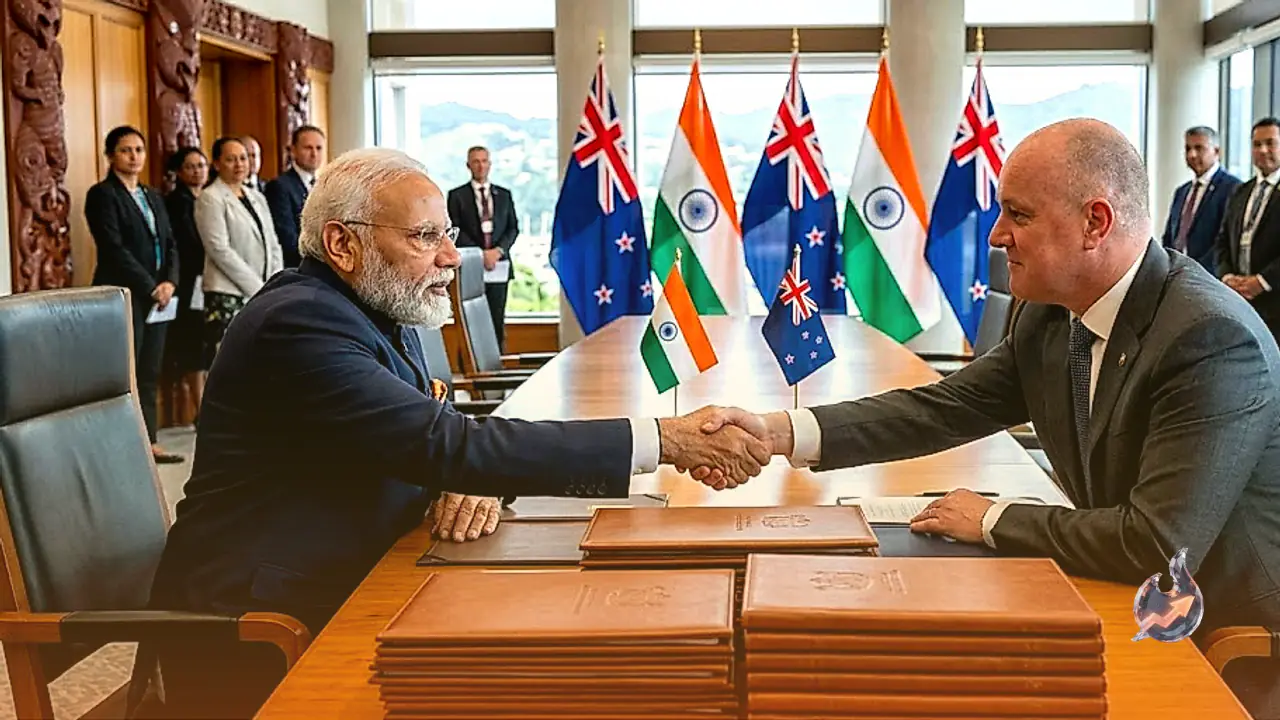

Prime Minister Narendra Modi’s recent state visit to New Zealand has propelled bilateral relations to an unprecedented historical milestone. Following an extensive summit-level dialogue between Prime Minister Narendra Modi and New Zealand Prime Minister Christopher Luxon, both nations formally upgraded their relationship into a strategic partnership. This transition is anchored by the newly approved 'India-New Zealand Strategic Partnership: Roadmap 2030.' The high-level discussions culminated in the signing of 18 critical agreements, spanning sectors as diverse as defense, trade, sports, animal husbandry, disaster management, maritime security, and counter-terrorism cooperation.
Strengthening Strategic Dialogue
The joint statement emphasized a long-term vision intended to elevate bilateral and multilateral cooperation. Both Prime Ministers committed to regular high-level interactions, mandating annual meetings between foreign ministers and senior officials to ensure consistent progress. Furthermore, the partnership encourages increased cooperation between the two nations' parliaments, fostering an active exchange program for lawmakers to deepen institutional ties.
Focus on Defense and Maritime Security
A central pillar of the meeting was the commitment to effectively implement the 2025 India-New Zealand Defense Cooperation Agreement. The leaders decided to formalize regular dialogues between their respective defense ministries and the three wings of their armed forces. The discussion also highlighted appreciation for ongoing efforts under the Combined Task Force-150, which targets maritime security, anti-terrorism operations, and the prevention of narcotics trafficking. Both nations agreed to bolster the Maritime Cooperation Arrangement (MCA), enhance hydrography cooperation, and strengthen reciprocal logistics support. A new annual maritime security dialogue will also be established to improve security collaboration in the Indo-Pacific region.
Targeting $7 Billion in Trade
In a significant push for economic synergy, India and New Zealand have set a target to increase bilateral trade in goods and services to 7 billion New Zealand dollars by the year 2030. The leaders welcomed the recently concluded India-New Zealand Free Trade Agreement (FTA) and expressed their shared commitment to ensuring its rapid and effective implementation. This framework is designed to encourage business investments and streamline trade between the two economies.
Unified Stance Against Terrorism
The joint communique expressed strong condemnation of terrorism in all its forms. Both leaders specifically denounced the terror attack in Pahalgam on April 22, 2025, and the incident near the Red Fort in New Delhi on November 10, 2025. They stressed the urgent need to dismantle terrorist financing networks, eliminate safe havens, and disrupt online extremist networks. The establishment of a Joint Anti-Terror Work Group was welcomed, with a renewed commitment to collaborate closely in multilateral forums like the United Nations and the FATF. Both sides demanded decisive action against sanctioned terrorist organizations, their supporters, and financiers.
Support for India’s UNSC Bid
New Zealand reaffirmed its steadfast support for India’s claim to a permanent seat at the United Nations Security Council (UNSC). The two leaders also pledged to increase coordination on regional and global platforms to ensure peace, security, and stability. With this new strategic partnership and the Roadmap 2030, the India-New Zealand relationship has evolved beyond traditional ties into a long-term, comprehensive alliance focused on shared strategies for defense, security, and economic prosperity.