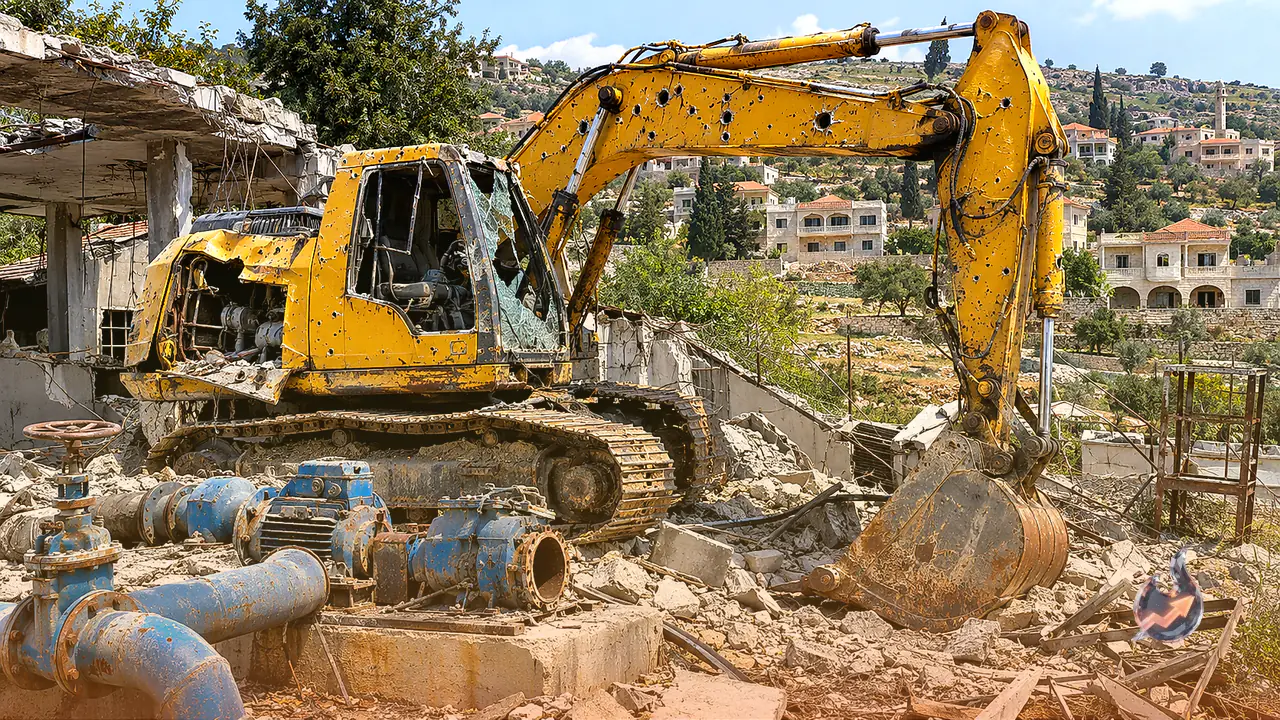

Ramzi Kaiss, a Human Rights Watch researcher in Lebanon, stated that the presence of heavy machinery typically used for reconstruction was perceived as a threat by Israeli forces. Rebuilding war-torn regions involves much more than simply replacing fallen buildings; it requires clearing blocked roadways, restoring compromised water networks, and operating functional factories that can supply necessary construction equipment and materials. However, independent documentation from human rights organizations, international aid workers, and United Nations peacekeepers highlights how ongoing military attacks have systematically damaged these vital recovery systems while fear of renewed strikes obstructs their urgent repair.
The Stalled Efforts of Post-Conflict Repair
Kandice Ardiel, a spokesperson for the United Nations Interim Force in Lebanon, noted that targeted attacks on construction equipment created severe obstacles on the ground. These strikes not only hindered the removal of massive debris and essential repairs but also prevented ordinary people from safely returning to their daily lives. According to Ardiel, many residents initially went back to their homes after the fighting ended in 2024 and managed to rebuild, but subsequent violence destroyed those newly restored areas all over again.
Human Rights Watch Investigation Details
An investigation conducted by Human Rights Watch in December 2025 examined four distinct Israeli airstrikes targeting heavy-machinery showrooms, vehicle maintenance facilities, and a dedicated factory producing cement and asphalt. These military operations took place between August and October 2025, following the November 2024 ceasefire agreement brokered between Israel and Hezbollah. The human rights organization reported that the attacks completely wrecked more than 360 individual pieces of construction equipment, classifying the targeted operations as apparent war crimes. Kaiss personally visited four of these impacted locations, observing a massive scale of physical destruction encompassing hundreds of heavy machines essential for reconstruction processes.
The Israeli military stated via Telegram that the targeted machinery and materials were actively supporting or intended to support Hezbollah in rebuilding its military infrastructure. Conversely, Human Rights Watch stated it found no credible evidence indicating the presence of military targets at or surrounding any of the investigated sites. Although the organization could not independently verify the intended use of every single machine or material stockpile, it found no evidence linking these civilian commercial supplies to military applications, while confirming civilian uses for several specific pieces of equipment.
Widespread Devastation Across Villages
Even as reconstruction efforts remained effectively stalled, physical destruction across the region continued unabated. According to the official count provided by Israeli defense minister Israel Katz, a total of 23,000 residential homes and more than 60 villages had been destroyed by October. A comprehensive spatial analysis conducted by The New York Times revealed that Israeli military forces had largely leveled 48 out of roughly 60 villages and towns situated inside their zone of occupation, with most of this extensive demolition occurring after the renewed ceasefire in April. The Israeli military informed the Times that it received no official directives to carry out widespread structural damage or deliberately demolish villages.
Water Infrastructure and Access Restrictions
During formal United Nations consultations, local municipal officials in Jabal Amel reported that approximately 6,500 displaced families remained unable to return to a dozen specific villages located inside the designated security zone. These communities fall within the perimeter of the Israeli-declared Yellow Line, a heavily restricted military zone in southern Lebanon where strict limitations have crippled attempts to restore basic public services. Charlene Silvin, a project coordinator with Doctors Without Borders, led a specialized field team that surveyed approximately 20 towns within the Bint Jbeil area to document extensive damage to local water supplies. She noted that not a single village along the surveyed route escaped structural damage of some kind.
Silvin tracked the deterioration of water systems from primary natural sources directly to residential households. In this specific geographical area, the deep boreholes that function as municipal wells are situated within a valley heavily controlled by Israeli troops. Physical access remains severely restricted, and vital components of the water infrastructure suffered catastrophic damage. Storage reservoirs lost their structural integrity, while electric pumps and filtration units were left entirely offline. Although these systems were designed to operate on solar power, nearly every single solar panel surveyed by Silvin's team was smashed or shattered.
Temporary Solutions and Ongoing Challenges
In the municipality of Yater, Doctors Without Borders was forced to install makeshift plastic water tanks because the primary municipal reservoir was deemed completely irreparable. In Froun, the organization adopted a different technical approach by repairing the filtration unit and linking it directly to the underlying water source to bypass the ruined storage tank. Such interventions represent only a tiny fraction of the massive repairs required across the region. In a public statement issued in September 2026, the organization documented widespread destruction inflicted upon wells, pumping stations, auxiliary generators, purification units, and distribution pipelines throughout southern Lebanon.
The destruction of heavy construction vehicles directly compounds the water crisis, as heavy machinery is often required simply to clear blocked access routes leading to broken water pumps. In a 2026 operational account, UNIFIL described surveying a 280-meter access path for a heavy maintenance crane. The route was heavily obstructed by large earth berms and military barriers that peacekeepers had to manually clear before bringing in heavy equipment to service the damaged well. Consequently, many returning residents must rely on expensive trucked-in water deliveries, such as the 90 families who returned to Zawtar Al-Gharbiyeh, a village that previously housed 500 households. Silvin emphasized that this delivery method serves as a costly, limited substitute rather than a sustainable system.
The constant threat of fresh military strikes dictates the scope and scale of local repair work. Anyone investing in infrastructure restoration does so under the constant apprehension that their work will be obliterated shortly thereafter. For humanitarian teams, this reality necessitates choosing temporary patchwork fixes over the permanent infrastructure desperately needed by local residents. An official United Nations report published in October noted that local municipalities struggle immensely to pay staff wages, fuel water pumps, and maintain service vehicles. Furthermore, municipal water authorities and civil servants informed Silvin that they faced direct intimidation from Israeli forces when attempting to reach damaged infrastructure sites near the Yellow Line.
Kandice Ardiel described UNIFIL peacekeepers as the impartial record keepers of ongoing events on the ground, raising critical questions about how international documentation will proceed following their eventual departure, alongside the immediate humanitarian challenge of restoring homes and municipal services. For a 27-year-old resident from Rshaf in the Bint Jbeil district who requested anonymity for personal safety, the destruction is visible only through distant satellite imagery. While staying in Spain, she received a satellite photograph showing her family home reduced to a pile of rubble. She expressed uncertainty over whether the local cemetery even remains intact, noting that pixelated satellite views cannot capture the full extent of the localized devastation.
The long-term human toll will undoubtedly outlast any formal ceasefire agreement. Ardiel, who has lived inside a UNIFIL base since March, has personally witnessed ancient olive trees hundreds or thousands of years old being systematically destroyed, wiping out a historical legacy. She emphasized that even if the military conflict were to halt immediately, the eventual recovery process will prove extraordinarily intense and protracted. Despite these overwhelming obstacles, displaced families maintain an unwavering desire to return. Kaiss noted that displaced residents repeatedly express their willingness to pitch tents directly on top of the rubble of their destroyed homes just to live on their ancestral land, a resilient spirit already visible as families restart their lives amidst the ruins.