




















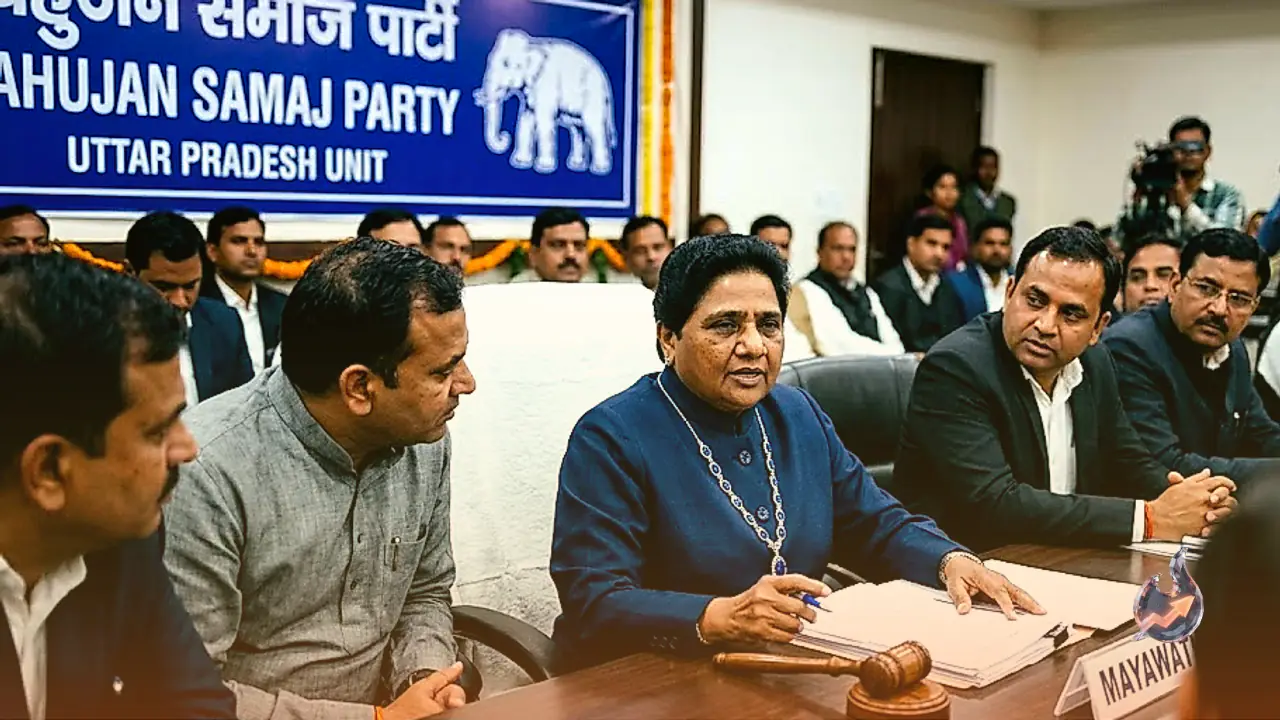

Bahujan Samaj Party chief and former Uttar Pradesh Chief Minister Mayawati is set to turn 71 on January 15. As has been the tradition for years, a massive gathering of party workers and supporters is expected in Lucknow, where the party leader will deliver an address aimed at boosting cadre morale. For a long time, these birthday events have served as major organizational platforms, even though recent electoral outcomes have brought persistent disappointments. Just before the 2027 Uttar Pradesh assembly elections, Mayawati will mark her 71st birthday on January 15, 2027, an occasion expected to witness significant political announcements. Yet, amidst these preparations, a central question continues to echo across political circles regarding who will lead the party after Mayawati. The leadership has not formally designated any successor to date, and despite periodic indications, the internal hierarchy remains tightly controlled from the top.
Centralized Command and Organizational Tradition
In Indian politics, the Bahujan Samaj Party stands out as an organization whose structure and identity revolve entirely around a single figure, Behen Kumari Mayawati. When the party was established in 1984 under the mentorship of Kanshi Ram, Mayawati emerged as a prominent and assertive Dalit female leader. However, ever since she assumed complete charge of the party in 2003, no parallel Dalit figure, youth face, or female leader has been allowed to establish deep political roots within the organization. Political observers note that the operational framework of the BSP relies heavily on absolute centralized authority. Mayawati's decisions within the party remain final and unquestioned. This hierarchy is distinctly visible during organizational meetings, where Mayawati occupies a raised central chair, with no seating placed to her left or right. Senior figures like Satish Chandra Mishra as well as her nephew Akash Anand are seated on chairs arranged in front of her elevated platform.
The Departure of Heavyweights and History of Expulsions
Over the past 10 to 15 years, a consistent pattern of entry and exit has defined the internal dynamics of the Bahujan Samaj Party. Historically, any leader who began building a personal voter base or achieved media prominence comparable to Mayawati was eventually removed on grounds of indiscipline or anti-party activity. Prominent OBC and Muslim faces who led the party until 2012, such as Swami Prasad Maurya and Nasimuddin Siddiqui, were either forced out or expelled after the loss of power. Similarly, influential Dalit and backward class leaders with strong ground connections, including Indrajit Saroj and Lalji Verma, were sidelined and subsequently joined rival political outfits. Vocal parliamentarians and organizational figures like Danish Ali and Ramachal Rajbhar have also faced party expulsions at various points in time.
Factors Hindering the Rise of Secondary Leadership
This persistent practice of reining in or expelling prominent leaders carries a direct message to the party's grassroots cadre. It establishes that the organization operates purely on the ideology and name of its supreme leader, rather than the individual influence of sub-leaders. The absence of a secondary female leader or a prominent national spokesperson within the BSP is tied directly to its internal working mechanisms. The party has never officially instituted a formal number two position or deputy post. Anyone approaching that proximity in the hierarchy faced exit from the organization. Mayawati seeks to preserve her standing as the foremost Dalit female leader in national politics. By avoiding the elevation of alternative female figures or national spokespersons, the party prevents any division of attention within its core voter base. Furthermore, traditional Dalit voters have historically cast their ballots directly in Mayawati's name rather than for local candidates, discouraging local leaders from cultivating independent bases of support.
Shifting Status of Akash Anand and Speculation Over Ishan Anand
When Mayawati appointed her nephew Akash Anand as the party's National Coordinator and elevated his profile, it appeared that a succession line was finally being drawn within the BSP. However, following his aggressive public addresses and growing influence, Mayawati temporarily removed him from the post before later restoring organizational responsibilities. Recent adjustments in his roles, alongside reports regarding potential involvement of his brother Ishan Anand, have prompted questions regarding whether Akash Anand's political trajectory might follow that of previous senior leaders. Analysts suggest that Mayawati aims to mature Akash Anand politically before entrusting him with long-term responsibility. Whenever his stance deviates from the party's traditional balanced line or involves heightened media visibility, Mayawati steps in to signal that organizational decisions remain strictly under her authority, regardless of familial ties.
Electoral Strategy for the 2027 Uttar Pradesh Assembly Polls
As the 2027 Uttar Pradesh assembly elections draw closer, strategic shifts are becoming apparent within the Bahujan Samaj Party. Rather than entering into broad political alliances, the party appears committed to contesting the upcoming polls independently. The core strategy centers on reclaiming lost support among Jatav and non-Jatav Dalit voters. Additionally, the party is reactivating Dalit-Brahmin and Muslim Bhaichara committees in an effort to reconstruct the coalition that delivered victory in 2007. Instead of relying on established political figures, Mayawati is focusing on promoting district-level and sector in-charges who possess no independent political clout and remain entirely accountable to the central leadership, reinforcing that the party's sole public face remains Mayawati.