






















A fresh political confrontation has erupted across the nation following the passage of a new law during the recent Monsoon Session of Parliament that made the recitation of all six stanzas of the national song, Vande Mataram, mandatory. In direct contrast to this legislative mandate, the Congress Working Committee formally passed a resolution declaring that only the first two stanzas of the song will be recited at all official and organizational party events, rather than the full six stanzas. As the Congress leadership cited a historical resolution from the 1937 Congress session to justify its position, a fierce battle of words broke out between the ruling Bharatiya Janata Party and the primary opposition party. Union Home Minister Amit Shah launched a scathing attack on the opposition, terming its stance an insult to parliamentary authority, an extreme form of appeasement politics, and evidence of a divisive mindset.
Amit Shah Launches Direct Attack on Congress From Tamil Nadu
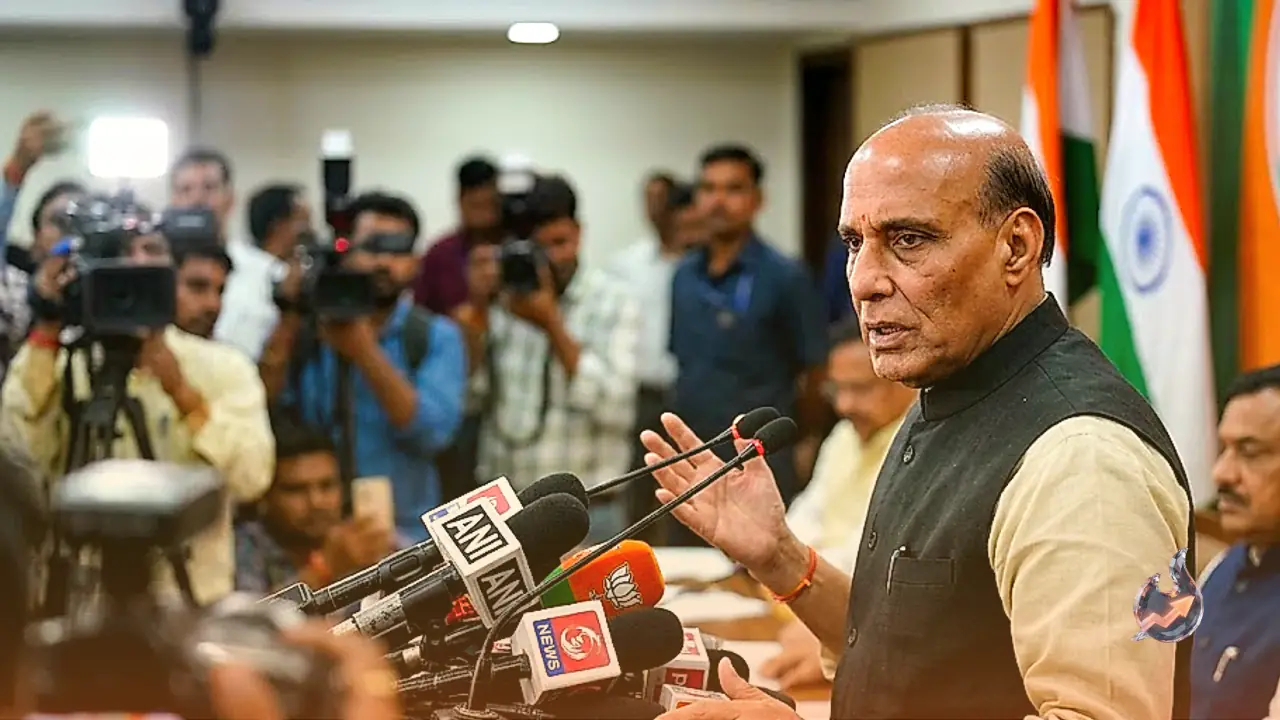
The core of the escalation stems from remarks delivered by Home Minister Amit Shah in Mahabalipuram, Tamil Nadu, immediately prior to the commencement of the South Zonal Council meeting. Speaking directly to the media, the Home Minister expressed profound astonishment over the position taken by Congress regarding the national song. He asserted that in its pursuit of Muslim vote-bank politics, the opposition party has refused to abide by a law duly passed by Parliament and has deliberately rejected the singing of the complete national song.
Revisiting historical events, Home Minister Amit Shah alleged that Congress had similarly partitioned Vande Mataram in 1937 under intense political pressure from the Muslim League. According to Shah, that historical compromise laid the very foundation for the eventual partition of India in 1947. He remarked that despite the passage of several decades, neither the intentions nor the policies of Congress have changed. He emphasized that the BJP remains committed to exposing this anti-national character and appeasement strategy of Congress before the Indian public.
Congress Working Committee Decision and Top Leadership Defense
When the government introduced and passed the legislation during the Monsoon Session of Parliament making all six stanzas of Vande Mataram compulsory, the Congress high command initially issued informal instructions directing party workers to recite only the first two stanzas. The matter intensified when the Congress Working Committee (CWC) formally ratified this policy through an official resolution. The resolution affirmed that Congress would strictly adhere to the decision adopted during the 1937 session, which recognized only the initial two stanzas of the song for official recitations.
Defending the move, senior Congress leader K.C. Venugopal and other party spokespersons presented several historical arguments. They highlighted that the 1937 resolution was adopted in a meeting attended by prominent national figures, including Mahatma Gandhi, Pandit Jawaharlal Nehru, Subhas Chandra Bose, Sardar Vallabhbhai Patel, and Rabindranath Tagore. Congress leaders questioned whether the ruling party considered all these legendary freedom fighters to be anti-national or proponents of appeasement. They emphasized that the 1937 decision was formulated specifically on the advice of Gurudev Rabindranath Tagore. K.C. Venugopal further accused the BJP of exploiting Vande Mataram to sow seeds of division and hatred rather than holding genuine reverence for the song, asserting that Congress would not yield to political pressure from the ruling party.
What Was the Historical Working Committee Resolution of 1937?
To fully comprehend the debate, it is essential to examine the context and text of the 1937 resolution frequently cited by Congress. According to the original document passed at the 1937 Congress session, the resolution noted that Vande Mataram had never been intended to challenge any community or hurt the religious sentiments of any group in India. It affirmed that the first two stanzas contained no statements or imagery to which anyone could reasonably object.
However, the 1937 resolution acknowledged that the remaining four stanzas contained specific religious imagery, allegories, and references that members of other religious communities might find objectionable. At that time, several Muslim leaders within the Congress Working Committee expressed reservations regarding the themes present in those later stanzas. Upon deliberation, the committee determined those objections to be valid and reasonable. Consequently, the Working Committee recommended that whenever Vande Mataram is recited at national gatherings, only its first two stanzas should be sung to maintain harmony among all groups.
Correspondence Between Mahatma Gandhi, Nehru, and Subhas Chandra Bose
Historical records reveal that during the freedom movement, opposition to Vande Mataram was actively driven by the Muslim League under the leadership of Muhammad Ali Jinnah, who transformed it into a major political controversy. Although Congress adopted the resolution under Jinnah's political pressure in 1937, many leaders within the party harbored deep reservations about the decision. This internal disquiet is documented in a letter written by Mahatma Gandhi to Pandit Jawaharlal Nehru on November 18, 1937.
In his letter, Mahatma Gandhi informed Nehru that the controversy surrounding Vande Mataram remained unresolved and that numerous Congress leaders in Bengal were deeply distressed by the Working Committee's decision. Gandhi noted that Subhas Chandra Bose was actively attempting to manage the anger generated by the decision to restrict the song to two stanzas. Pandit Nehru, who was already aware of the sentiment, wrote a detailed explanatory letter to Subhas Chandra Bose. Nehru explained that the background imagery of the song, particularly its references to Hindu deities, caused distress among Muslims. He argued that omitting the final four stanzas was intended as a gesture of respect toward Muslim religious sensitivities.
Complete Recitation by Muslim Congress Presidents From 1896 to 1927
Amid the current political arguments, historical evidence highlights that several prominent Muslim leaders who served as Congress Presidents prior to 1937 routinely recited the complete text of Vande Mataram without objection. At the 1896 Calcutta session of Congress, President Rahmatullah (Rahimtulla M. Sayani) recited the full national song from the presidential platform. Later, at the 1913 Karachi session, President Nawab Syed Muhammad Bahadur also recited all six stanzas.
Similarly, during the 1918 Bombay session, Congress President Syed Hasan Imam recited the complete song. At the 1920 Nagpur session, renowned Islamic scholar and freedom fighter Maulana Abul Kalam Azad sang the entire national song from the dais. Furthermore, at the 1927 Madras session, President M.A. Ansari recited all six stanzas of Vande Mataram. Each of these leaders was a distinguished scholar and national figure, yet none raised objections to the full recitation of the national song.
Muslim League Resolution and the 11-Day Turning Point
A crucial timeline in this controversy occurred on October 17, 1937, when the Muslim League held its annual session in Lucknow and passed an official resolution strongly opposing Vande Mataram. Following this resolution, Muhammad Ali Jinnah intensified pressure on the Congress leadership. Exactly 11 days later, on October 28, 1937, during the Calcutta session, the Congress Working Committee formally adopted the policy restricting recitations to the first two stanzas.
Leaders of the BJP point directly to this 11-day interval as evidence that Congress compromised on the national song in response to pressure from the Muslim League. The ruling party contends that the current opposition policy represents a continuation of the same vote-bank political strategy.
Statements From Nishikant Dubey, Imran Masood, and Jitan Ram Manjhi
Political figures from across the spectrum have issued sharp statements regarding the controversy. BJP MP Nishikant Dubey criticized Congress, alleging that just as the party succumbed to Jinnah's demands in 1937, it continues to follow Jinnah's ideology today, describing Congress as Jinnah's true political heir.
In response, Congress leader Imran Masood defended his party's stance, arguing that Vande Mataram had no connection to the partition of the country. He asserted that the Two-Nation Theory was originally articulated by Veer Savarkar, cautioning against misrepresenting historical facts. Meanwhile, Union Minister Jitan Ram Manjhi posted a strong statement on social media, warning that the public would decisively reject those who attempt to fragment the national song.