

















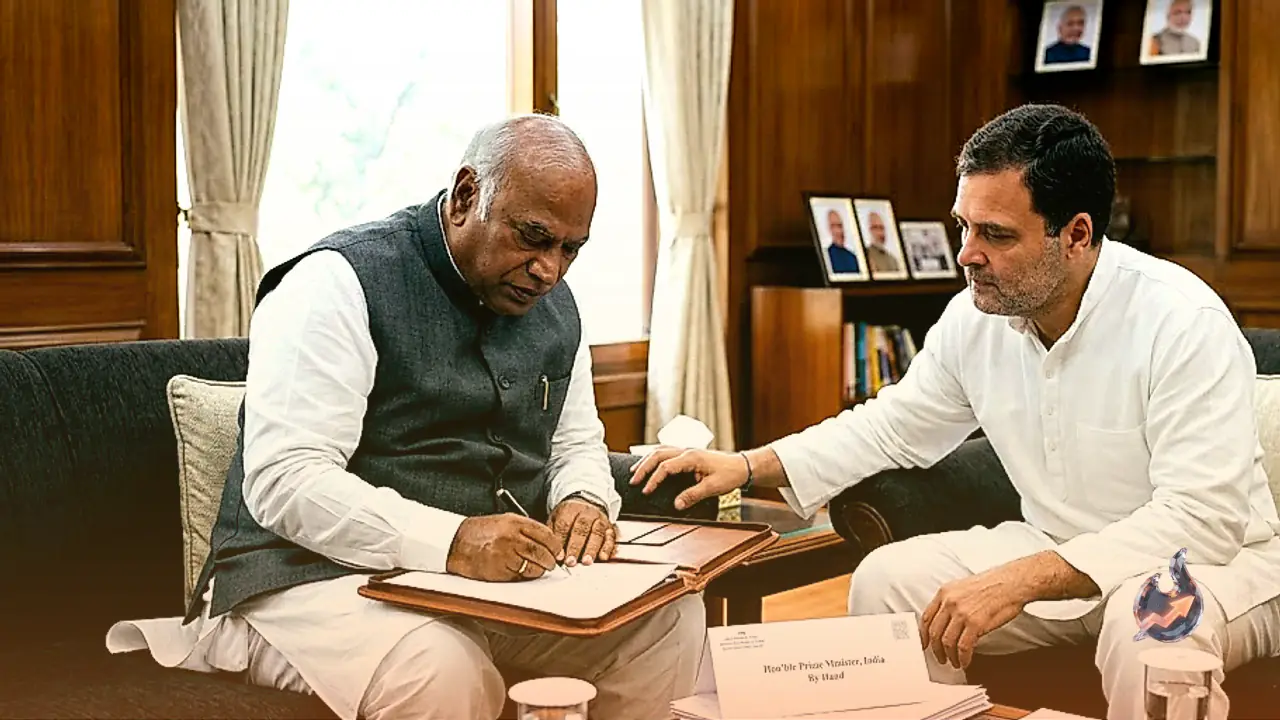

In a significant political development from New Delhi, Congress National President Mallikarjun Kharge and Leader of the Opposition in the Lok Sabha Rahul Gandhi have dispatched a joint letter to Prime Minister Narendra Modi, raising serious concerns regarding the current framework of the proposed caste census. The senior leaders have called for the immediate cancellation of the existing questionnaire and demanded that a fresh format be formulated based on an authenticated list of castes to ensure accuracy and fairness.
Concerns Shared on Social Media Platforms
Taking to social media platform X to elaborate on the issue, Mallikarjun Kharge stated that accurate enumeration of castes is simply not feasible through open-ended questions. He warned that if individuals record their identities using varying names and sub-castes, the resulting data will inevitably scatter, with the hardest blow falling on OBCs, extremely backward classes, and marginalized communities. The leaders reiterated their clear demand that the current questionnaire must be scrapped and replaced with a new one formulated after extensive consultations with political parties, subject experts, and the general public.
The Core Argument on Social Justice and Data
In the formal communication addressed to the Prime Minister, the two leaders emphasized that policies aimed at achieving social justice in India cannot succeed without reliable and precise data. They noted that an authentic assessment of the numerical strength and socio-economic standing of various communities is only possible through a rigorous counting methodology. According to the letter, the government's current choice of an open-ended question format for recording caste identity is misleading, as it merely logs whatever name an individual provides at the moment of enumeration.
The Risk of Fragmented Data and Scattered Sub-Castes
Highlighting India's complex social fabric, the Congress leaders pointed out that the same caste is often known by different names, sub-castes, and linguistic variations across diverse geographical regions. Consequently, if members of a single community register under disparate names during the census, that single community will fracture into thousands of fragments. This would render the entire dataset virtually useless, preventing policymakers from ascertaining true demographic figures. Such inaccuracies would directly undermine decisions regarding education, employment, welfare schemes, and broader social justice initiatives, while also failing to capture the exact population share of Other Backward Classes since the term backward class itself is reportedly missing from the questionnaire.
Proposed Solutions and Precedents from States
As a practical remedy, the letter suggests utilizing a pre-existing drop-down list format, similar to the method already deployed during the enumeration of Scheduled Castes and Scheduled Tribes. Such a standardized list, the leaders argue, can be easily compiled using existing official documents such as the lists of socially and educationally backward classes alongside data from the Anthropological Survey of India. To reinforce their argument, they cited the successful precedents set by caste surveys conducted in the states of Telangana and Bihar, copies of whose caste lists were attached to the communication for reference. Concluding their appeal, the leaders stated that the current methodology is unacceptable and urged the administration to engage in broad consultations to draft a meaningful questionnaire.