


















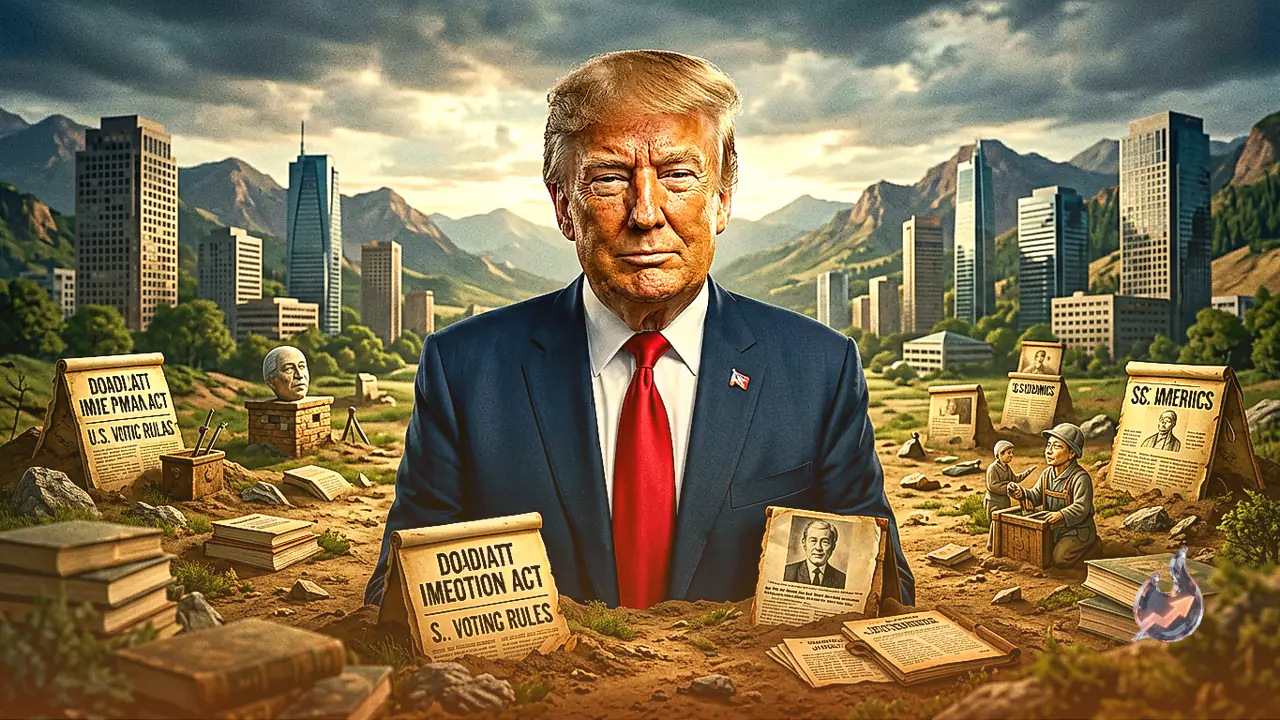

Debates surrounding the structural efficiency of democratic processes have gained fresh momentum in the United States following a notable social media post by Donald Trump. Taking to his official True platform account, he drew widespread attention by praising the electoral framework of India. In his message, he highlighted an inquiry from Chief Election Commissioner Gyanesh Kumar, who questioned how the American administration could conduct elections without requiring valid photo identification from voters. The post underscored the sheer scale of Indian democracy, noting that more than 64,60,00,000 citizens participated in the previous national elections.
The Push for the Save America Act
At the center of this ongoing dialogue is a legislative proposal known as the Save America Act, which is receiving fervent advocacy from political leaders. Trump has strongly urged the immediate enactment of this bill to establish stricter protocols. According to information published on the official White House website, the core premise of the legislation is that American citizens, and exclusively American citizens, should determine the outcomes of U.S. elections. Both Republican and Democratic lawmakers are being urged to support this bipartisan measure to bring much-needed integrity to the ballot box.
Key Provisions of the Proposed Legislation
The proposed Save America Act introduces several stringent requirements designed to tighten election security. If passed, the bill will mandate that individuals present a valid form of identification before they are allowed to register for federal elections. Furthermore, providing concrete proof of citizenship will become an absolute prerequisite. The legislation also seeks to heavily restrict mail-in ballots, limiting the practice strictly to circumstances involving illness, physical disability, military service, or necessary travel.
Purging Non-Citizens from Voter Rolls
Another critical aspect of the proposed law directs individual states to actively remove non-citizens from their active voter registration lists. Proponents of the bill argue that the United States currently lags behind many other nations when it comes to enforcing basic and necessary election security measures that prevent unauthorized participation.
Global Contrasts in Voting Security Standards
When examined through a global lens, numerous other democracies maintain significantly more rigorous safeguards. Nations like India and Brazil successfully link voter identification cards directly to comprehensive biometric databases, whereas the United States relies primarily on self-attestation regarding citizenship status. Countries such as Germany and Canada strictly require paper ballots throughout the entire vote-tallying process, while the American system often lacks fundamental chain-of-custody security protocols.
Additionally, nations like Denmark and Sweden prudently restrict mail-in voting strictly to individuals who are physically incapable of casting their votes in person. These countries also prohibit the tabulation of ballots that arrive after election day, contrasting sharply with American practices where widespread mail-in voting continues long after the polls officially close.
Structural Vulnerabilities in the U.S. System
The American electoral framework suffers from several inherent vulnerabilities that frequently trigger public disputes. One major hurdle is the decentralized nature of regulations, with all 50 states maintaining completely different voting rules. Discrepancies in identification standards, registration guidelines, and mail-in ballot procedures across state lines generate widespread confusion and public distrust.
Another pressing issue involves sluggish vote counting and the subsequent controversies it generates. Due to the heavy reliance on postal paper ballots, finalizing election results can take several days or even weeks. This prolonged delay frequently fuels allegations of manipulation and leads to increased litigation. Furthermore, the complexities of the Electoral College mean that a presidential candidate who secures the highest national popular vote can still lose the election, a scenario that famously unfolded in 2016.
Contrasting the Indian and American Frameworks
The operational differences between the Indian and American electoral systems remain stark. Despite managing an electorate numbering in the hundreds of millions, India leverages electronic voting machines to deliver transparent and definitive results within a single day. In contrast, the prolonged counting periods in the U.S. often erode public confidence in the democratic process.
India operates under a centralized and fully independent body, the Election Commission of India, which enforces uniform rules nationwide. Meanwhile, political parties in the U.S. frequently adjust rules within their respective states for partisan convenience. The mandatory use of voter ID cards and VVPAT paper slips in India leaves virtually no room for fraudulent voting, whereas the lack of a universal photo ID requirement and concerns over mail-in ballot security continue to spark bitter political friction in America. Consequently, the precision, speed, and centralization of India's model serve as a compelling point of reference for American reformers seeking transparency.