














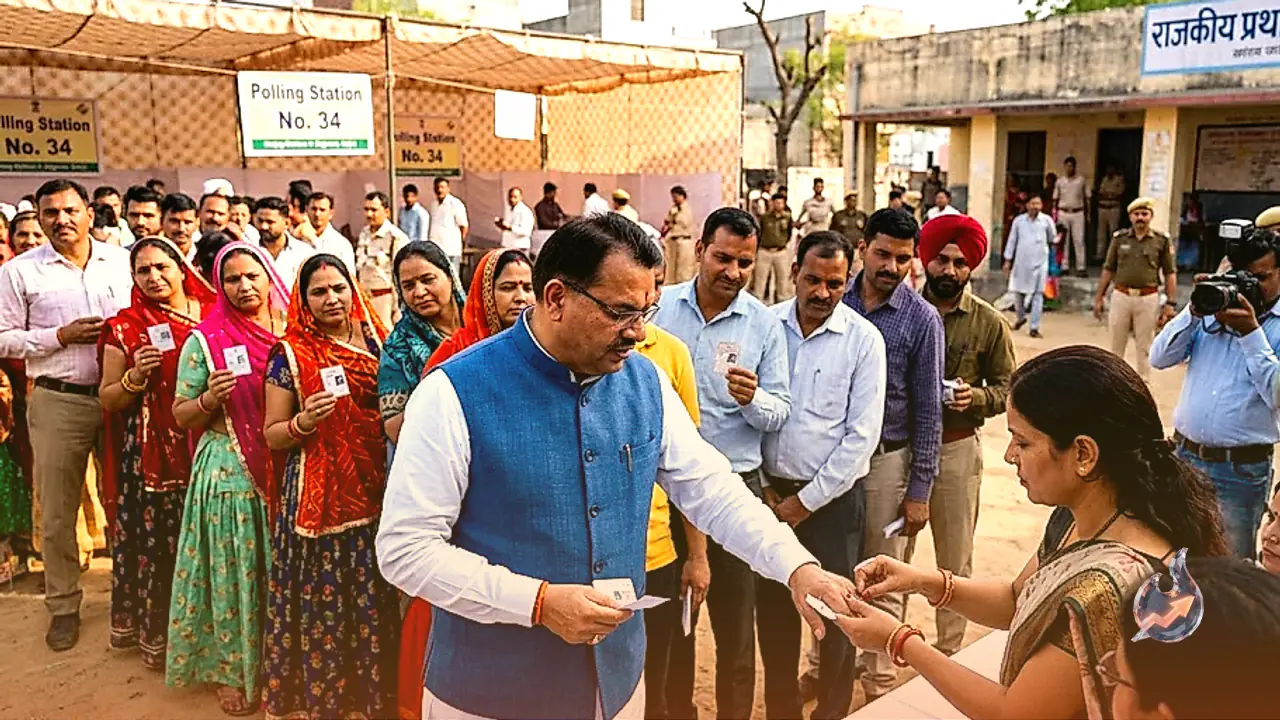

Political activity in Rajasthan has hit a fever pitch as the state moves through its urban local body elections. Although these elections decide civic representation at the grassroots level, their ramifications are expected to echo through the state's political landscape for years to come. Occurring precisely as the ruling Bhajan Lal Sharma administration completes the halfway mark of its tenure, this contest represents the first major statewide electoral exercise since the government assumed office. Consequently, political observers are framing these polls as a direct referendum on the Chief Minister's performance and governance model. The final outcome is poised to impact not only the upcoming Panchayati Raj elections due in the coming months but also the larger assembly elections two and a half years away, as well as the subsequent general elections.
Midterm Leadership Evaluation for Chief Minister Bhajan Lal Sharma
When the BJP secured victory in the late 2023 Rajasthan assembly elections, the party leadership surprised political analysts by selecting Bhajan Lal Sharma, a first-time Member of the Legislative Assembly, for the Chief Minister's chair. Known for maintaining a clean image and staying clear of factional rivalries, Sharma was elevated ahead of seasoned stalwarts including former Chief Minister Vasundhara Raje. Similar leadership shifts were executed in neighboring Madhya Pradesh and Chhattisgarh. Now, halfway into his term, the focus shifts to whether the Chief Minister can convert his administrative record into a decisive electoral mandate. This local election serves as a crucial moment to validate the central leadership's unexpected appointment and demonstrate his political hold over the state's voter base.
Top Organizational Strategy and Links to Uttar Pradesh Polls
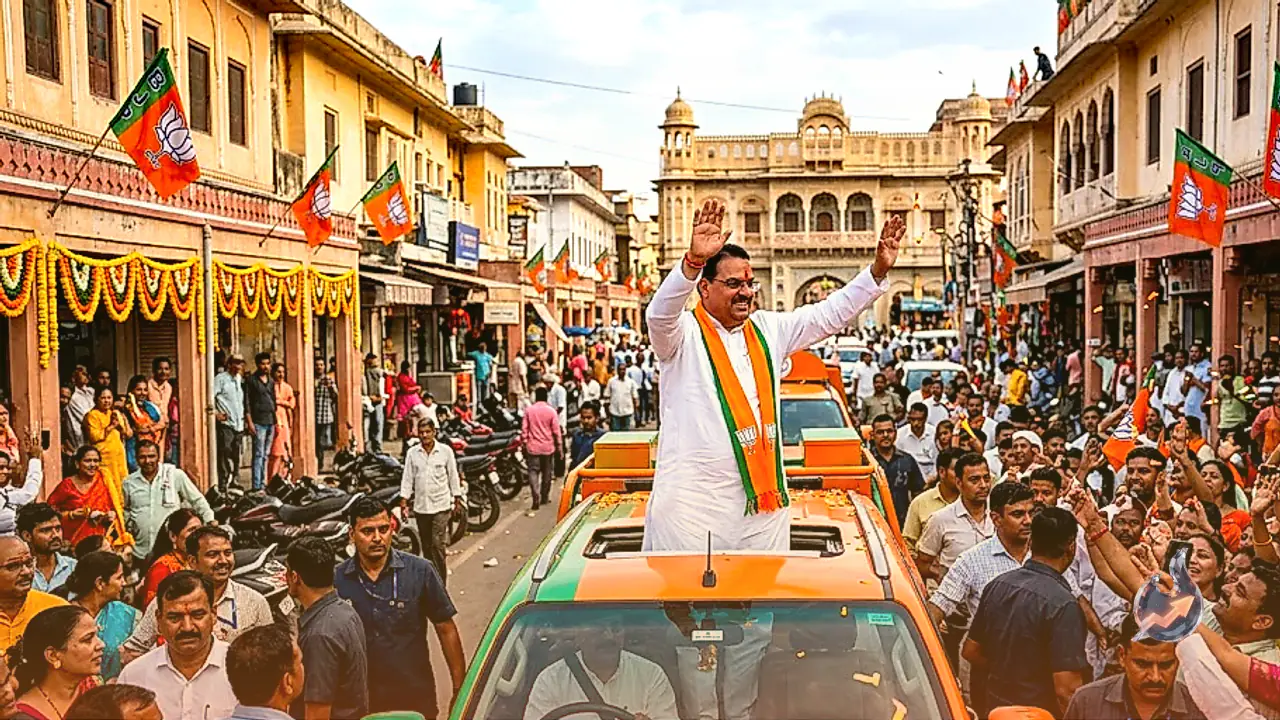
Recognizing the strategic weight of these elections, the BJP has mobilized its organizational machinery from top to bottom. Chief Minister Bhajan Lal Sharma has adopted an aggressive campaigning schedule, conducting roadshows across municipalities to generate early momentum for party candidates. Simultaneously, national leaders have taken charge of election management, led by the party's National Organization General Secretary BL Santhosh. Beyond state boundaries, the election carries broader regional implications, particularly for neighboring Uttar Pradesh, which is slated for assembly elections in the near future. With the BJP governing both states, securing a strong mandate in Rajasthan is viewed as essential for shaping a favorable political narrative across northern India.
Marathon Jaipur Strategy Sessions and Rebel Management
A primary challenge confronting the ruling party is internal friction in the form of rebel candidates. Even after the official deadline for nomination withdrawals passed, numerous dissatisfied party workers remained in the fray as independents. While these rebels may not secure victories independently, their presence risks splitting the core vote bank and disrupting party calculations in tight contests. To counter this threat, BL Santhosh arrived in Jaipur to oversee strategic operations at the state party headquarters. He conducted division-wise feedback meetings to review candidate nominations, evaluate local grievances, and draft counter-strategies. The high-level briefings were attended by BJP State President Madan Rathore, National General Secretary Harish Dwivedi, Organization General Secretary Ajeya Kumar, and key members of the election steering committee, underscoring the party's push to transform its double-engine government into a triple-engine administration.
Repercussions of 2024 Lok Sabha Results and Recent By-elections
Rajasthan has historically adhered to a power-alternating trend every five years. While the BJP successfully displaced the Congress in 2023, the 2024 Lok Sabha elections dealt a noticeable setback to the ruling party. Having achieved clean sweeps of all 25 parliamentary seats in both the 2014 and 2019 general elections, the BJP saw its tally decline to 14 seats in 2024, leaving 11 seats to the opposition alliance. This drop invigorated the Congress opposition and put the ruling party on high alert. Although the BJP subsequently maintained its ground in six out of seven vacant assembly seat by-elections, it suffered a high-profile defeat in the Anta constituency, located within former Chief Minister Vasundhara Raje's traditional sphere of influence. That loss further highlighted the necessity of rigorous election management at the local level.
Opposition Offensives: Administrators, Delimitation, and NEET Issues
Following the expiration of terms for local bodies and Panchayati Raj institutions, the state government opted to appoint bureaucratic administrators rather than holding immediate elections. The decision to place municipal governance under civil servants became a primary line of attack for the Congress, which accused the government of undermining democratic institutions. In addition, the opposition built sustained public campaigns around the delimitation of municipal wards and controversies surrounding the NEET paper leak. These combined issues placed the state administration on the defensive, enabling the opposition to build public momentum ahead of the civic polls.
OBC Reservation Dynamics, High Court Mandate, and Campaign Manifesto
The state government attributed the delay in scheduling civic elections to pending deliberations by the Other Backward Classes Commission, maintaining that conducting polls without defining updated quota terms would disadvantage OBC communities. The dispute ultimately reached the Rajasthan High Court. Following strict judicial directives, the commission submitted its report, paving the way for the election process to resume. In the interim, however, the opposition succeeded in keeping public focus on administrative delays. With election dates finalized, the BJP responded by releasing a comprehensive manifesto focusing on urban infrastructure, civic services, and local development. Chief Minister Bhajan Lal Sharma continues his statewide roadshows to lock in voter support as campaigning reaches its final leg.