

















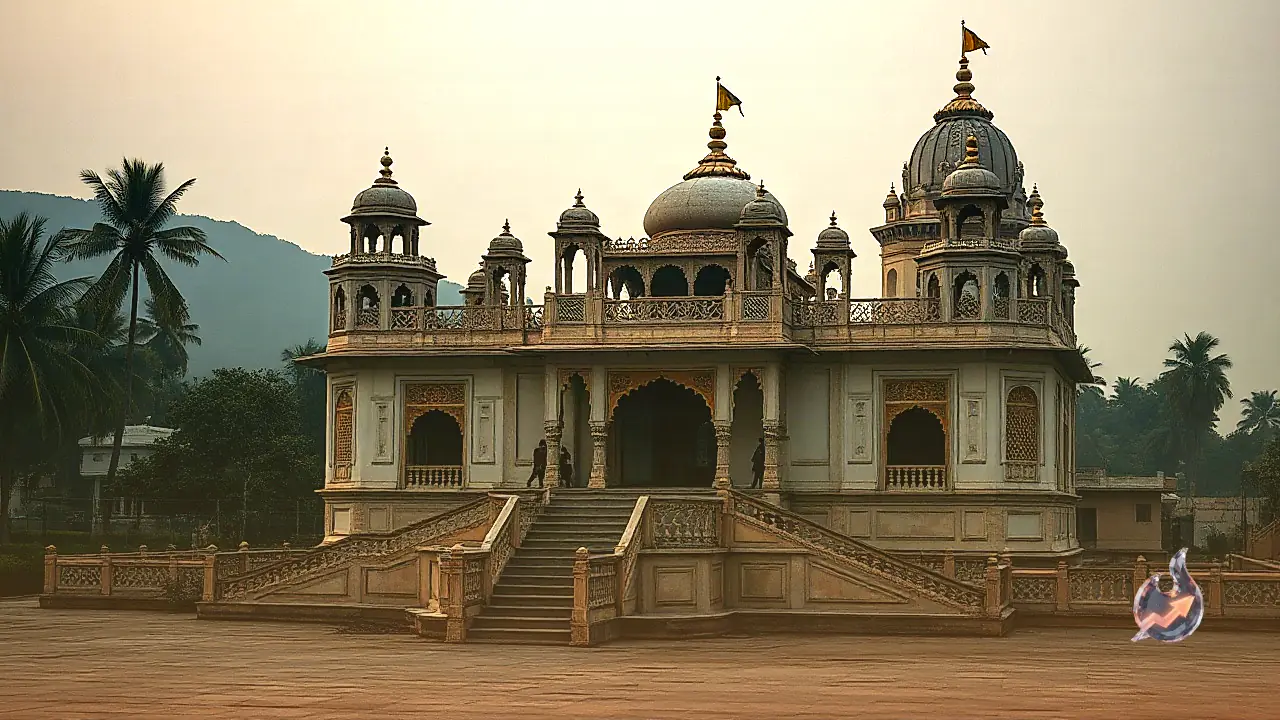

In Dholpur, Rajasthan, several old buildings and temples still carry memories of the princely era etched into their walls. One such heritage site standing at the district headquarters is the Radha Vihari Temple, known for its 118-year-old legacy and its striking stone carvings.
Built in 1908
The temple was built on the orders of Maharaja Rana Ram Singh of the Dholpur princely state. Construction was completed in 1908, which makes the temple roughly 118 years old today. It was built using the famous red and white sandstone found in Dholpur, a material that has long defined the region's architecture. Artisans carved the stone finely to create numerous beautiful figures and motifs on the temple walls, adding to its visual appeal. The overall structure clearly reflects the architectural style of the princely era.
Built close to the royal palace
According to historian Arvind Sharma, several historic temples from the princely era still stand at Dholpur's district headquarters, including the temple of Lord Narsingh, the historic Chopra Temple and the Nihaleshwar Temple. Among these, the Radha Vihari Temple holds a special place. Sharma says Maharaja Rana Ram Singh deliberately had this temple built right next to the royal palace, so that he could easily visit it. The Maharaja himself used to come here to have darshan of Lord Krishna and Radha Rani, which reflects how deeply the temple was tied to his personal religious and spiritual devotion.
Grand idols of Krishna and Radha
Inside the temple's sanctum sit striking and grand idols of Lord Krishna and Radha Rani. Devotees who come here do not just offer prayers, they also take time to admire the temple's ancient structure and the fine carvings etched into its stones. Visitors and locals alike often praise its architecture.
118 years as a centre of faith and pride
The Radha Vihari Temple today forms an important part of Dholpur's historical heritage. For nearly 118 years, it has remained not just a centre of religious faith for people but also a symbol of the city's pride. Its old walls, the beautiful construction using red and white stone, and the art of the princely era together tell the story of Dholpur's rich history. Tourists and devotees who visit the city today still get a glimpse of the grandeur of the princely era through this temple.