





















Decades of planetary exploration have deepened our understanding of the solar system, yet the origin of the two small moons orbiting Mars remains one of space science's most fascinating mysteries. Named Phobos and Deimos, these irregular rocky bodies measure roughly 22 to 27 kilometers and 12 to 15 kilometers in length, respectively. Despite extensive imaging from passing orbiters, researchers have never reached a consensus on how either body came to exist. Were they wandering rogue asteroids captured long ago by the gravitational pull of Mars, or did they coalesce out of a gigantic ring of debris blasted into orbit during a violent planetary collision? To resolve this lingering debate with hard physical evidence, the Japan Aerospace Exploration Agency is preparing a bold robotic venture directly to the Martian system.
The Objectives Behind the MMX Endeavor
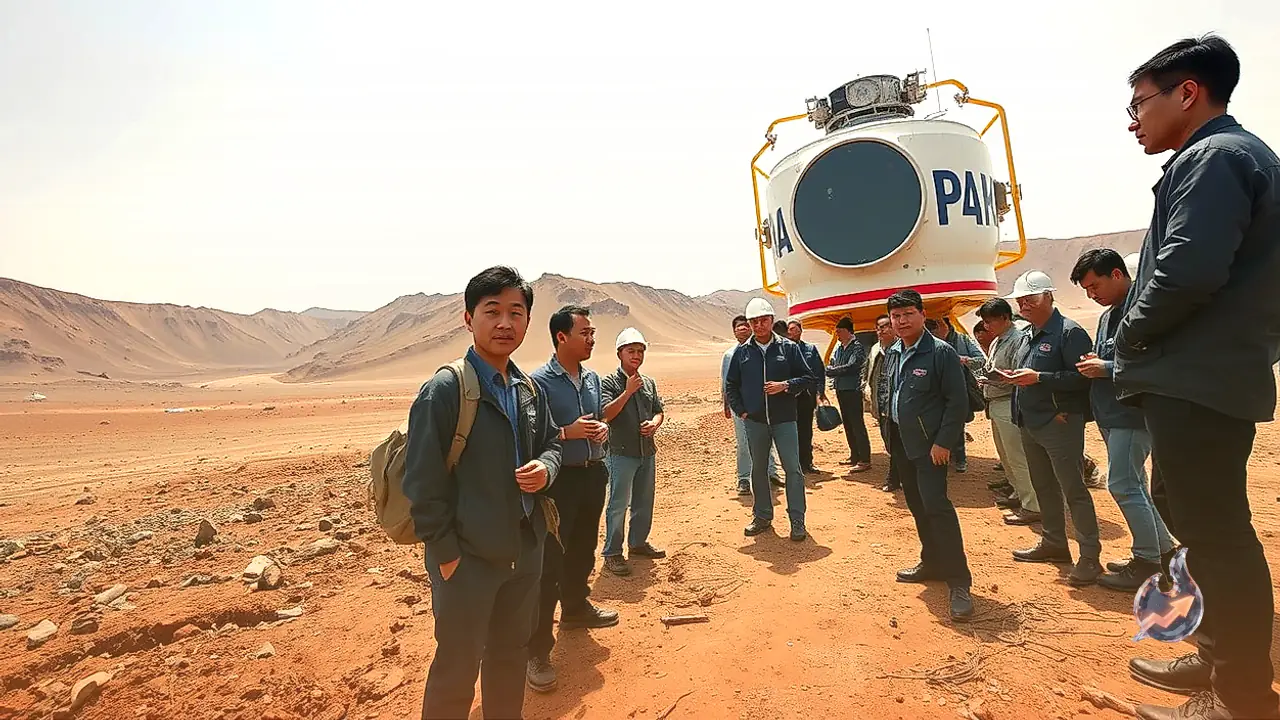
Designated as the Martian Moons eXploration project, or MMX, the mission aims to settle the origin debate by collecting pristine soil directly from the surface of Phobos. The flight plan calls for the spacecraft to retrieve at least 10 grams of regolith and surface material before making the journey back to terrestrial laboratories. Current mission milestones anticipate that the craft will arrive in the vicinity of Mars in 2027. Once situated in orbit, the probe will spend extended time surveying both moons in detail and executing touch-and-go maneuvers to gather its precious scientific payload. If all technical operations succeed, the sample capsule will complete its voyage back to Earth in 2031, providing planetary geologists with raw, unaltered material from the Martian environment for the very first time.
Two Competing Hypotheses on How the Moons Formed
Scientists have narrowed the origin of Phobos and Deimos down to two primary explanatory scenarios. Under the captured asteroid hypothesis, both bodies were once independent space rocks that drifted across interplanetary space. As they passed close to Mars, the planet's gravitational well snagged them into stable orbits, preserving their original composition from the outer asteroid belt. The alternative theory proposes a catastrophic collision early in Martian history. In that scenario, a massive protoplanet collided with Mars billions of years ago, hurling vast plumes of pulverized crust and mantle into space. Over eons, this circling debris disk gradually coalesced into the two diminutive satellites we observe today. Analyzing the elemental isotopes and mineral crystalline structures inside the 10-gram sample will definitively verify which narrative accurately reflects planetary history.
Overcoming the Hazard of Extremely Weak Gravity
Executing scientific operations on Phobos presents extreme mechanical challenges due to the moon's negligible mass. Because its gravitational field is remarkably weak, standard landing methods run the constant danger of having the spacecraft rebound and drift hopelessly into open space. To circumvent this hazard, engineers designed two redundant collection mechanisms to harvest regolith quickly and securely. One tool relies on a subsurface corer to extract pristine dirt from beneath the top layer. The companion system discharges high-pressure nitrogen gas onto the terrain, lofting loose particles straight into an onboard collection chamber. Flight controllers plan to execute sampling routines at two distinct locations across Phobos to maximize the geological variety of the returned material.
Global Scientific Collaboration and Return Logistics
The scope of the Japanese enterprise extends well beyond gathering a physical sample. The mission integrates a compact surface rover engineered through a collaboration involving French and German aerospace institutes. Once deployed onto Phobos, this mobile unit will evaluate terrain cohesion, grain distribution, and surface mechanics at close range. Concurrently, the mother ship will perform orbital surveys of both Phobos and Deimos, mapping out their gravitational variations, surface morphology, internal density distributions, and elemental chemistry. When surface tasks conclude, the accumulated materials will be sealed inside a rugged atmospheric entry capsule. That return vehicle is scheduled to re-enter Earth's atmosphere in 2031, with a planned touchdown targeting the isolated expanse of Woomera in South Australia for recovery and containment.