





















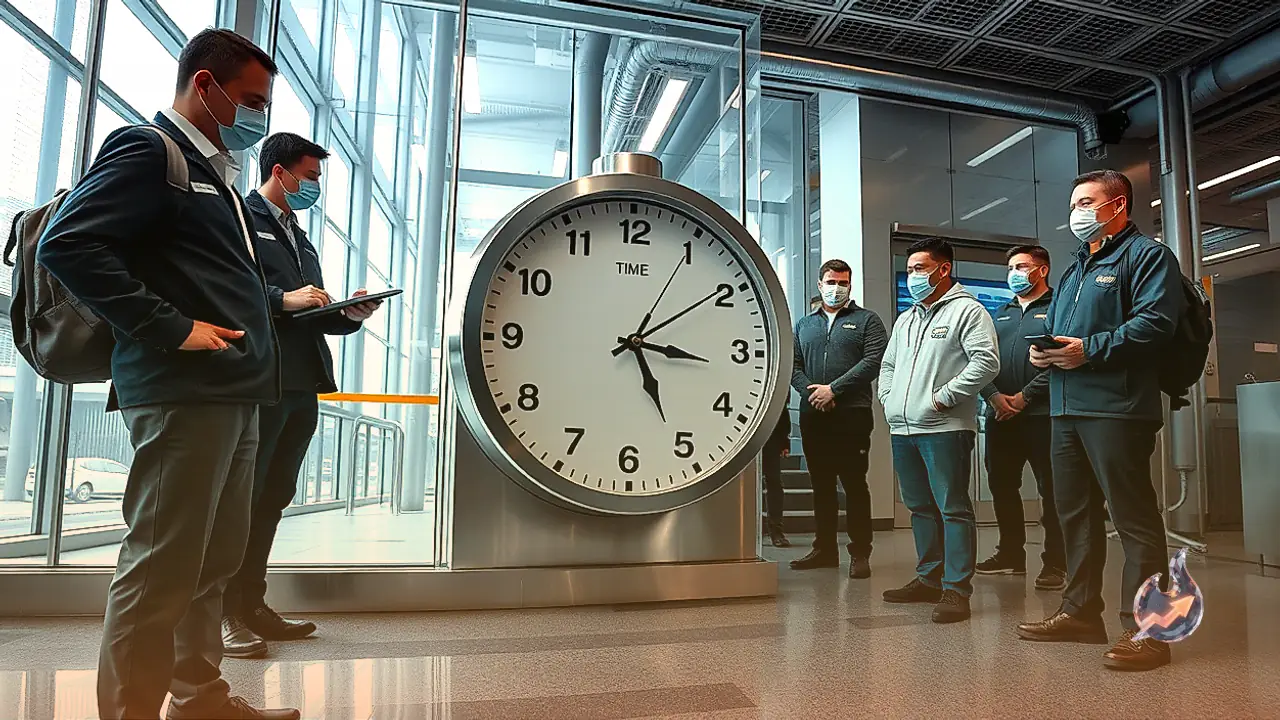

A debate that has simmered within the scientific and metrological community for over three decades has finally reached a definitive conclusion. The leap second is being officially consigned to history. While the average person going about their daily routine has rarely noticed the addition of a stray second to official clocks, the decision to eliminate this practice carries profound consequences for the global telecommunications networks, financial clearinghouses, and cloud computing architectures that modern civilization depends upon. Moreover, the decision averts what could have been an unprecedented technological hazard, the looming arrival of our planet's first ever negative leap second.
The Mechanics and Origins of the Leap Second
The International Bureau of Weights and Measures, widely known by its French acronym BIPM, confirmed that starting in May 2027, it will cease inserting leap seconds into Coordinated Universal Time, or UTC. The concept was originally introduced in 1972 to reconcile an unavoidable physical dilemma: the growing temporal divergence between ultra-precise atomic clocks and astronomical time derived from the actual rotation of the Earth. Since its inception, exactly 32 leap seconds have been injected into global timekeeping, with the most recent adjustment occurring at the conclusion of 2016.
Under normal conditions, our planet does not spin at a perfectly uniform velocity. The gravitational pull of the moon exerts tidal friction on the oceans, acting as a gentle brake on Earth's axial rotation. Concurrently, dynamic forces within the Earth's liquid metal core, shifting oceanic patterns, and atmospheric winds all interact to perturb the rotational velocity. Because atomic clocks, based on the invariant quantum vibrations of atoms like cesium, maintain unwavering accuracy, astronomical time designated as UT1 gradually drifts away from atomic UTC. To prevent this drift from widening noticeably, metrologists periodically introduced a single leap second, effectively laying down a momentary patch of track so that the astronomical and atomic timelines ran alongside one another.
Software Vulnerabilities and Corporate Workarounds
While inserting an extra tick of the clock appears trivial to human observers, it represents an unnatural anomaly to computerized infrastructure. Modern operating systems, databases, distributed ledgers, and application programming interfaces operate on the foundational premise that every minute consists of precisely sixty continuous seconds. When timekeepers mandate a minute containing 61 seconds, automated scheduling algorithms frequently panic. Systems can record duplicate timestamps or see network nodes fall out of synchronization, resulting in silent data corruption or outright system crashes.
The hazards are far from theoretical. During a leap second insertion in 2012, Australian carrier Qantas suffered a catastrophic failure of its automated reservation and airport check-in engines. The software outage grounded flights, stranded passengers, and caused widespread disruptions across aviation terminals. To insulate their operations from recurring disruptions, major technological enterprises including Google and Meta implemented proprietary time smearing techniques. Instead of tacking on an abrupt sixty-first second at midnight, their systems deliberately slow server clocks by microscopic increments across a span of twenty-four hours, absorbing the extra second imperceptibly. Yet such elaborate engineering fixes remain beyond the reach of countless legacy systems and standard industrial networks.
The Peril of a Negative Leap Second and Climate Shifts
For half a century, every adjustment ever made to UTC has been a positive leap second, compensating for an Earth that was gradually slowing down. However, recent planetary phenomena have disrupted this trend. The widespread melting of polar ice caps, driven by accelerated climate change, has altered the distribution of mass across the globe and shifted the planet's gravitational field. This redistribution, alongside core fluctuations, has caused the Earth's rotational speed to pick up unexpectedly. A landmark scientific study published in Nature in 2024 revealed that this acceleration could have necessitated an unprecedented negative leap second as early as 2029.
A negative leap second would require global clocks to skip a second entirely, jumping instantly from second 58 directly to zero. While positive additions have plagued infrastructure for decades, skipping an integer in temporal sequences had never been evaluated under live operational conditions. Judah Levine, a prominent fellow at the United States National Institute of Standards and Technology, highlighted that if positive leap seconds were still generating unresolved bugs after 50 years, attempting an untested negative subtraction posed an immense and unacceptable risk to international infrastructure. Industry standards working groups conducted simulation trials that revealed widespread, severe software failures whenever a second was subtracted, establishing a clear imperative to abandon the framework before a negative adjustment became unavoidable.
Setting the 2027 Deadline and Looking Millennia Ahead
Patrizia Tavella, who leads the time department at BIPM, noted that the concrete likelihood of having to execute a negative leap second directly convinced the committee to establish May 2027 as the termination date. The chosen day, May 20, 2027, bears deep symbolic importance for international science. It marks the anniversary of the 1875 signing of the Metre Convention, the foundational diplomatic treaty that established BIPM, and aligns with the annual celebration of World Metrology Day.
Both Tavella and Levine underscored that dismantling the leap second mechanism will streamline operations across the technological landscape. Levine observed that daily life for engineers will shed a major headache, while Tavella remarked that standard UTC-based operations will no longer need to implement special procedures. Systems can simply allow seconds to tick away within normal 60-second minutes without intervention.
Decoupling atomic clocks from planetary spin does mean that UTC and the astronomical time UT1 will steadily drift apart over extended epochs. To manage this divergence over the long horizon, BIPM has agreed in principle to the future concept of a leap hour. Given that an hour encompasses 3,600 seconds, accumulating enough disparity to justify a one-hour shift will take multiple millennia. For the foreseeable future, astronomical organizations requiring raw planetary orientation can calculate and utilize the UT1-UTC delta directly, leaving the rest of the world to enjoy uninterrupted, predictable digital timekeeping.