




















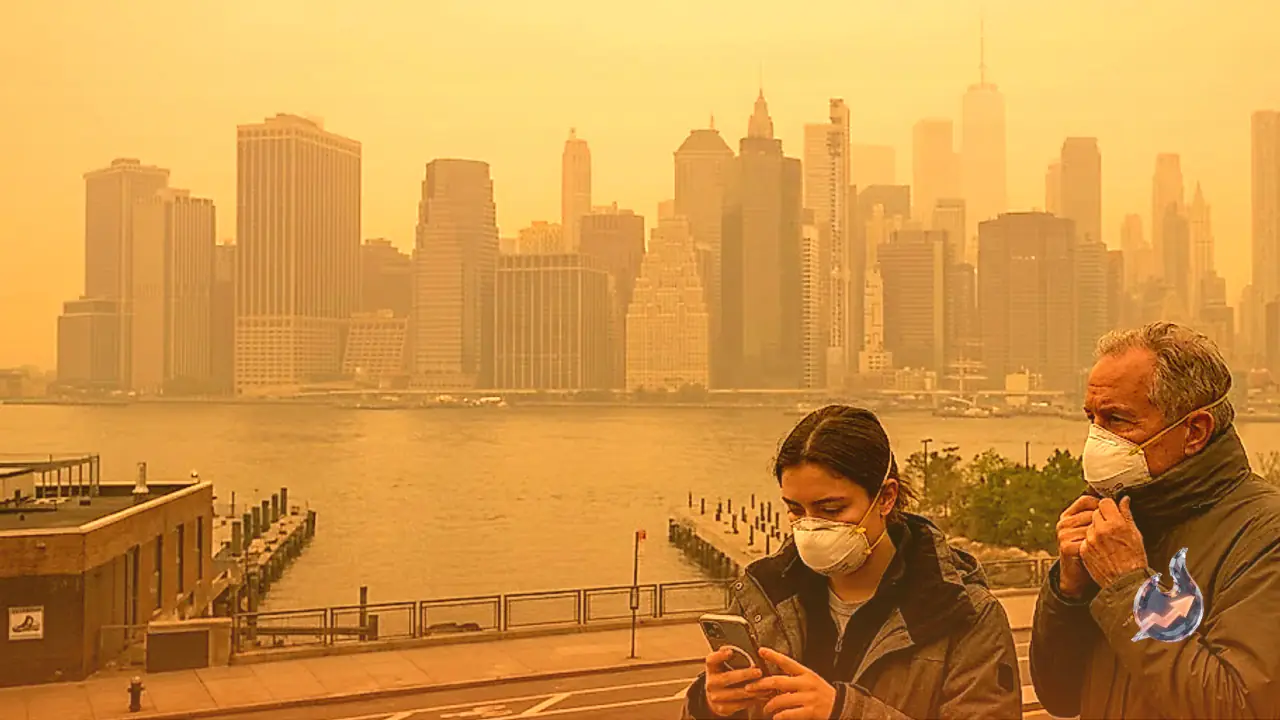

Wildfires burning across Canada have sent a thick blanket of smoke drifting into the American Midwest and Northeast this week, forcing multiple cities to issue air quality warnings as skies turned hazy and, in some cases, orange.
More Than 100 Fires Raging Out of Control
As of Wednesday, more than 100 wildfires were burning out of control across Canada, with hundreds of additional fires being actively monitored or fought by crews. The smoke generated by these blazes has traveled south and east across the border, dulling skies from Minnesota all the way to New York. Some of the most striking images came out of Toronto, where commuters made their way to work on Wednesday morning under a sky tinted orange by the smoke overhead. Compounding the problem, the same region is currently in the grip of a heat wave, with daytime temperatures climbing well above 90 degrees Fahrenheit in many areas and the heat index reading even higher than the thermometer.
Air Quality Drops to Unhealthy and Hazardous Levels
By Wednesday evening, New York City's air quality index had topped out at 180, a figure that lands squarely in the unhealthy category as defined by the US Environmental Protection Agency. Conditions were far worse elsewhere. In Duluth, Minnesota, the air quality index surged past 500, well beyond the 301 threshold at which air is labeled hazardous and unsafe for absolutely everyone, regardless of health status. Forecasters expect the smoky conditions to grow even worse across parts of the Northeast on Thursday, including in New York City itself.
Why PM2.5 From Wildfire Smoke Is So Dangerous
The haze drifting over these cities is made up largely of microscopic particles known as PM2.5, shorthand for particulate matter smaller than 2.5 micrometers wide, or roughly 30 times smaller than the width of a single human hair. Because these particles are so tiny, they can penetrate deep into the lungs and even enter the bloodstream, triggering or worsening a range of medical conditions, particularly among people who are already vulnerable.
Nicholas Nassikas, a pulmonologist and assistant professor of medicine at Harvard Medical School, says he is advising his patients who have preexisting conditions such as asthma and other lung diseases to limit the time they spend outdoors while the smoke lingers. Children face particular risk, he notes, because they have a faster breathing rate and simply inhale more air relative to their size. Older adults are also especially vulnerable, both because they frequently have other health conditions layered on top of one another and because they often live in homes or senior centers that are not well ventilated.
Jennifer Stowell, an assistant professor at the University of Maryland's School of Public Health, says even healthy adults should think twice about spending long stretches outside once the air quality index climbs past 100. At the very least, it is important to limit your time outdoors to reduce your overall exposure, she says. For anyone who does need to be outside for extended periods, she recommends wearing an N95 mask. Stowell, who is currently in Boston, where the air quality index reached 110 on Wednesday, says she was holding off on attending any outdoor events until later in the evening.
Dan Westervelt, an associate professor of climate physics at Columbia University, is taking similar precautions. I'm going to make sure my kids are staying indoors today, he says, adding that he does not plan to do any physical exertion, like running, either today or tomorrow.
A Warming Climate Is Making Smoky Skies More Common
Rising temperatures driven by climate change are extending wildfire seasons and creating the hotter, drier conditions that fuel more explosive fires in the first place. A study published last year estimated that wildfire smoke is already responsible for roughly 40,000 deaths a year in the United States, a toll that could more than double to about 70,000 deaths annually by 2050 if global warming continues on its current path. Even as smoke-choked air quality days become more frequent, scientists are still working to fully understand the long-term health consequences of repeated exposure. A comparable surge of smoke from Canadian wildfires blanketed the Northeast back in 2023.
Westervelt says, Exposure to high levels of air pollution over the course of a lifetime or a long period of time is demonstrated numerous times in research to lead to premature mortality. You can chop off some months of your life expectancy if you are living in conditions where you're very frequently, regularly exposed to high levels of air pollution.
Not All Pollution Is the Same
PM2.5 can come from many everyday sources, including vehicle traffic and power plants, but wildfire smoke carries a different kind of danger. As fires increasingly spread into populated towns, they end up burning homes, cars, playgrounds and other manmade structures alongside vegetation, releasing a toxic mixture of pollutants into the smoke. While N95 masks can filter out some of that particulate matter, they do not remove every pollutant that wildfire smoke can carry.
Cooling Centers Face a Dual Challenge
New York City has opened cooling centers to help residents cope with the ongoing heat wave, since high temperatures can also make PM2.5 pollution worse, and the city is handing out masks at some of these locations. But masks do not filter out gaseous pollutants found in wildfire smoke, and cooling centers may not be prioritizing air purifiers even though air conditioning can help somewhat with air quality. Stowell argues these centers should also be havens for clean air.
The New Frontline of Air Pollution
After decades spent cleaning up other sources of pollution across the country, Westervelt says wildfire smoke has become the big challenge the US now faces. We've done a pretty good job as a nation of making vehicles more efficient, having more renewables, switching to cleaner fuels, he says. There could be more progress on that, but really, it's mostly all about wildfire smoke.