




















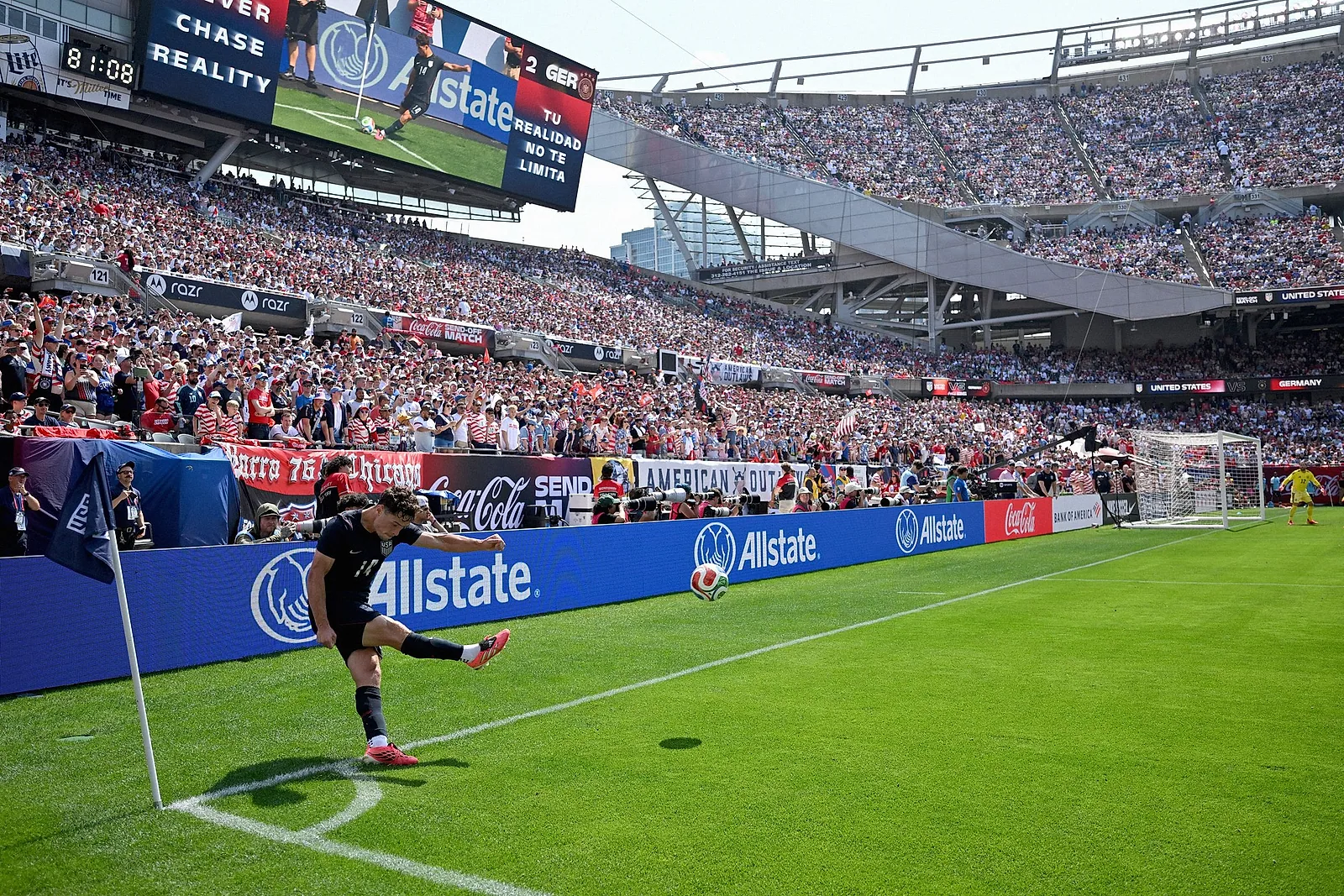

When a player strikes a ball so cleanly that it swerves through the air and dips into the net, it can look like sorcery. In truth, what's at work is fluid dynamics — the study of how objects behave inside a fluid. And yes, air counts as a fluid, because it flows. (Kids, if you dream of being a real-life FIFA hero, study physics.) The cleanest way to understand the trick is to build up a model of a ball's motion: start with the simplest, silliest scenario imaginable, then add back the pieces of reality one at a time.
Step one: playing soccer in space
Why on earth would you play soccer in space? Well, after a glance at this year's tournament ticket prices, leaving the planet might start to look like the cheaper option. Either way, picture us somewhere far out in the void, where there's neither air nor gravity. The ball sits still, and then a player in a space suit boots it.
For the brief moment the foot is touching the ball, it applies a pushing force. The ball squashes, then springs back and launches off the foot — the whole thing happens in roughly a hundredth of a second, and a pro can comfortably send the ball flying at 80 miles per hour.
That applied force changes the ball's velocity, but here's the key point: the instant the ball leaves the foot, no force acts on it any longer. So the ball keeps gliding in a perfectly straight line at a constant speed… forever, until the end of time. You'll recognize that as Newton's first law.
Back to Earth — but with the air switched off
Of course, you'd lose an awful lot of balls this way out in space, so it's not exactly practical. Let's bring the action home to Earth — but to keep things tidy, we'll first pretend there's no atmosphere. Suit up again!
Now a new player joins the game: the planet's gravitational pull. We can find this downward force with Fg = m × g, where m is the ball's mass and g is Earth's gravitational field (9.8 newtons per kilogram). Incidentally, Fg is what ordinary folks simply call an object's "weight."
What makes this force special is that it doesn't vanish once the ball is kicked — it stays. The ball travels with some velocity, and gravity is constantly tugging on that motion. The rate at which the velocity changes is what we call acceleration (a).
We need one more ingredient — how about Newton's second law? It tells us that acceleration depends on the net force (Fnet) on an object and its mass (m). It's usually written Fnet = m × a, but we can shuffle it into a = Fnet/m. Pair that with our gravitational force and something rather neat pops out.
Because both gravity and acceleration hinge on the ball's mass, the mass simply cancels out. The result: every object on Earth has a downward acceleration of 9.8 meters per second per second (m/s²). That's why, if you release a bowling ball and a marble at the same moment, they smack the ground at the same instant — even though the gravitational force on the bowling ball is thousands of times greater. Strange, isn't it?
Why a rising ball still comes down
So now, with gravity in play, if you kick the ball upward at an angle, its vertical velocity will slow, stop, and then reverse, picking up speed as it plummets back down. Put another way, the ball begins accelerating downward the very moment it's kicked — even while it's still climbing.
And the horizontal motion? Since there's no horizontal force after that first kick, the ball keeps rolling forward at the same speed, exactly as it did in space. People tend to assume a ball drops because its forward motion peters out, but the reality is the opposite. With no air drag, it doesn't slow down one bit. It only stops because the ground happens to be in the way.
The path this carves out is that familiar upside-down parabola, often called a ballistic trajectory, because it's the route taken by any unpowered projectile — a cannon ball, a bullet, a basketball. Any flying object on which gravity is the only force that matters will travel this way.
Enter the air: drag enters the picture
Happily, Earth does have air. But it changes the game dramatically. Now there's a continuous force acting horizontally, which we call air resistance, or drag, and it always shoves in the direction opposite to the ball's motion.
Picture air molecules as a swarm of tiny ping-pong balls. As a soccer ball plows through the air, it slams into gazillions of these little air balls, and every collision delivers a backward push; added together, they make up the total air-resistance force. The larger the object, the more collisions it has to barrel through.
You also rack up more collisions the faster you go. That means if you're merely tossing a ball in from the sideline, air resistance barely registers — but on a powerful kick, you can't afford to ignore it. In fact, doubling the ball's speed quadruples the air resistance. Were there no air resistance at all, a goalkeeper could boot a ball the entire length of the field and clear the stands beyond.
Spin, the Magnus force, and the secret of the curve
But there's a second way air gets its hands on a soccer ball. If the ball is spinning, those tiny air balls don't just bounce away; they also get dragged along in the direction the ball is rotating. This is where fluid dynamics earns its keep — it's what makes the ball's path curve. Imagine a ball moving to the right but spinning counterclockwise, meaning it has a horizontal axis of rotation.
As it spins, it hauls some of the air from above the ball around and shoves it back and underneath. But if the ball is pushing air downward, the air must be pushing the ball upward. Remember, forces always arise from an interaction between two things — so the ball pushing on the air and the air pushing on the ball are equal and opposite forces. (Hat trick! Newton's third law.)
We call this the Magnus force, and how strong it is depends on the size of the ball, the kind of surface it has (rough or smooth), how fast it's spinning, and its velocity. Yes, it's complicated.
With backspin, as in that example, the Magnus force pushes upward on the ball, partly canceling out gravity. That means the ball carries farther through the air. It's exactly why baseball players work to put backspin on the ball when they're hunting for home runs.
A fun experiment you can try at home
Here's a genuinely fun experiment you can run yourself. Grab two paper cups and tape their bottoms together (so the open ends point outward). Then loop three or four rubber bands together into a chain and wrap it around the middle. Use the loose end of the chain as a slingshot to fire the cup-contraption forward. With backspin, you can watch it curve upward.
And that's how you bend it
And guess what? We've just answered the question we set out to solve. If you want an object to curve in flight, all you have to do is spin it — and it works precisely because the object is interacting with the air. To bend a soccer shot sideways, you simply need to spin the ball on a vertical axis instead of a horizontal one. You pull that off by striking the ball slightly off-center, to one side or the other.
Just for fun, I coded the physics of my last three scenarios into a Python model and produced the animation below. It shows three balls launched at the same upward angle and the same starting velocity. The red ball has gravity alone acting on it, so it traces a parabolic path. The blue ball has gravity plus air resistance, which drags down its horizontal velocity and causes it to land short of the red one.
Finally, the magenta ball has both of those forces, but it's also spinning — so the Magnus force kicks in too. And there's your sideways curve. That's how you bend it like Beckham — or mash it like Messi. Olé, olé, olé!