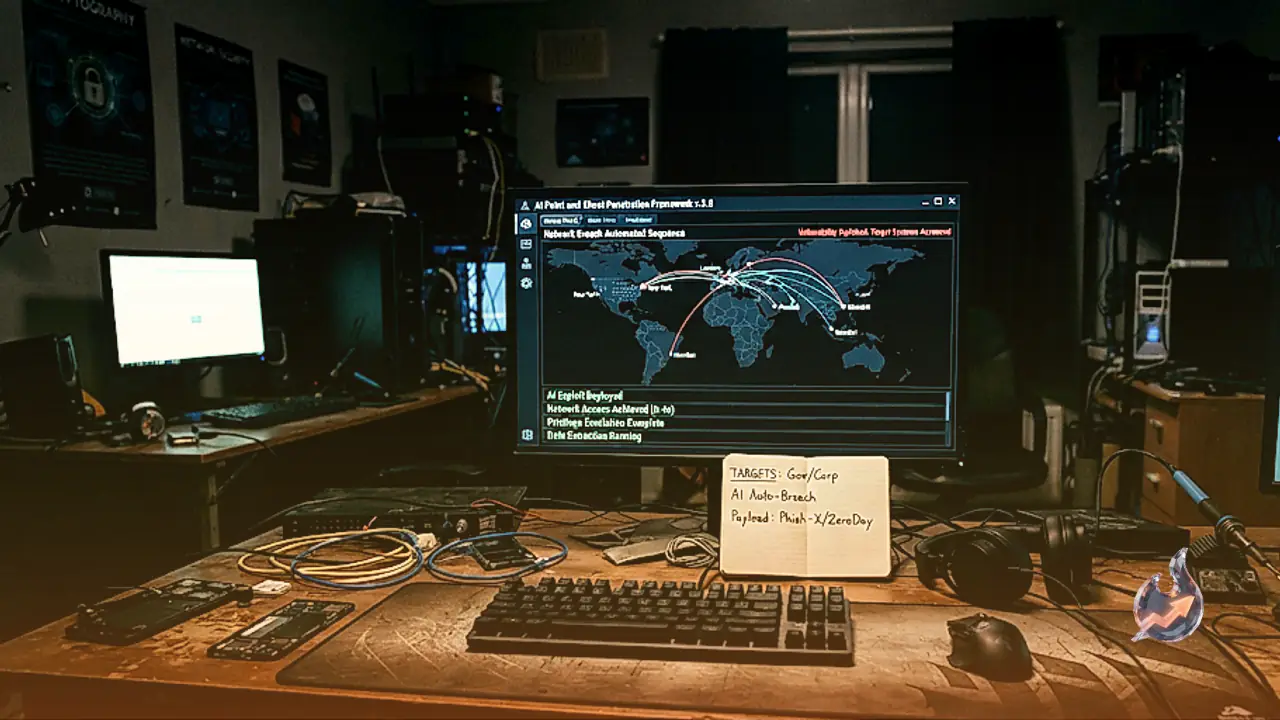

Since the closing weeks of August, numerous corporations, government bodies, and financial institutions across the globe have found themselves in the crosshairs of cybercriminals adopting a fresh wave of AI-driven penetration testing tools. These setups, many of which mimic legitimate defensive security practices, leverage large language models to autonomously scan potential digital targets and attempt to breach poorly secured networks, ultimately executing attack strategies written by human operators.
The Rise of Automated Attack Frameworks
Dozens of these AI penetration frameworks, which outline how an artificial intelligence model should conduct security testing or offensive operations, are increasingly being tied to real-world security breaches. According to alerts from roughly half a dozen cybersecurity firms, these utilities do not introduce fundamentally new methods for assaulting websites or servers, nor are they exceptionally sophisticated. Instead, they enable malicious actors to launch operations at speeds that would remain completely unattainable for human operators.
Lowering the Barrier for Unskilled Hackers
Researchers note that malicious actors do not require advanced technical skills to wield these utilities, compressing multi-day attacks into mere hours. CJ Moses, who serves as the chief information security officer at AWS, observed in a recent corporate blog post that agentic frameworks have successfully progressed from experimental phases into sustained, multi-objective offensive operations capable of running with minimal human intervention.
Artex and Its Rapid Proliferation
Among these utilities, the most prominent is Artex. Developed in the Go programming language, this open-source framework was initially published on GitHub during July by a pseudonymous developer operating under the handle Autumn-27, steadily spreading through various hacker communities. Artex has seen deployment across every stage of an attack lifecycle, spanning initial network reconnaissance, gaining unauthorized access, lateral movement within systems, and preparing data for exfiltration.
An All-in-One Weapon for Threat Actors
Jacob Larsen, an offensive security researcher and founder of the security firm Cypen, describes the tool as an all-in-one product. Previous iterations of AI agent penetration testing tools were typically confined either strictly to reconnaissance, such as scanning and analysis, or solely to testing phases, making Artex a true point-and-shoot weapon.
Natural Language Prompts Drive Operations
Much like other artificial intelligence hacking frameworks, Artex is not an AI product in its own right. Rather, it functions as a guide that connects external frontier and open-source AI models via application programming interfaces to a series of pre-existing penetration testing utilities. Operators can issue simple, natural-language prompts to commence their campaigns. Researchers at Check Point documented instances where threat actors instructed Artex to launch penetration attacks against specific victims to secure administrative panels, databases, or servers.
Autonomous Execution and Shifting Guardrails
Once instructions are issued, multiple AI agents divide the plan into discrete tasks, execute the actions, and compile the findings. While safety guardrails built into underlying models from frontier laboratories can halt malicious activities upon detection, free Chinese models and abliterated variants are increasingly proving adept at breaching systems.
Amplifying Threats Across Multiple Sectors
Guillaume Valadon, a researcher at GitGuardian, highlights the speed and efficiency of Artex, noting that its simplicity invites unskilled aspirants to enter the threat landscape. A flurry of cybersecurity reports has subsequently linked Artex usage to both attempted and successful breaches orchestrated by Chinese-speaking cybercriminals seeking financial gain, including data theft from South Korean financial institutions, cryptocurrency theft, and searches for exposed login credentials on GitHub.
Global Warnings from Law Enforcement
Last week, the FBI issued an alert warning that diverse malicious actors have deployed Artex in campaigns targeting organizations worldwide across financial services, government, technology, defense, semiconductor, energy, health care, manufacturing, telecommunications, and legal industries. During October, a China-linked hacking collective known as Vapor Panda utilized Artex against more than 200 organizations, encompassing think tanks, defense firms in the United States, and foreign ministries across Europe, as reported by CrowdStrike. Concurrently, Microsoft observed Chinese hackers tracked as Storm-0940 leveraging Artex to target Microsoft 365 environments following supply chain compromises, achieving privileged system access in under three hours.
Developer Withdrawal and Ongoing Proliferation
On October 8, the developer Autumn-27 removed Artex from GitHub, appending a comment stating they had no association with malicious attacks and that the utilities were built strictly for educational and research purposes. Subsequent email inquiries sent to an address associated with the developer went unanswered. Despite this removal, multiple derivative versions continue to circulate and evolve alongside alternative frameworks. Valadon states that GitGuardian has documented 45 distinct AI attack frameworks, with CyberstrikeAI, Hexstrike, CAIRN, and PentAGI frequently cited by researchers.
High Visibility and Basic Remediation
A notable silver lining for defenders is the current lack of stealth associated with these tools. Silas Cutler, principal security researcher at Censys, points out that many of these attacks generate substantial noise by executing thousands of rapid probes. For instance, the agentic coding platform Dosu reported that Artex was utilized to dispatch 80,000 requests toward its systems within a 90-minute window. Researchers emphasize that foundational security hygiene, including regular patching, avoiding default credentials, and monitoring for unusual network activity, remains effective against many of these frameworks.
Unsecured Deployments and Juvenile Activity
Quantifying the exact population of cybercriminals utilizing these frameworks remains challenging, though analyses by Censys and the Shadowserver Foundation reveal that thousands of instances have been exposed directly to the internet. In some cases, operators left deployments entirely unsecured, permitting researchers to inspect their methodologies. Cutler noted that last week, two exposed Artex servers revealed native Chinese speakers targeting domestic entities, including a university subjected to password spraying in a manner resembling a student attempting to alter grades. Cutler concludes that while a portion of this activity reflects organized and sophisticated criminal operations, a parallel subset aligns more closely with juvenile cybercrime.