



















A compelling demonstration of rural ingenuity has emerged from Azamgarh district in Uttar Pradesh, where a local farmer successfully tackled a recurring agricultural challenge using technical skill and household scrap material. During peak planting cycles, the scarcity of farm labor poses a significant obstacle for smallholders trying to complete field operations on schedule. Rather than suffering crop losses or waiting indefinitely for hired hands, farmer Arjun Maurya built an effective manual seed-sowing tool using discarded metal components lying around his house. His invention has eliminated his dependence on external workers while making crop planting far faster and physically lighter than traditional manual techniques.
Agricultural Labor Shortages and Planting Delays
Traditional farming practices across rural India remain heavily dependent on manual labor, particularly during critical sowing phases. When managing sizable agricultural plots, a single farmer often struggles to prepare the land and deposit seeds within the brief seasonal window required for optimal germination. Farmers typically rely on fellow villagers or day laborers to assist with field tasks. However, when laborers fail to show up during peak agricultural operations, planting timelines are disrupted, directly harming crop yields and diminishing farm income.
Arjun Maurya, a resident of Azamgarh, faced this exact predicament year after year on his farm. Arjun specializes in the commercial cultivation of holy basil, locally known as Tulsi, along with various ornamental flowers. Commercial flower and medicinal plant cultivation demands precise planting schedules to maximize bloom quality and harvest timing. Arjun noted that during the sowing season for Tulsi and flower seeds, he repeatedly had to seek assistance from local workers. Frequently, individuals who agreed to work would cancel at the last minute or fail to arrive, halting field operations and causing costly time delays.
Combining ITI Technical Training with Upcycled Scrap
Frustrated by frequent work stoppages and the unpredictability of hired labor, Arjun decided to create a self-reliant technical solution. Beyond his agricultural background, Arjun holds a vocational qualification from an Industrial Training Institute, commonly known as ITI. This technical education provided him with a solid foundation in mechanical principles, metal fabrication, and practical machine design. Leveraging his technical know-how, he set out to build a functional planting implement using scrap items already available in his store room.
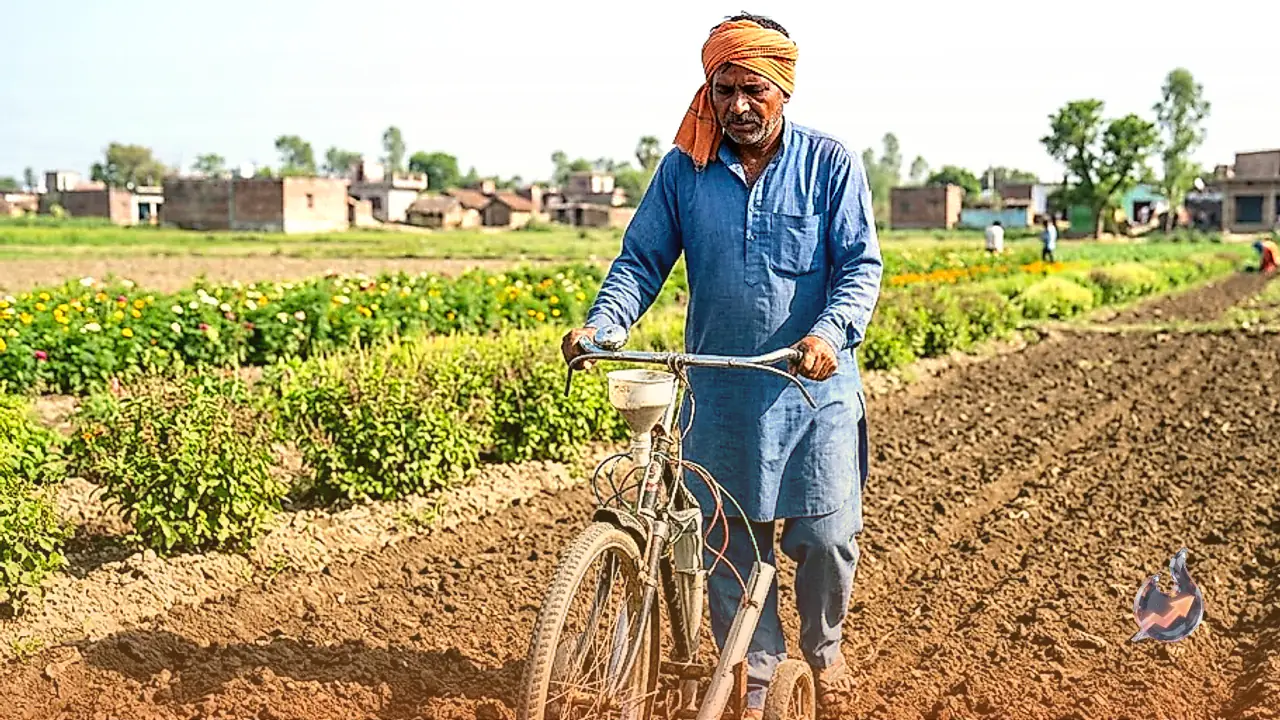
He gathered unused iron items and discarded domestic parts from around his household. His material list included wheels salvaged from an old bicycle, discarded iron water pipes, and leftover iron metal strips. By cutting, shaping, and joining these scrap components together, he constructed a lightweight yet durable manual seed planter. The structural layout was tailored specifically to glide smoothly over tilled soil while ensuring consistent seed placement across agricultural beds.
Single-Person Operation and Enhanced Physical Efficiency
The manual sowing apparatus designed by Arjun Maurya is exceptionally easy to operate and requires minimal physical exertion. Its primary advantage is that it enables a single individual to handle seed sowing across an entire field without requiring additional assistance. The operator can push the wheeled tool across tilled rows to plant Tulsi and flower seeds evenly, ensuring proper spacing between plants and encouraging healthy crop growth.
With this machine, the time required for planting has been reduced substantially, allowing Arjun to finish sowing operations without delay. Because the implement was constructed entirely from repurposed metal scrap, the project required virtually no financial investment. Consequently, the device represents an affordable, highly practical alternative for small-scale and resource-constrained farmers seeking to streamline field labor.
Community Adoption Among Neighboring Farmers
The utility of Arjun Maurya's homemade sowing machine quickly extended beyond his own acreage. Observing the machine's efficiency during the sowing season, neighboring farmers in the village expressed interest in utilizing the technology on their own land. Arjun began sharing the equipment with nearby cultivators, enabling them to complete their seed planting during labor shortages as well.
Arjun Maurya's grassroots innovation highlights how combining vocational skills with resourcefulness can overcome pressing agricultural constraints. By transforming discarded scrap into a functional farming tool, he has established an inspiring model of self-sufficiency and practical problem-solving for agricultural communities.