






















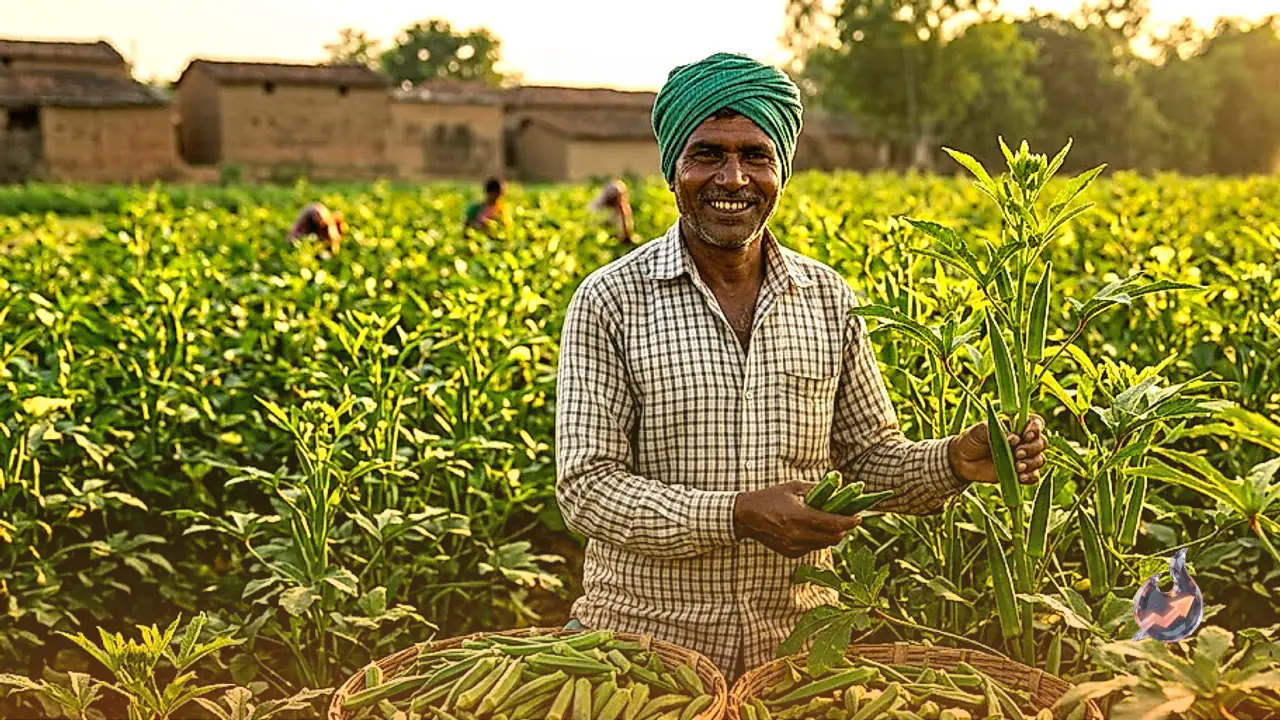

A progressive farmer from Deoghar has achieved what every agricultural worker dreams of—transforming a loss-making endeavor into a highly profitable enterprise. Agriculture is often perceived as a struggle, but when aligned with market demands and smart crop selection, it can yield exceptional returns. Ambika Kushwaha, a resident of Gopidih village in the Deoghar block, has changed his destiny with exactly this mindset. After spending decades entangled in the traditional cultivation of paddy and wheat, Ambika made the bold decision to switch to growing okra (bhindi) on his one-acre plot. This single decision completely revitalized his financial status. The very piece of land that once barely provided enough to sustain his family’s basic needs has now become a reliable machine for generating regular cash flow. This story is not just about personal success; it is a testament to the power of adopting modern, market-driven agricultural practices.
The Hidden Struggles of Wheat and Paddy
For generations, Ambika Kushwaha’s family relied on traditional farming methods. He recalls how his father spent years cultivating paddy and wheat on the exact same one-acre field. While these crops did produce grain, the financial margins were incredibly thin. Cultivating traditional grains requires a long, agonizing wait of several months before the harvest is ready to be sold. Despite the backbreaking labor involved, the income generated was only enough to cover the family’s daily expenses. Building financial security or saving for the future seemed impossible. After deducting the costs of fertilizers, seeds, and irrigation, the farmer was left with practically nothing. This economic stagnation forced Ambika to rethink his entire approach. He realized that to move forward and make real money from farming, he had to break away from the old, inherited patterns and try something completely different.
The Pivot to Profitable Vegetable Farming
Understanding the shifting dynamics of the local market, Ambika completely overhauled his agricultural strategy. He abandoned the staple crops of wheat and paddy and pivoted toward cash crops, specifically focusing on vegetable cultivation. He planted a fresh crop of okra on his one-acre field. According to Ambika, while the initial stages of okra cultivation—preparing the soil, sowing the seeds, and nurturing the young plants—require intense labor and attention, the rewards are exponential. Once the plants mature and begin to bear vegetables, the crop practically turns into a goldmine. This strategic shift in crop selection disrupted the old economics of his farm, replacing an unpredictable, low-yield cycle with a guaranteed, high-profit harvest.
Instant Cash Flow Every Two to Three Days
The most significant advantage of growing okra lies in its continuous production cycle. Ambika explains that once an okra crop is ready, it continuously yields vegetables for roughly three months. Unlike traditional crops, where a farmer must wait an entire season for a single payday, okra offers immediate gratification. The vegetables are plucked fresh from the field every two or three days and immediately sold in the local market. This brings instant cash directly into the farmer's hands. This steady and predictable cash flow is a massive relief for any agricultural household. Because there is a constant demand for okra in the market, Ambika consistently secures fair and immediate compensation for his produce. The regular influx of cash has not only met his daily operational needs but has also significantly boosted his confidence in farming as a viable business.
Tenfold Returns and Financial Independence
The results of this scientific and market-oriented approach to farming have been nothing short of spectacular. So far, Ambika Kushwaha has earned an impressive Rs 1.5 lakh from his okra harvest. This staggering revenue represents a profit margin that is nearly 10 times his initial investment in the crop. The same one-acre plot that previously offered negligible returns has now elevated his economic standing to new heights. Ambika firmly believes that if farmers study market demand rather than solely depending on seasonal rains and traditional habits, they can generate substantial wealth even from small landholdings. By adopting newer techniques and planting high-demand crops, Ambika has become a beacon of inspiration for other farmers in Gopidih and surrounding villages.
Deoghar's Tourism Engine Drives Vegetable Demand
A crucial factor behind Ambika Kushwaha's massive success is the geographical and cultural significance of Deoghar itself. Deoghar is a globally renowned religious and tourist destination. The holy shrine of Baba Baidyanath Dham draws a continuous, year-round influx of pilgrims from all over India and abroad. Even outside the peak monsoon month of Shravan, thousands of tourists visit the city daily. Because of this massive floating population, the local hospitality industry—comprising hotels, dharamshalas, lodges, and restaurants—requires a never-ending supply of fresh vegetables. Ambika points out that he never has to struggle to find buyers for his fresh okra. Not only does he get excellent prices at the local vegetable markets, but he also receives regular, bulk supply orders from nearby traders and hotel operators. This ready-made, high-consumption local ecosystem has turned his vegetable farming into an incredibly secure and lucrative venture.