




















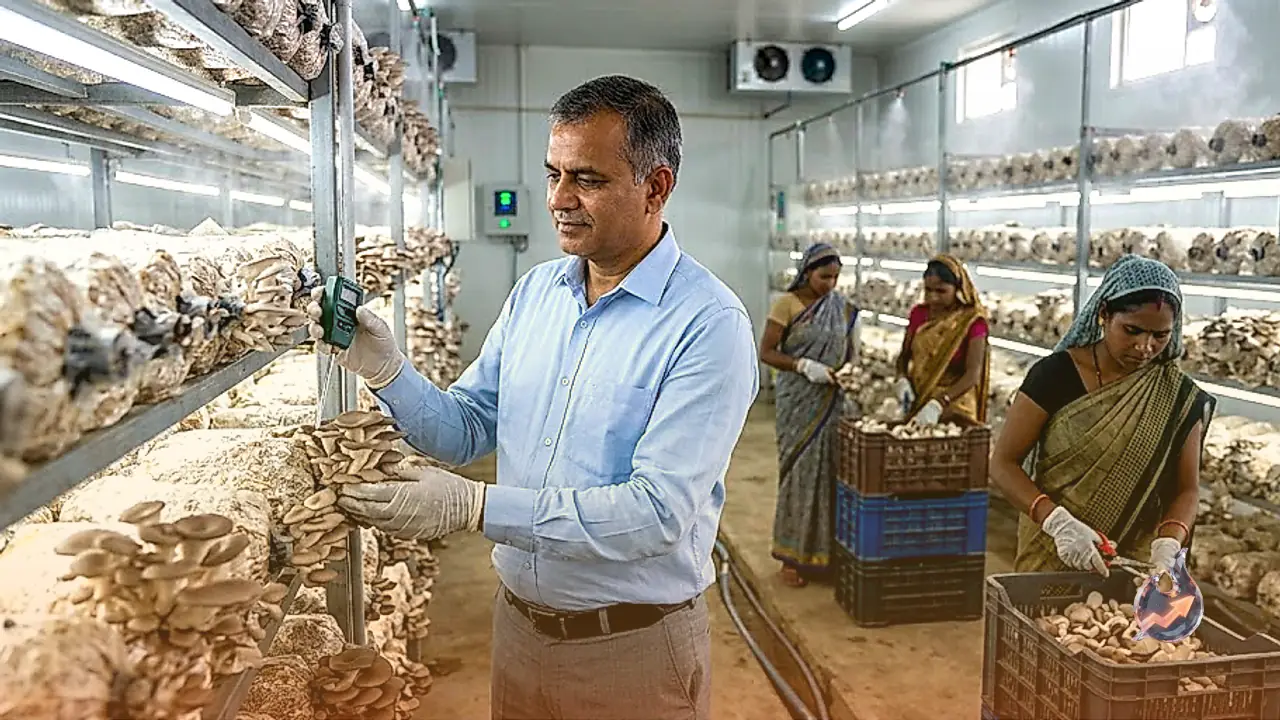

In Samastipur district of Bihar, agricultural practices are rapidly transforming from traditional farming into sophisticated, tech-driven agribusiness. Dr. Radheshyam Gupta has constructed a state-of-the-art climate-controlled mushroom production facility spanning approximately 12 to 13 kattha of land near Pusa-Vaini Road. Designed to insulate crop output from extreme seasonal weather variations, the plant utilizes a fully air-conditioned environment to maintain ideal temperature and humidity levels year-round. Financed through personal capital alongside a bank loan structured around equated monthly installments (EMIs), the venture generates a monthly net profit of up to 2 lakh rupees while providing employment to 25 local residents.
Financing a 2 Crore Rupee Facility Through Bank Loans and EMIs
Dr. Radheshyam Gupta adopted a structured financial roadmap to construct the modern mushroom processing plant. The total setup cost for the infrastructure reached approximately 2 crore rupees. Recognizing that establishing an industrial-grade unit required capital far beyond personal savings, he secured a commercial bank loan and created a manageable repayment schedule via monthly EMIs. The project was further supported by government schemes and agricultural development assistance, combining personal equity, banking institutions, and state aid.
The primary advantage of establishing a controlled indoor environment is year-round production stability. Severe summer heat and intense winter cold in northern India typically disrupt conventional mushroom harvesting. However, the climate-controlled technology within the facility regulates internal environmental parameters scientifically, enabling continuous weekly harvesting regardless of outdoor weather conditions.
Inspiration from Agricultural University Scientists
The impetus to launch this modern enterprise stemmed from Dr. Gupta's proximity to the renowned Dr. Rajendra Prasad Central Agricultural University in Pusa. Agricultural scientists and technical experts at the university frequently conduct outreach programs to motivate local farmers and young entrepreneurs toward high-tech farming and commercial agricultural ventures. Their guidance provided Dr. Gupta with the technical clarity and confidence needed to make a substantial investment in mushroom farming.
Before launching the mushroom facility, Dr. Radheshyam Gupta already possessed business experience as the operator of a local Patanjali store. Applying his background in retail management and supply logistics, he integrated mushroom production as an expansion of his commercial activities. His prior understanding of market dynamics enabled him to streamline operations and ensure efficient business management from the outset.
Weekly Output Capacities and Local Job Creation
Beyond generating individual revenue, the mushroom production facility has created tangible social and economic benefits for the surrounding rural community. The unit offers direct and indirect employment opportunities to approximately 20 to 25 local people. Out of these workers, 12 to 13 individuals are employed on a regular daily basis to handle planting, climate regulation, sanitation, and harvesting tasks.
From an operational standpoint, the facility boasts robust harvesting metrics, producing over 4 quintals of fresh mushrooms on a weekly basis. Marketing the harvest has proven seamless due to strong regional consumer demand. The high market absorption rate ensures that weekly yields are sold quickly without incurring storage losses or price drops.
Monthly Earnings and Opportunities for Emerging Farmers
The financial metrics of the venture highlight the profitability of high-tech indoor agriculture. After clearing all operational expenditures, labor wages, electricity charges, and bank loan EMIs, Dr. Gupta achieves a regular monthly net income exceeding 1 to 1.5 lakh rupees, with peak monthly net profits crossing 2 lakh rupees.
Reflecting on his journey, Dr. Radheshyam Gupta emphasizes that systematic planning and modern technology can redefine farming for the next generation. He noted, "If mushroom production is done in a planned manner, it can become a better option for employment and income for youth and farmers." His venture serves as a practical model for how institutional credit, scientific knowledge, and entrepreneurial initiative can convert agriculture into a lucrative enterprise.