























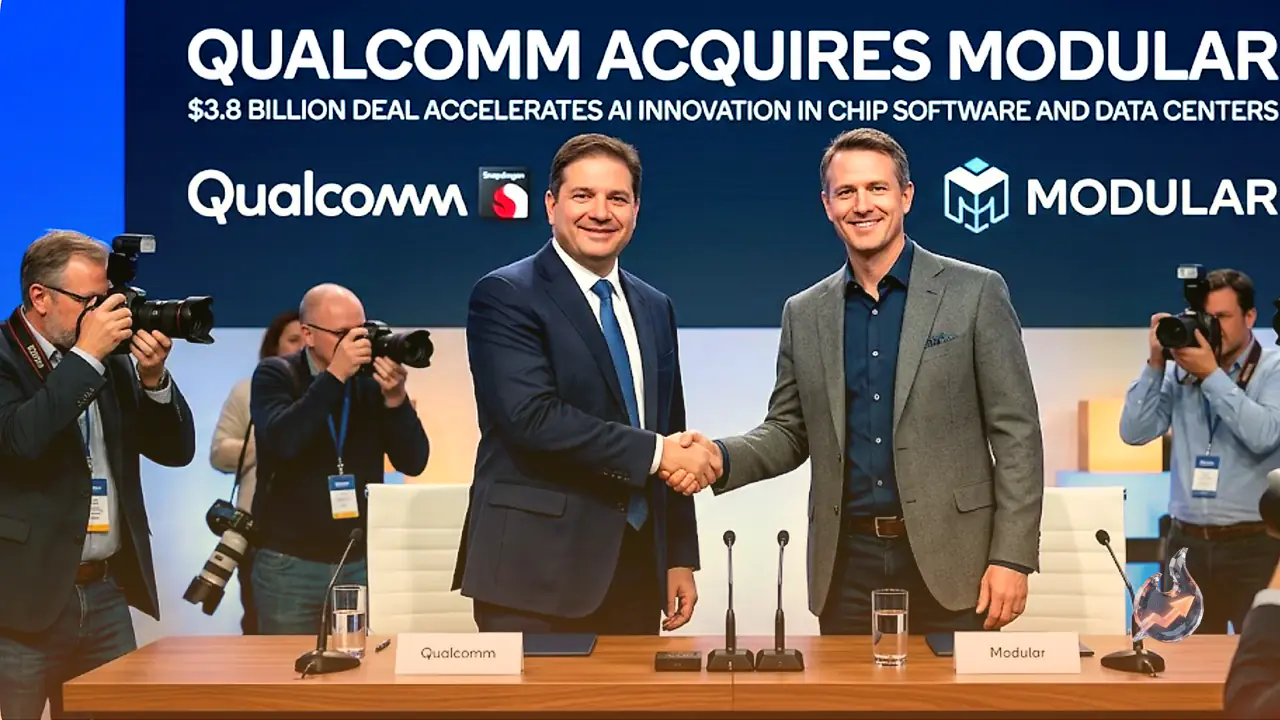

Chip giant Qualcomm is set to buy the buzzy Silicon Valley startup Modular for nearly $4 billion. Both companies announced the deal on Wednesday, with Qualcomm saying it expects to issue up to 19.2 million shares of common stock, a figure that comes to just under $4 billion based on the company's last closing share price. The acquisition is expected to close in the second half of this year.
The timing is striking: the deal lands just nine months after Modular raised $250 million at a $1.6 billion valuation.
What Modular Actually Does
Modular builds and sells a chip software platform. It also produces its own proprietary coding language that lets developers write AI software capable of running across different chips, without having to rewrite the code for each one. As part of the deal, the startup's entire team is expected to move over to Qualcomm, including its two cofounders and around 150 employees.
“We believe the future belongs to developer-friendly, horizontal platforms that can run across diverse compute environments and give customers real choice in how and where they deploy AI,” Qualcomm president and CEO Cristiano Amon said in a statement.
Looking Beyond the Phone
The acquisition is a clear signal that Qualcomm wants to grow beyond chips for the mobile device market, which still generates the vast majority of its revenue. Amon recently said the company is working on 40 different chip designs for AI gadgets, spanning smart glasses, jewelry, earbuds, pins and watches. At the same time, Qualcomm has been pushing hard into the data center market, which demands far more powerful chips.
Late last year, the company acquired Ventana Micro Systems, a startup focused on building server CPUs based on RISC-V, an open-standard chip architecture. Qualcomm is also developing custom ASIC designs, or application-specific integrated circuits, for data centers, with China's ByteDance said to be an early customer.
The Minds Behind Modular
Modular was founded in 2022 by Chris Lattner and Tim Davis. Both worked on Google's TPU chips before leaving to start their own company. Lattner's resume before Google is a storied one: he built the open source compiler infrastructure project LLVM, as well as Apple's Swift programming language. He also briefly led Tesla's Autopilot software program, a role later taken on by famed AI researcher Andrej Karpathy, who recently joined Anthropic.
Taking On the Giants, Then Partnering With Them
Lattner and Davis set out to create a unifying software layer that helps cloud businesses squeeze as much performance as possible out of GPUs and CPUs. In doing so, Modular took on Nvidia's CUDA, a closed software system for GPUs, and AMD's ROCm, which is open-source but not always easy to port to other chips.
That left Modular in an awkward spot. It eventually struck partnerships with those same big chipmakers, with hyperscalers like Amazon, and even with Apple, all while competing against them and the software they built in-house.
At the time, Lattner believed the software problem he and Davis were tackling had to be solved outside a Big Tech environment because it was “structural.” In the end, though, it was the structure of Qualcomm that won out.