

















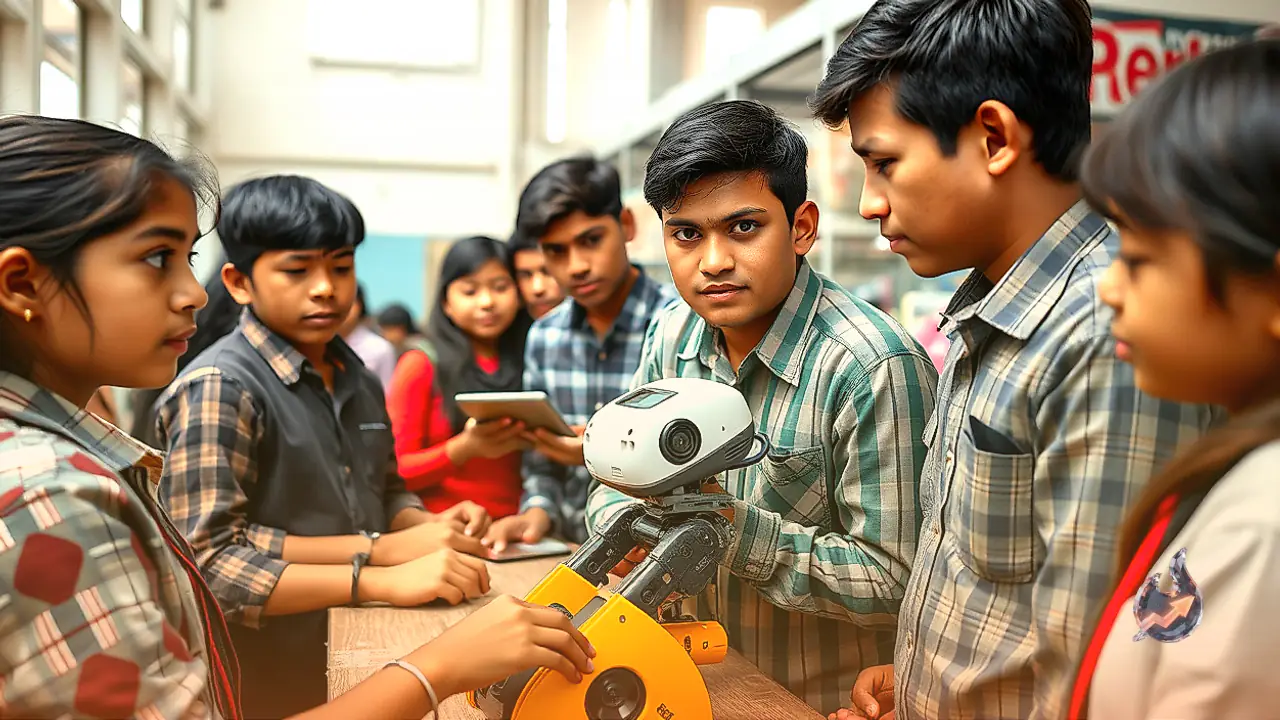

Demonstrating remarkable engineering acumen with minimal financial resources, students from the Government Polytechnic College in Purnea, Bihar, have developed an affordable artificial intelligence-driven serving robot named Nova. Designed and built by four fifth-semester electrical engineering students over the span of approximately one month, the entire machine was constructed on an extraordinarily lean budget of just ₹5,500. Standing roughly four feet tall, the robot's primary highlight is its capability to converse fluently with people in both Hindi and English, relying on an integrated AI assistant to retrieve information and address user queries.
Four-Member Student Team Completes Build in One Month
The innovative robotic assistant was conceived and assembled by fifth-semester electrical engineering classmates Aryan Kumar, Anand Kumar, Rajeev Kumar Pandit, and Shankar Kumar. According to the student creators, the development process required roughly a month of rigorous collaborative labor. Named Nova, the robot was initially developed to interact verbally and deliver contextual information, while establishing a physical and computational foundation for performing practical service-oriented tasks in the future.
Real-Time Weather Updates and General Assistance Features
Nova is capable of answering a broad range of user questions, including providing instant local weather updates upon request. Beyond meteorological queries, the robotic system can address everyday inquiries, play music or songs, and deliver diverse factual information. The development team is preparing to upgrade Nova into a full-fledged multi-functional unit. Future iterations will be equipped to handle physical tasks such as shifting packages, supplies, or items from one point to another.
Built Using Low-Cost Components and ESP32 Microcontrollers
Explaining the technical architecture of the build, the students shared that Nova incorporates a motorized driving system, navigational and proximity sensors, Bluetooth, Wi-Fi connectivity modules, a central processor, an ESP32 board, a battery pack, a microphone, and integrated AI assistant software. The defining accomplishment of the initiative is that all these electronic and mechanical modules were sourced and assembled within an aggregate budget of around ₹5,500. The creators emphasize that Nova can process user prompts across varied domains despite the strict financial constraints of the project.
Faculty Guidance Catalyzed the Project
The student engineers credited faculty member Professor Aman Kumar for inspiring the venture, noting that he originally recommended that they undertake a practical robotics project. Acting on their professor's guidance, the four students outlined their schematics and worked consistently for approximately four weeks to bring the concept to reality. Since its completion, the robot has drawn widespread enthusiasm and interest across the polytechnic campus among fellow classmates and academic staff.
Potential Deployment from Rail Terminals to Healthcare Facilities
The student creators expressed optimism that with adequate technical mentorship and financial backing from the government or external organizations, the Nova platform could be scaled up for commercial and institutional environments. Potential deployment venues cited by the creators include railway stations, hospitals, shopping malls, corporate offices, restaurants, and parcel delivery operations. The ultimate vision driving the project is to build an assistive technological framework that eases human labor while satisfying routine communication and service demands.
Principal Commends Innovation and Urges Patent Support
Dr. Professor Mohammad Latif, Principal of Government Polytechnic College, lauded the student team for their ingenuity and practical problem-solving. He noted that the college serves as a dynamic launchpad for technical aptitude where students regularly construct inventive prototypes. The principal highlighted how the team managed to deliver a fully conversational bilingual robot on a remarkably low expenditure. Wishing the young inventors success in their upcoming academic and professional endeavors, he stressed the importance of scaling such engineering initiatives and formally requested government support to help the students secure an intellectual property patent for their project.