


















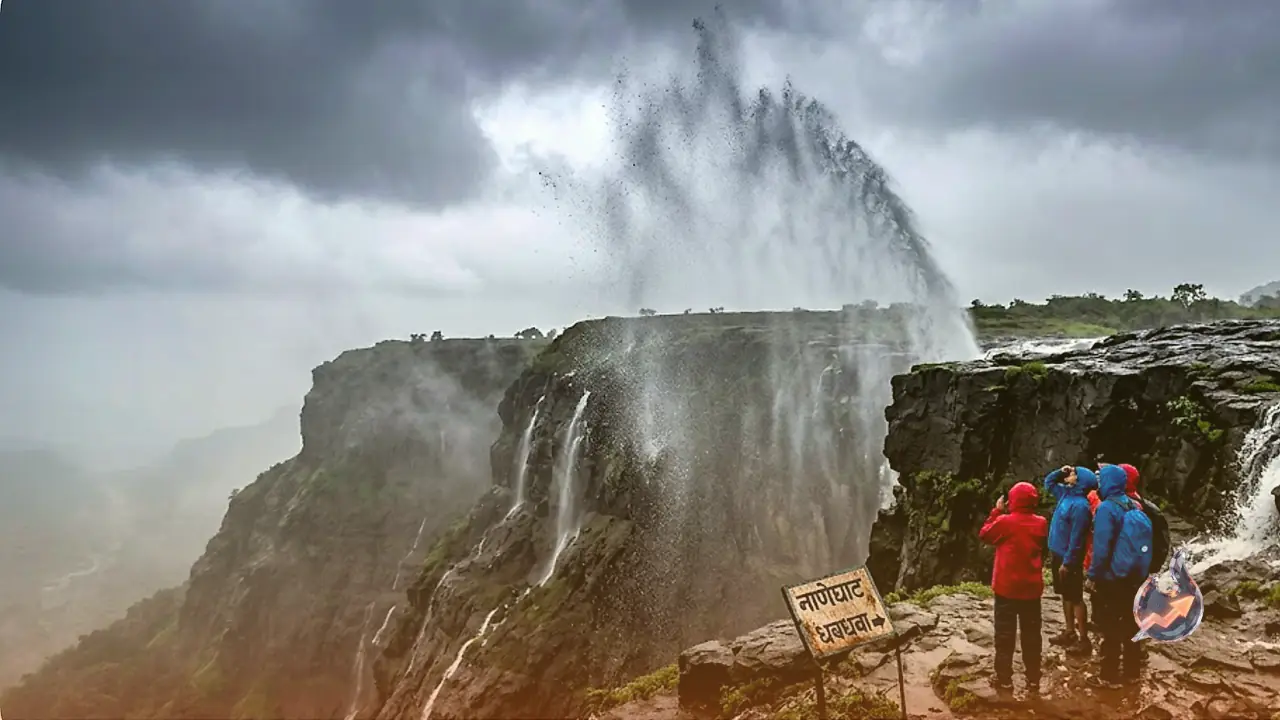

In the monsoon months, a mountain pass in Maharashtra's Western Ghats turns into one of the state's strangest natural spectacles: a waterfall whose water appears to shoot upward into the sky instead of falling to the ground. The spot, known as Naneghat, has earned itself the nickname "Reverse Waterfall" because of this optical illusion, and every year visitors seeing it for the first time mistake it for something supernatural, even though the explanation is entirely physical. Clips of the phenomenon spread quickly on social media every monsoon, with viewers sharing them in disbelief.
A 2,000 Year Old Trade Route Turned Trekking Hotspot
Naneghat is an ancient hill pass that sits between Maharashtra's Pune and Thane districts. Historians trace its origins back nearly 2,000 years, and during the Satavahana era it served as a trade route connecting the region. Today the pass is known for trekking, thick greenery and dramatic monsoon views, but it is the reverse waterfall that draws the biggest crowds once the rains set in. Seen from a distance, the water genuinely looks like it is flying upward toward the sky instead of tumbling down the rock face, and the moment someone captures it on camera, the clip almost always ends up circulating online.
It Isn't Gravity Defying Itself, It's the Wind
The upward flying water has nothing to do with any change in gravity. The real cause is wind pressure. During the monsoon, wind speeds on Naneghat's high ridges can climb to 40 to 60 kilometres per hour, sometimes even higher. When the waterfall's water starts falling from a height, it breaks apart into fine droplets. Winds moving at that speed catch these light droplets before they can hit the ground and push them upward and backward instead. That creates the illusion that the entire waterfall is flowing in reverse. In reality, the water is still falling downward the whole time; it is only the fine mist of droplets that gets carried upward by the force of the wind. It is much the same effect as raindrops being blown sideways or backward in a strong storm, except here it happens to an entire waterfall at once, which is what makes the sight so striking.
Why the Illusion Only Shows Up During Monsoon
This reverse flow effect is not visible all year round. It appears mainly between June and September, the core monsoon months, because that is when both conditions needed for the illusion line up at once: the waterfall carries enough volume of water, and the Western Ghats see sustained high speed winds. If the wind slows down or the rain stops, the waterfall simply falls the normal way, straight down. That makes timing crucial for anyone hoping to witness the phenomenon in person, since arriving outside the right weather window means going home without seeing it at all.
A Magnet for Trekkers and Photographers Every Year
Thousands of tourists and trekking enthusiasts head to Naneghat every monsoon season specifically to see this. The combination of lush green valleys, cloud wrapped hills and a waterfall that seems to defy its own direction makes the location a favourite for photography and videography. That is also why clips of Naneghat's reverse waterfall go viral on social media year after year, with many viewers assuming they are looking at a miracle rather than a straightforward case of wind speed overpowering falling water droplets. At its core, the entire spectacle comes down to a simple physical tug of war between wind speed and gravity, one that resets itself every monsoon.