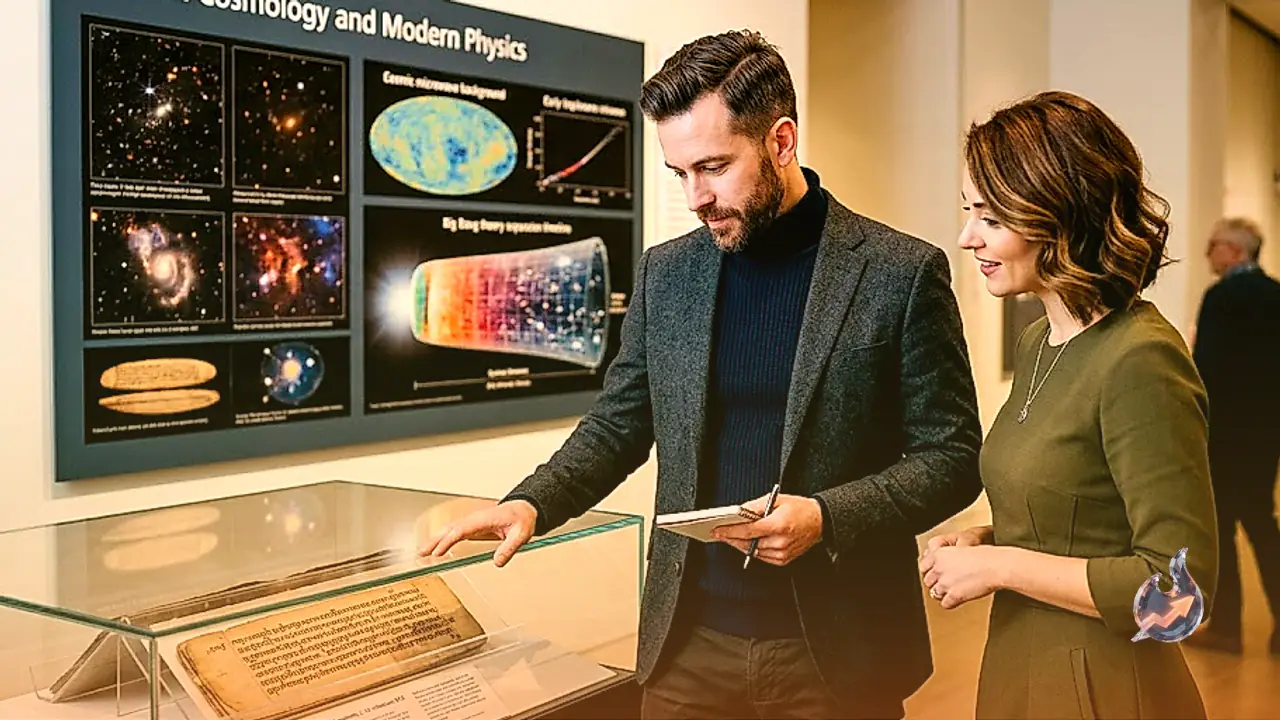























The origin of the universe and the inception of this vast cosmos have perpetually remained subjects of immense fascination for human civilization. The endless twinkling stars scattered across the night sky and countless celestial bodies only deepen this profound curiosity. The foremost question that naturally arises in every inquiring mind concerns the fundamental origin of these stars, planets, and the entire universe itself. While contemporary astronomy and astrophysics continuously strive to find definitive answers through scientific methods, Manusmriti, composed approximately two and a half millennia ago, offered detailed insights into these complex matters.
Manusmriti is widely regarded as one of the ancient foundational texts of the world, containing references to numerous unresolved mysteries of the cosmos. Interestingly, the majority of assertions made in this classical text align remarkably well with modern scientific theories. The opening chapter of the text provides a detailed, philosophical, and sequential description of the state of affairs prior to creation and the subsequent developmental stages of the universe. Chapter one comprises a total of 119 verses, out of which 27 verses ranging from verse 5 to 31 specifically elaborate upon the formation of the cosmos, the manifestation of elemental forces, and the origin of living beings.
Describing the primordial phase prior to creation, the text notes that the entire universe was enveloped in absolute darkness. During that initial state, nothing was knowable, nor did any distinctive features or characteristics exist. The condition was beyond logical comprehension, appearing as though everything was immersed in a profound slumber. Modern cosmology has similarly established that an era known as the dark age preceded the formation of the universe, during which physical structures were entirely absent.
Continuing the chronological sequence of events, verse 8 states that the supreme entity dispelled this darkness, penetrated the subtle cosmic energy, and initially created water for the propagation of infinite living beings, subsequently planting its divine seed within it. Following this, verse 9 elaborates that the seed transformed into a massive cosmic egg, possessing a radiance comparable to a thousand suns, referred to as Hiranyagarbha. From the expansion of this colossal golden egg, Brahma, the grandfather of all realms and the creator of the universe, manifested himself.
Detailing the process of division and cosmic expansion, verses 12 and 13 explain that Lord Brahma first bifurcated the primeval egg. When Hiranyagarbha split into two halves, the upper portion formed the celestial sphere and heaven, while the lower portion constituted the earthly realm. The intermediate space between these two halves accommodated the expanse of the sky, the eight cardinal directions, and the permanent reservoirs of water including oceans and rivers. Subsequently, the creator formed the mind, ego, the five fundamental elements comprising earth, water, fire, air, and ether, alongside all living creatures.
This ancient concept of Hiranyagarbha and the cosmic egg mentioned in Manusmriti corresponds closely with the modern scientific theory of the cosmic egg. Noted scientist Georges Lemaitre proposed a theory regarding the origin of the universe, designating it as the primordial atom or cosmic egg. According to his scientific framework, the universe before its formation was confined to an infinitely dense point, which the ancient text conceptualizes as Hiranyagarbha.
The Big Bang theory remains the most widely accepted scientific explanation concerning the formation of the universe. According to this model, the cosmos originated approximately 13.8 billion years ago from a powerful and dense singularity. Prior to that momentous event, neither space nor time existed in any recognizable form. The universe was compressed into an infinitesimally small and dense point, which underwent a massive explosion, thereby initiating creation and driving the continuous expansion of space and time.
According to contemporary particle physics and cosmology, the occurrence of the Big Bang generated primary energy particles such as plasma and fundamental gases. During this foundational event, fundamental forces and matter separated from one another. Much like the splitting of the singularity or Hiranyagarbha, the subsequent expansion of space and matter commenced immediately. The birth of space and directional dimensions occurred strictly in the aftermath of this cosmic explosion, rendering the operation of physical laws possible.
These established scientific principles find deep resonance with the opening chapter of Manusmriti. The ancient text asserts that the construction of the universe did not occur through random chance. Instead, the process began with the division of the singularity or Hiranyagarbha, followed by the establishment of space-time and directional coordinates, and ultimately culminated in the condensation of energy and subtle elements into gross matter. This evolutionary sequence closely parallels the developmental framework of modern Big Bang cosmology and quantum physics.