


















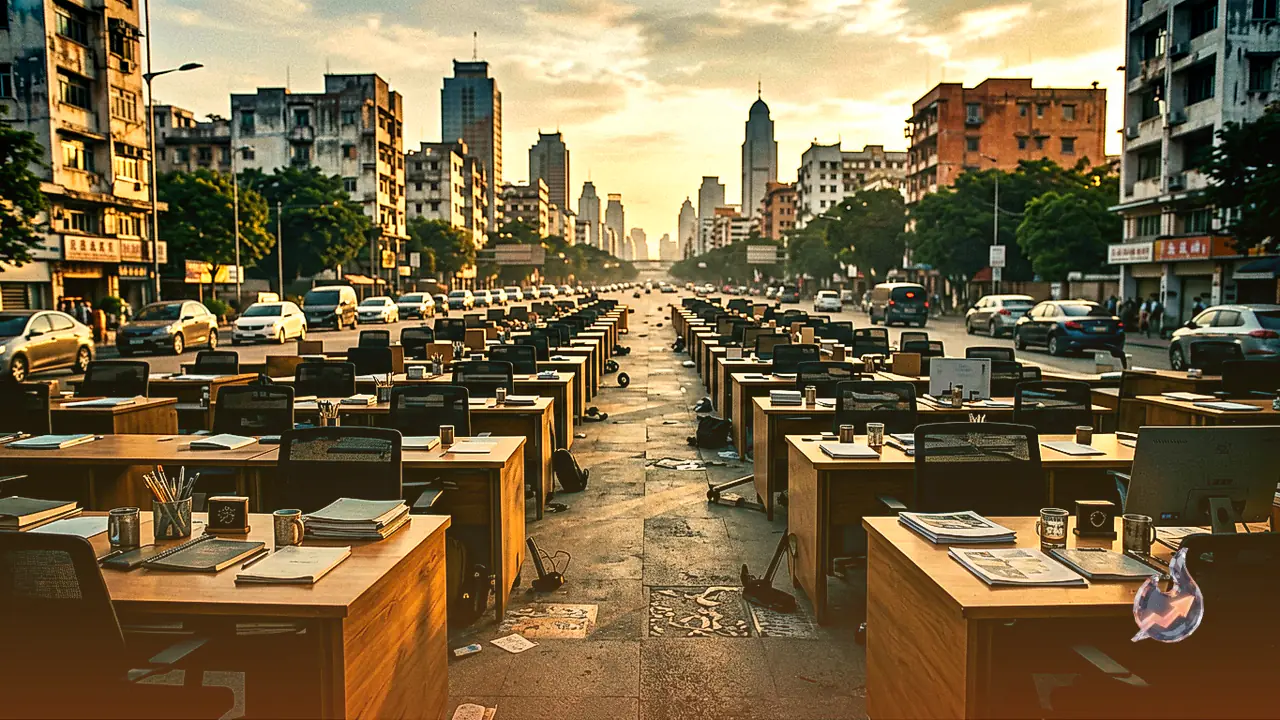

It is 10:15 AM in Bengaluru, widely recognized as the Silicon Valley of India, yet most chairs inside a prominent city office remain entirely unoccupied. This morning quietness is not the result of employee laziness or lack of dedication, but rather a testament to the exhausting daily battle workers face on congested roads. Bala Panneerselvam shared this harsh reality on the social media platform LinkedIn, posting a visual of empty desks that has quickly gone viral and sparked an intense discussion on urban transit efficiency.
Mental Drain Before the Workday Starts
In his widely shared post, Bala Panneerselvam emphasized that delayed office arrivals stem from logistical nightmare rather than poor employee intent. The primary obstacle is the excessive time wasted in gridlock combined with the severe mental fatigue accumulated during the journey. Commuters are forced to navigate relentless blaring horns, erratic two-wheeler drivers making sudden turns, and crawling lines of traffic before even reaching their workstations. By the time an employee steps into the office after such a grueling ordeal, most of their focus and energy has already been dissipated, making peak cognitive performance and creativity virtually impossible throughout the day.
Covering Just 4 Kilometers Takes 30 Minutes
The severity of urban congestion is vividly apparent in prominent technology corridors like HSR Layout. Traveling a distance of merely 4 kilometers in this locality requires roughly 20 minutes on a two-wheeler scooter, while car commuters spend at least 30 minutes. During peak commuting hours, an additional 10 minutes is routinely added to this brief journey. Beyond the time loss, navigating through chaotic intersections where drivers frequently disregard traffic signals demands constant hyper-vigilance. The pervasive noise pollution experienced along the route leaves commuters thoroughly drained, ensuring that their mental freshness is totally shattered upon arrival.
A 17 Kilometer Journey Stretched Across 2 Hours
Illustrating the unpredictability of city roads, Bala detailed a specific personal experience when traveling from Whitefield to HSR Layout, a span of 17 kilometers. Departing at 4 PM on an ordinary day, there was no rush-hour surge, no rainfall, and no traffic accidents along the corridor. Despite these ideal conditions, completing the 17 kilometer trip took an astounding 2 full hours. Leaving work at 5 PM leaves professionals so physically spent by the time they reach home that personal life and relaxation are compromised. Sleeping late due to delayed home arrivals creates a recurring cycle that guarantees late arrivals the following morning.
Erosion of Workplace Innovation and Productivity
The uncontrollable traffic situation in Bengaluru is no longer just a transportation hassle; it is actively eroding the cognitive capacity and productivity of tech workers. When an individual's mental state is constantly bombarded with noise and frustration, the capacity for strategic thinking and innovative problem-solving drops significantly. Bala maintained that resolving this systemic crisis is entirely feasible, noting that several densely populated global metropolises have successfully implemented robust urban planning solutions to transform their transit networks.
Strengthening Transit Infrastructure and Dedicated Lanes
Addressing these commute challenges requires actionable solutions and structural commitment. Bala proposed curtailing the volume of private automobiles on city roads while significantly expanding public transportation networks. Constructing dedicated bicycle lanes on narrower roads could offer a viable alternative for short-distance travel. Furthermore, until physical infrastructure is appropriately upgraded, restricting heavy vehicles, commercial trucks, and cabs from entering narrow congested streets during peak hours is essential. However, implementing such decisive measures remains complicated due to a lack of political initiative and an urban economy heavily reliant on car and auto sales.