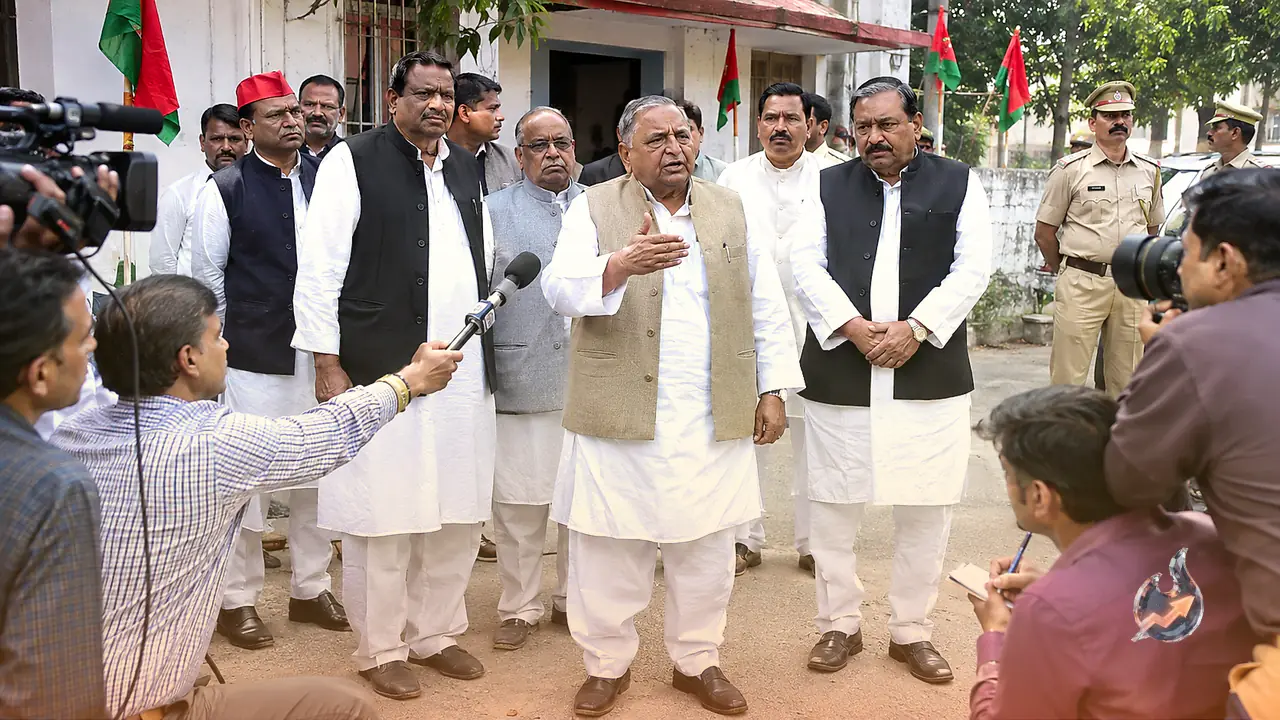






















With the 2027 Uttar Pradesh Assembly elections on the political horizon, fresh electoral equations are beginning to reshape the state's political arena. On November 12 in Lucknow, All India Majlis-e-Ittehadul Muslimeen (AIMIM) chief Asaduddin Owaisi and Azad Samaj Party (Kanshi Ram) president Chandrashekhar Azad formally announced their alliance under the banner of the Samajik Parivartan Morcha. Within twenty-four hours of this declaration, the newly formed front put its political strategy into motion on the ground. Chandrashekhar Azad, designated as the coalition's chief ministerial face, bypassed Bahujan Samaj Party supremo Mayawati and directed his initial political offensive straight at Samajwadi Party chief Akhilesh Yadav.
The controversy gathered momentum after Chandrashekhar Azad made sharp remarks regarding senior Samajwadi Party leader Azam Khan, who remains behind bars. Addressing the situation, Chandrashekhar stated that everyone is well aware of who is responsible for Azam Khan being in prison today. He argued that certain forces merely maintained a transactional relationship with Azam Khan for votes, only to remain completely silent when the time arrived to stand up and fight for his legal and constitutional rights. Signalling his upcoming steps, Chandrashekhar indicated that he plans to visit Azam Khan in prison and present his grievances directly to the public.
Targeting the Dalit and Minority Pillars of the PDA
Political observers view Chandrashekhar Azad's remarks as a direct challenge to Akhilesh Yadav's core PDA formula. During the 2024 parliamentary elections, the Samajwadi Party achieved significant electoral success by mobilizing this coalition, structured around the backward classes (Pichhda), Dalits, and minorities (Alpsankhyak), primarily Muslims. While party leadership has periodically offered varying interpretations of the formula, the combination of Dalit and Muslim support proved to be a decisive electoral engine. The alliance between Chandrashekhar Azad and Asaduddin Owaisi is expressly designed to appeal to these two exact voting blocs.
Chandrashekhar Azad has carved out a distinct profile within aggressive Dalit youth politics, while Asaduddin Owaisi consistently argues for autonomous political representation for Muslims rather than reliance on mainstream regional parties. Invoking Azam Khan goes beyond offering personal sympathy to an incarcerated veteran; it serves as a calculated appeal to Muslim voters regarding party loyalty during moments of political adversity. By questioning how firmly mainstream organizations defend prominent minority figures facing legal distress, the new alliance is attempting to detach the Dalit and minority elements from the broader PDA architecture.
Azam Khan's Current Custody and Legal Proceedings
The political resurfacing of Azam Khan coincides with ongoing enforcement actions against him. Azam Khan is currently lodged in Ghaziabad's Dasna Jail. On October 31, the Enforcement Directorate (ED) formally arrested him in connection with an alleged money laundering investigation linked to the Maulana Mohammad Ali Jauhar University. On November 12, the agency secured four days of custody remand from the court to conduct interrogations. Investigators have alleged that public funds and state assets were misappropriated in connection with financial transactions involving the university establishment.
Amid these developments, Azam Khan was brought to Delhi for questioning by the central investigative agency. Reports also surfaced that Samajwadi Party leader Shivpal Yadav sought to visit Azam Khan upon learning of the developing Owaisi-Azad front, though the scheduled interrogation and custody arrangements complicated direct interactions. The legal hurdles surrounding Azam Khan continue to form the backdrop against which multiple parties are positioning their outreach to his political constituency in Rampur and surrounding districts.
The Samajwadi Party's Defense and Jailhouse Meetings
In response to recurring scrutiny over its loyalty to Azam Khan, the Samajwadi Party points to its leadership's direct outreach. On the 23rd of last month, Samajwadi Party chief Akhilesh Yadav travelled to Rampur jail to meet Azam Khan in person. Following that meeting, Akhilesh issued a public statement asserting that Azam was, is, and will remain an integral leader for the party. He characterized the extensive list of cases filed against Azam Khan as a politically motivated conspiracy orchestrated by the ruling dispensation.
During that visit, Akhilesh also stated that the two leaders discussed electoral strategies for the upcoming 2027 Uttar Pradesh Assembly polls. The Samajwadi Party maintains that it has continuously offered public and moral backing to Azam Khan, refuting claims of political abandonment. By asserting that Azam Khan remains a central figure within its ranks, the party has attempted to insulate itself against charges that it deserted its most visible Muslim leader during his legal ordeals.
Owaisi's Sharp Accusations Against SP Leadership
Asaduddin Owaisi has repeatedly criticized the Samajwadi Party's treatment of Muslim voters, accusing the party of treating the community as an electoral buffer without granting genuine decision-making power. During a public rally in Rampur held in October, Owaisi specifically raised Azam Khan's ongoing plight to challenge Akhilesh Yadav. Owaisi has also made direct accusations against Akhilesh Yadav, claiming that he keeps his money in London.
According to Owaisi, Muslim voters have consistently backed the Samajwadi Party during state and national elections, yet the party confines them to ground-level campaigning rather than conceding substantial leadership roles. Azam Khan retains significant regional sway across Rampur and adjoining districts of Western Uttar Pradesh. Should the Owaisi-Azad front successfully channel dissatisfaction among Azam Khan's followers regarding the Samajwadi Party's handling of his circumstances, any resulting fragmentation of Muslim and Dalit votes could directly benefit the Bharatiya Janata Party in the 2027 contest.