




















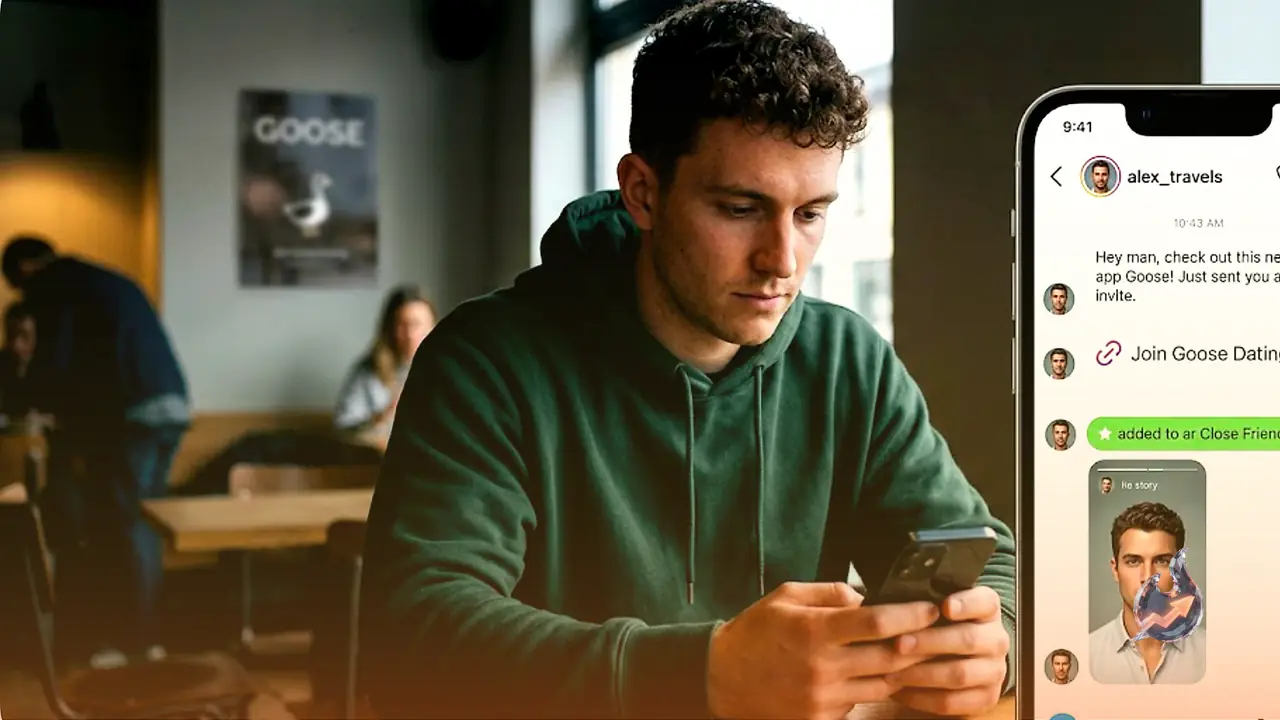

A curly haired, neatly mustachioed man appeared to be floating happily on the water in an Instagram Close Friends Story posted from the handle @miles.sumrall, with a caption promising an exclusive invite to a new "members only community." The invite led straight to Goose, a dating and friendship app built for gay men that carries the slogan "for the boys" and promises, according to its website, to let users "meet guys through the life you already have." There is just one catch: the man who sent that invitation does not appear to be a real person.
A profile that fails every authenticity test
The @miles.sumrall account is not alone. A second account, @danielmmulugeta, shared the exact same caption and invite code with its own Close Friends list. Both accounts were set up in May 2026, both carry fewer than ten posts, and both follow far more people than follow them back, a common giveaway of accounts built for outreach rather than genuine use. Running the two profile photos through AI Image Detector software returned better than 90 percent confidence that the images were artificially generated. A separate SynthID check inside Google Gemini, a tool built to flag AI made imagery, concluded that "most or all of" both Miles' and Daniel's profile photos were produced with Google AI.
The company behind the app
Goose was built by model turned influencer Derek Chadwick alongside David Aliagas, who previously worked in growth and community management at BeReal. The pitch is that Goose is a warmer alternative to Grindr, aimed at gay men looking for something longer lasting than a hookup. When the app was first announced, plenty of people doubted that framing. "Goose is basically Pokemon Ho," one X user joked at the time. Whatever the skepticism, interest was strong enough that after Goose launched last Thursday it climbed to number four in the App Store's free lifestyle downloads chart, and it currently sits 33rd among lifestyle apps worldwide. Accounts like @miles.sumrall pushing the app into private Stories and DMs appear to have helped drive a meaningful share of that traffic.
More than two dozen matching accounts
Screenshots of Miles and Daniel's posts were shared on X by a user going by @pspthe2nd, who claimed the app was using "AI models to promote fake interest #goose." That claim lines up with a much bigger pattern: more than two dozen similar accounts have been identified, all created in May or June 2026, each carrying just a handful of posts, a classic marker of inauthentic activity. The accounts also cross pollinate each other's feeds, liking and commenting on one another's photos with the same recurring heart and fire emojis.
Ryan Cheam, an account executive who works in marketing and public relations, first noticed a strange new follower named @alistaircrombbie about a week ago. The bio claimed a job in public relations at a well known art gallery, so, as Cheam put it, "I thought he was just a normal gay guy." Suspicion set in once Alistair sent a direct message inviting him into a "curated network of guys" through Goose, invite code attached. A SynthID scan of Alistair's profile photo again found that "most or all" of it had been generated using Google AI.
The messages land in strangers' inboxes
Not every account waits for someone to notice a Close Friends invite. Some go straight to direct messages, as happened to Dalton Bauer, who works in marketing and received a message from an account called @lucalepkowski. "Hey! Okay this might feel random but felt you'd be interested :)," the message opened, before steering Bauer toward the Goose community, using phrasing almost identical to what Cheam had received from Alistair. Bauer was not charmed. It was the third message with that exact wording he had gotten that week, each from an account that had barely existed. "This is the first time I've seen this on Instagram, and at this scale," he said. "I think someone needs to shed light on this as it's shady and deceiving."
The @lucalepkowski account, like the others, traces back to May 2026. Its profile picture, a photo of a college aged man in khaki shorts standing on a beach and sipping from a large water bottle, scored an 80 percent likelihood of being artificially generated according to AI Image Detector software. A further pass through Google Gemini found that at least part of Luca's photo "was edited or generated with Google AI."
Paid ambassadors and a market for fake profiles
Chadwick did not answer multiple requests for comment, and no one else connected to Goose responded either. But Aliagas's own Instagram Stories point toward how the network may have been assembled. On a Story posted six weeks earlier, he wrote: "Need some help w my new app and you know I always give priority access to these opportunities to my OGs here :)." He laid out an "ambassador role" that required managing three Instagram accounts for four hours a day over more than two months, paying between $1,800 and $2,100 a month. "Familiarity with gay culture is a big +. Time to monetize ur traumas :)," he added, before signing off with, "And btw, still buying finstas [fake Instagram accounts] for $100 :)."
Three weeks ago, Aliagas posted a second call for ambassadors, this time asking for a three month commitment. "We are going big :-)," he wrote. Both Stories remain saved in his profile's highlights, filed under the heading "AMBASSADORS."
A well worn tactic that still breaks the rules
Quietly deploying AI generated influencers to push a product is nothing new. A recent Guardian investigation cited a former celebrity manager who now builds these kinds of accounts for a living, estimating that "40 percent to 60 percent of the content out there from some of the big brands" is artificially generated, and that most of it carries no disclosure at all.
That does not make it legal, according to Rob Freund, an advertising and ecommerce attorney. The Federal Trade Commission bars deceptive advertising, including brands that use AI to impersonate real people, and New York has passed its own law requiring advertisers to disclose AI generated content, with an initial fine of $1,000 for companies that skip that step. "If you are creating fake accounts for people who promote a product and explicitly creating a bunch of fake accounts that look like they are users of a product or a service to drive attention or sales to that product or service, that activity is very obviously unlawful under FTC guidelines," Freund said, adding that this holds regardless of whether the app itself is free to download. A spokesperson for the FTC declined to answer questions, saying the agency "cannot comment on a specific company's practices."
Meta, which owns Instagram, did not offer a comment either. Under its own content rules, the platform requires AI generated content to be labeled and says it will remove posts that fail to do so. But a campaign that lives largely inside private DMs and Close Friends Stories is much harder for the platform to police than public posts. Mislabeled or unlabeled AI content has a track record of slipping past detection altogether, which lets users assume that clearly fabricated accounts like @miles.sumrall's and @lucalepkowski's are genuine people.
Not everyone is convinced
Some of the people targeted are seeing through it. "On one hand I'm flattered that I'm their target audience," Cheam said. "But the need to essentially bait gay guys into signing up feels really sketchy."