





















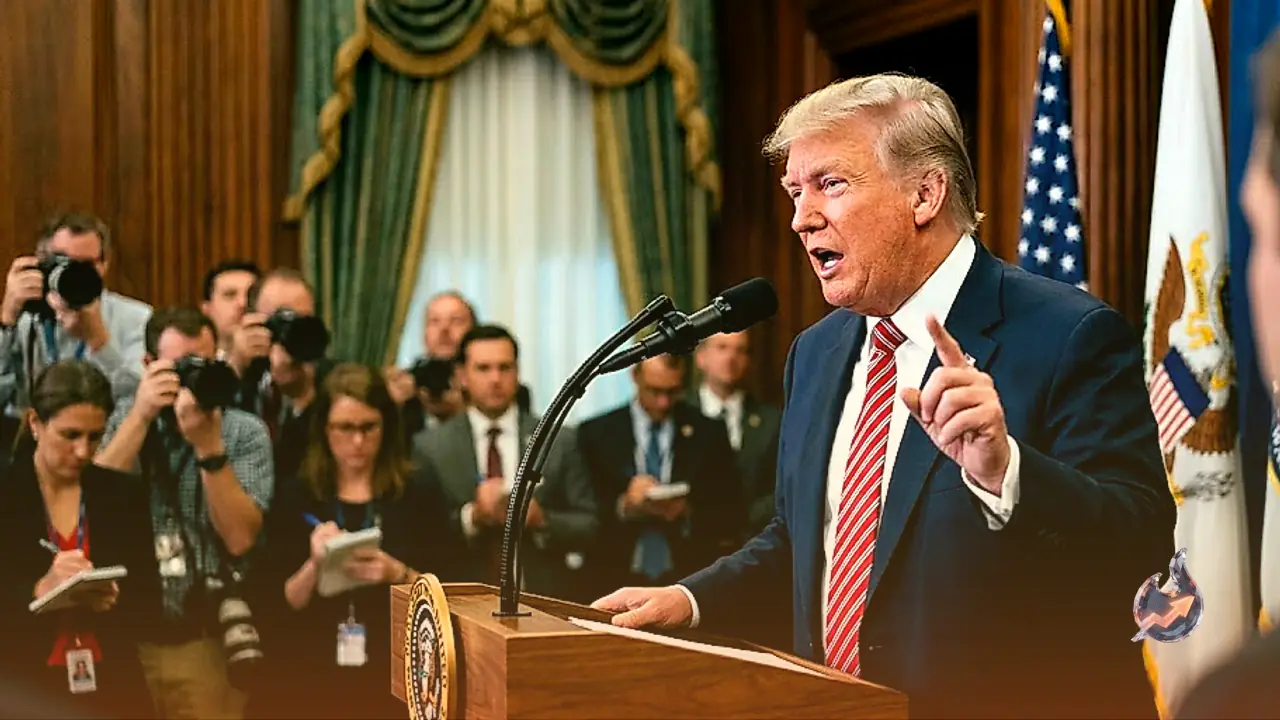

President Donald Trump has firmly pushed back against escalating debates surrounding technological safeguards, framing public and regulatory pushback as politically motivated attempts to weaken the nation. Addressing the expanding discussion around computing systems, he insisted that efforts to restrict advanced systems are artificial controversies aimed at stalling technological progress. Rather than allowing restrictions to halt innovation, he pledged direct federal backing and oversight to foster uninterrupted sector expansion.
Public Polling on New Terminology
Opening his remarks on Truth Social, Donald Trump argued that the phrase artificial intelligence feels fundamentally inaccurate and fails to capture the true sophistication of modern computing power. To address what he described as an ineloquent label, he initiated an interactive poll asking his followers to select an alternative identity for the sector. The proposed titles presented for public consideration include Superior Intelligence, Extreme Intelligence, and Supreme Intelligence, with voting remaining active among his online audience.
Pushback on Technological Opposition and Data Center Debates
Shortly after proposing the renaming effort, Donald Trump expanded on his stance by asserting that campaigns directed at dismantling or decimating advanced computing are part of an established pattern of political hoaxes. He drew direct comparisons to past national controversies, claiming that current opposition represents a continuation of partisan tactics. In his account, this pattern began with organized resistance against data centers, which subsided once regional populations recognized the immense financial wealth and status these facilities deliver to their host communities. With initial resistance weakening, he contended that critics have now shifted focus toward attacking the underlying technology itself.
Infrastructure Battles Across State Jurisdictions
While Donald Trump offered no specific documentation to substantiate claims that skepticism toward data center expansion lacks genuine civic roots, regulatory scrutiny has crossed traditional political lines. Demonstrating this trend, New York recently established a precedent by becoming the initial state to halt permitting procedures for large-scale data facilities. These developments align with observations he shared at a golf tournament the prior weekend, where he noted a willingness to consider structural boundaries while cautioning that opposing factions are magnifying concerns without merit.
Establishment of an AI Force and Administrative Leadership
Outlining proactive administrative measures, Donald Trump committed to nurturing and defending computing infrastructure as it scales. As part of this strategy, he announced plans to introduce an AI Force modeled after the Space Force established during his initial presidential term. Additionally, he indicated that an official appointment for an AI czar will occur in the near future, emphasizing that eligibility will be limited strictly to individuals demonstrating superior intellectual ability. The formal operational scope and institutional parameters for both the force and the czar were not detailed. Earlier in the year, venture capitalist David Sacks stepped down from his role overseeing computing and digital assets to co-chair the President's Council of Advisors on Science and Technology.
Industry Ideological Divides and Commercial Momentum
The broader debate over development speed gained renewed intensity following the high-profile departure of a researcher from Anthropic, who voiced grave warnings that leading laboratories are taking catastrophic gambles with long-term human survival. Following that resignation, Anthropic CEO Dario Amodei detailed a framework designed to manage frontier progress, a strategy that garnered tacit backing from OpenAI CEO Sam Altman and SpaceX CEO Elon Musk. Conversely, independent observers argue that speculative extinction scenarios merely divert public attention away from tangible, immediate challenges. During the All-In Summit, Nvidia CEO Jensen Huang spoke with Donald Trump, characterizing the pushback as an unfounded campaign and declaring that industry leaders will not permit any slowdown in technological development.