






















David Turturean, a recent MIT graduate and a technical staff member at the startup lab Physical Superintelligence (PSI), utilized early access to Anthropic's Fable 5.2 model to solve an 18-year-old quantum computing problem. Turturean deferred plans to pursue a master's degree at MIT's computer science and AI lab to join PSI, telling reporters that he is completely accepting the idea that this might be the final paper he ever publishes and questioning why anyone would bother putting out a paper in a few months.
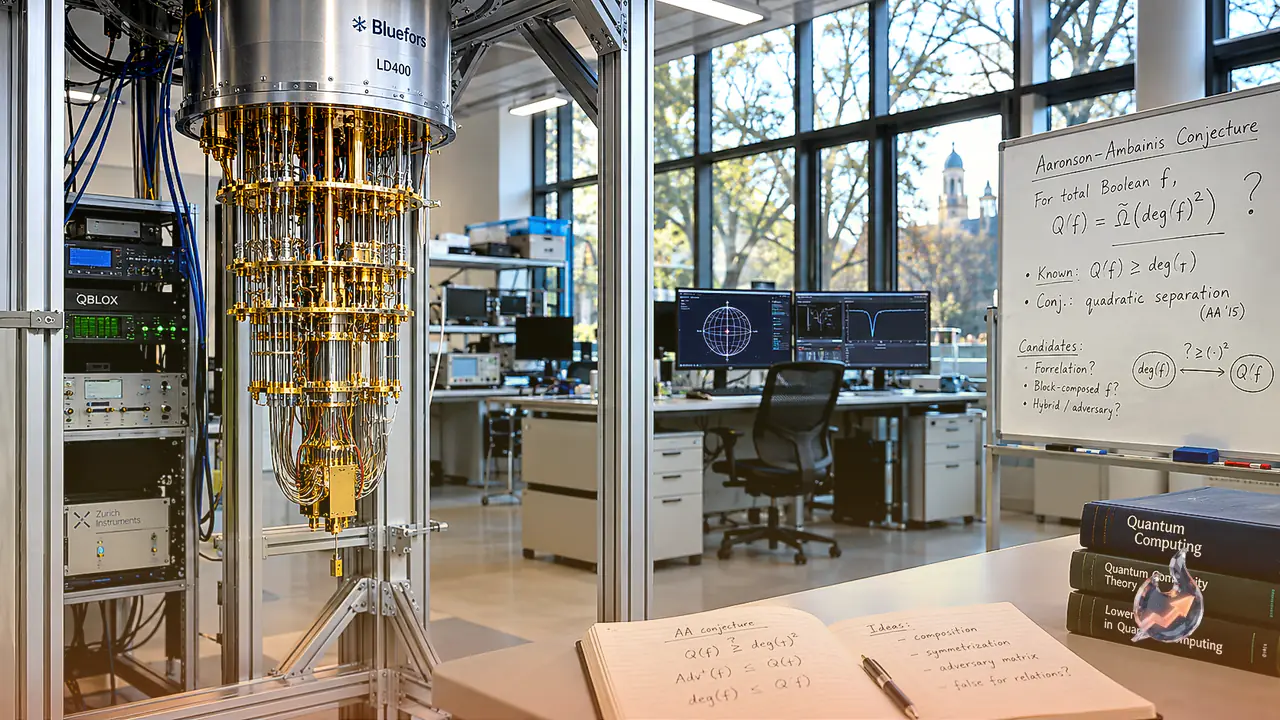
The problem in question, known as the Aaronson-Ambainis conjecture, explores the capacity of quantum computers to solve specific tasks faster than classical machines. Scott Aaronson, one of the original researchers who formulated the problem, wrote that while he does not fully understand the proof, he believes it is correct because it was autoformalized in the mathematical coding language Lean and explained by a cohort of top researchers with whom PSI shared the solution.
This solution appears to close off one potential avenue that quantum computers might have explored to solve certain difficult problems rapidly, though it leaves other pathways open. Turturean noted that it serves as a negative result letting people know they no longer need to look in that specific direction. On a broader scale, the breakthrough mirrors the significant upheaval rippling through the scientific community due to AI-driven problem-solving capabilities.
Aaronson noted that proving the full Aaronson-Ambainis conjecture was one of the final remaining open problems in quantum query complexity that experts universally agreed was critically important. Expressing a mix of satisfaction, awe, disappointment, and fatigue, Aaronson stated he was honestly surprised to see the problem omitted from OpenAI's recent Mathocalypse release, wondering if they attempted it and if it proved much harder than the solved problems.
This development underscores the core thesis behind PSI, which aims to solve scientific challenges using specialized model harnesses and scaffolding frameworks. PSI CEO Matt Pines explained that an effective research system requires a robust combination of harnesses, tools, memory systems, and simulation infrastructure to tackle problems with both breadth and depth while evaluating numerous potential alternatives.
At present, the company generates revenue by deploying its tools to optimize data centers, running simulations that account for variables including heat, power, water, and sound where performance and community impact are direct functions of physics. However, the long-term objective is translating theoretical physics breakthroughs into tangible physical technologies. Pines noted that months ago when speaking with investors, he had to stretch to validate the idea that theoretical physics would soon become largely the domain of machines, and while not fully realized yet, that future is approaching.
Despite AI achieving major solutions in fields like mathematics and computer science where concepts translate easily into validated code, replicating this success in less abstracted domains like life sciences or physics has proven considerably harder. Recently, the startup Discovered Materials announced a $1 million grand challenge aimed at researchers utilizing AI to tackle complex problems such as superconductivity and heat dissipation. Pines emphasized that physics differs fundamentally from math because it deals with the real world, meaning nature ultimately validates reality models.
Pines added that PSI focuses heavily on discovering how to take computational results and validate them through real-world experiments as efficiently as possible. Each validated fact of nature provides a trick that can be exploited to build new devices or achieve things previously impossible, forming the core innovation loops that PSI is currently constructing.
As science neolabs emerge as pathways toward potentially revolutionary discoveries, participants are still establishing the norms and standards for this uncharted territory. Because PSI had to withhold its findings until Anthropic's model was nearly ready for release, the team was able to share the solution with relevant academic experts to ensure proper peer understanding.
Jim Halverson, a Northeastern University professor and advisor to PSI, remarked that as academics they wanted to ensure proper procedures were followed, noting he will attend an upcoming MIT summit where leading physicists will discuss responses to the accelerating pace of science. Halverson added that best practices are still evolving and transparency combined with expert outreach remains the preferred approach. Turturean reflected that reading through his first AI-generated solution in print made him consider how to present the findings more naturally for human readers while fully grasping the immense weight of what artificial intelligence can achieve.