

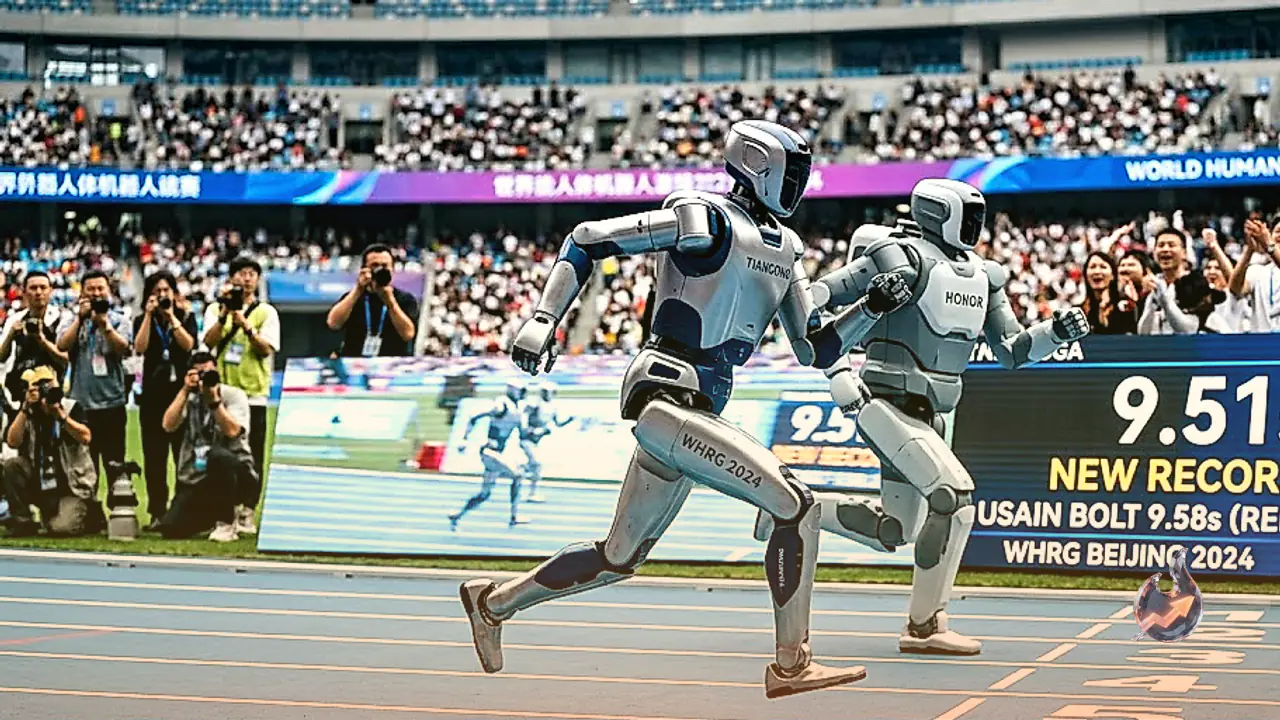






















The annual World Humanoid Robot Games officially wrapped up in Beijing on August 26, concluding five dynamic days of international technical competition that first opened on August 22. Bringing together cutting-edge physical engineering, advanced algorithmic innovations, and a memorable dose of mechanical slapstick, the tournament offered a comprehensive window into the state of modern robotics. Beyond internet-viral athletic achievements, including sprint times that eclipsed human world records, and occasional arena disasters like weightlifting attempts gone wrong, this year's edition introduced novel dexterity tests. These challenges highlighted the event's fundamental purpose: pushing competitive humanoid developers to refine systems that move steadily closer to practical real-world deployment across factories, warehouses, and daily life.
Record-Smashing Track Times and Athletic Feats
The impressive scale of the tournament was on display from the opening ceremony, where event organizers confirmed that over 600 teams participated with more than 2,000 individual robots. China alone currently boasts more than 100 specialized humanoid robot manufacturers, and the event attracted competing engineering delegations from 15 additional foreign countries. Throughout the venue, robots participated in a mix of structured contests and scored demonstrations evaluated by expert judges.
The track and field events generated the most dramatic moments of the games. The Tiangong Ultra, a high-performance machine developed by the Beijing Humanoid Robot Innovation Center, set a new milestone by completing the 100-meter dash in an astonishing 8.86 seconds. Just a few days prior, another sprinting robot named Lightning, created by smartphone manufacturer Honor, covered the exact same 100-meter distance in 9.47 seconds. Both of these electronic performances surpassed the long-standing human world record set by Jamaican sprinter Usain Bolt. Demonstrating remarkable operational versatility, the Tiangong robot also captured victory in the long jump competition with a leap of 7.97 meters, earning it a reputation as a multi-talented renaissance machine. In another corner of the arena, a specialized robot engaged in a fast-paced table tennis match directly against an Olympic champion.
Arena Slapstick, Mechanical Overheating, and Physical Limits
In addition to speed records, the competitive schedule featured humanoid robots trading punches in boxing rings, scoring goals on soccer pitches, trying to lift heavy barbells with mixed success, and executing synchronized cheerleading routines while dressed in festive costumes. Much of the entertainment stemmed from the natural human tendency to anthropomorphize humanoid movements, which rendered their balance failures particularly funny to spectators. In one widely shared incident, a robot appeared to get momentarily distracted by a nearby cheerleading display before losing its footing and tumbling over a balcony balustrade.
Underneath the lighthearted entertainment lay severe engineering realities. Numerous high-speed robots struggled when forced to come to an immediate halt, frequently blowing out their internal electric motors due to intense deceleration forces. These mechanical breakdowns demonstrated that developers are actively driving their hardware platforms to their absolute physical boundaries in order to identify structural weaknesses.
Engineering Behind the Speed: Motors and Simulation AI
While humanoid concepts have been researched for decades, recent industry breakthroughs are largely driven by compact, high-power electric motors capable of maintaining dynamic balance while moving at extreme velocities. Stefanie Tellex, a prominent roboticist at Brown University, highlighted China's remarkable manufacturing success in producing high-performance robot hardware. Companies like Unitree, which was established in the high-tech hub of Hangzhou and recently launched its initial public offering, rose to international prominence by concentrating heavily on these core motor and actuation innovations.
Alongside hardware engineering, running and leaping humanoids depend on complex artificial intelligence algorithms trained within computer simulations long before they step onto physical tracks. By exploring millions of movement permutations in virtual environments, algorithms discover optimal strategies to maintain balance and prevent falls. This simulation-based training approach explains why many running robots exhibit distinctly non-human gaits; the AI algorithms land on mathematically ideal movement mechanics that do not necessarily match the way human limbs evolved to run over millions of years.
Moravec's Paradox and the Holy Grail of Micro Precision
To tax the robots' artificial brains as much as their physical brawn, organizers introduced several new practical tasks that would seem trivial to human athletes. Competitors were tasked with plugging electrical cables into wall sockets and carefully placing pieces of garbage into a trash container inside a mock bedroom environment. Stefanie Tellex explained that training machines to manipulate objects within complex, unstructured environments represents a far more formidable challenge than having them sprint across flat surfaces or leap through the air. Developing advanced object manipulation is widely viewed as a holy grail within the robotics sector, prompting several startups in the United States to deploy sophisticated AI architectures in pursuit of a solution.
Fiddly manual skills are exceptionally difficult for robots because they involve unpredictable physical phenomena such as surface friction and microscopic slippage. Human beings possess a highly refined sense of touch, an innate intuitive understanding of physics, and the capability to make microscopic physical adaptations at lightning speed. Robots currently lack these inherent sensory capabilities. As Tellex noted, this disparity perfectly illustrates Moravec's paradox in robotics research: complex physical feats like executing backflips seem far more impressive to human observers, yet they are actually much easier for robotic algorithms to accomplish than seemingly simple tasks like inserting an electrical plug into a socket.
Factory Automation, Teleoperation, and Autonomous Feats
Observers noted an important caveat regarding the tournament demonstrations: video footage and photographs revealed that several machines were being remotely operated by human technicians using teleoperation controllers, indicating that full autonomy remains an ongoing hurdle. Nevertheless, engineers emphasized that the ability of mechanical hands to grasp tiny objects with specialized tools, even under remote human control, represents significant mechanical progress. Competitions requiring manual dexterity, such as precision block building and picking up individual beans with tweezers, reflected China's aggressive ambition to automate repetitive manual labor in manufacturing plants and distribution warehouses, such as threading wiring harnesses through automobile chassis or assembling delicate microelectronics.
Robot maker Galbot competed across multiple events, including a Supermarket Scenario Competition that required humanoids to restock retail store shelves. Yvonne Yuan, speaking on behalf of Galbot, explained that participating in these trials pushes commercial capabilities forward. She stated that Galbot intends to continuously advance humanoid capabilities by taking on increasingly difficult operational scenarios, progressing from structured lab settings toward open, unpredictable real-world environments where machines must comprehend their surroundings, adapt to changing conditions, and collaborate safely with human workers. Despite the prevalence of remote control across various events, Galbot demonstrated a striking achievement in full autonomy by showcasing a robot capable of playing a game of tennis against a human opponent, a task requiring real-time visual perception coupled with ultra-fast motor reflexes.
Public Enthusiasm and the Global Robotics Landscape
At a time when rapid advancements in artificial intelligence are generating widespread anxiety regarding potential job displacement, the World Humanoid Robot Games played a vital role in building public enthusiasm for the future of technology. Chris Atkeson, a renowned roboticist at Carnegie Mellon University, praised the event's cultural impact, observing that it is fantastic to see a nation express genuine excitement for science and engineering while maintaining an optimistic vision of technological progress. He added a note of reflection, expressing regret that the United States is not demonstrating that same level of national enthusiasm for robotics.