



















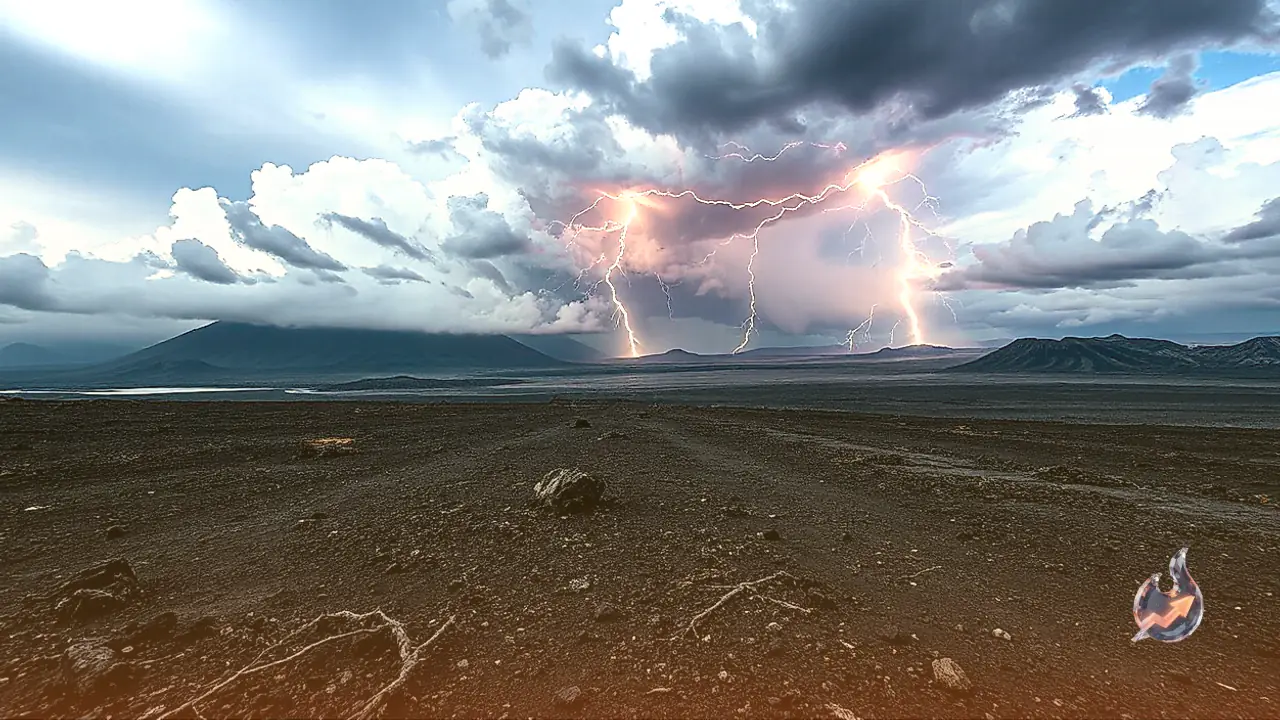

Imagine total darkness covering the sky while a massive plume of ash billows upward from a volcano, and suddenly, lightning begins to crackle right through that ash-filled cloud. As magnificent as this spectacle appears, it can be equally terrifying. This unique natural phenomenon is referred to as a dirty thunderstorm. However, a major question naturally arises about how electricity is actually generated inside the ash clouds erupting from a volcano.
How Lightning Forms Inside Ash Clouds
Whenever a massive volcanic eruption takes place, ash, tiny fragments of rocks, and various other materials are expelled outward at an extremely high speed. These particles violently collide with one another, which can lead to the distribution and separation of electrical charges among them. When positive and negative electrical charges begin to accumulate in different parts of the cloud, the potential difference between them increases significantly. A point eventually arrives when this difference triggers an electrical discharge in the air, resulting in a flash of lightning. Amidst the darkness, the flash of lightning cutting through the massive cloud of volcanic ash makes the entire scene extraordinarily unique, giving the impression that the sky itself is glowing from within the billowing cloud.
Why It Is Called A Dirty Thunderstorm
Normally, when people discuss thunderstorms, water-filled clouds immediately come to mind. In ordinary storms, water droplets, ice particles, and their mutual interactions help separate electrical charges effectively. However, the clouds formed during a volcanic eruption contain massive quantities of ash and rock particles. The collision of these solid particles can also separate electrical charges and create conditions for lightning to strike. For this exact reason, the phenomenon has been given the name dirty thunderstorm. Here, the word dirty does not imply filth or pollution, but rather refers to clouds densely packed with ash and volcanic materials.
Does Every Volcano Produce Lightning
This is certainly not the case, as lightning does not necessarily flash during every single volcanic eruption. For it to happen, the collision of ash particles, the separation of electrical charges, and specific atmospheric conditions are crucially important. If these conditions are not favorable, lightning may not be visible even if a massive plume of ash rises from the volcano. A dirty thunderstorm demonstrates that a volcanic eruption is not limited only to flowing lava and ash. The physical processes taking place between the particles rising from the eruption can also become the cause of lightning flashing in the sky. The lightning glowing within these ash clouds is not the result of any mysterious supernatural power, but rather an electrical process occurring under specific natural conditions. This is precisely why the phenomenon remains an object of fascination for scientists and a startling sight for ordinary observers.