






















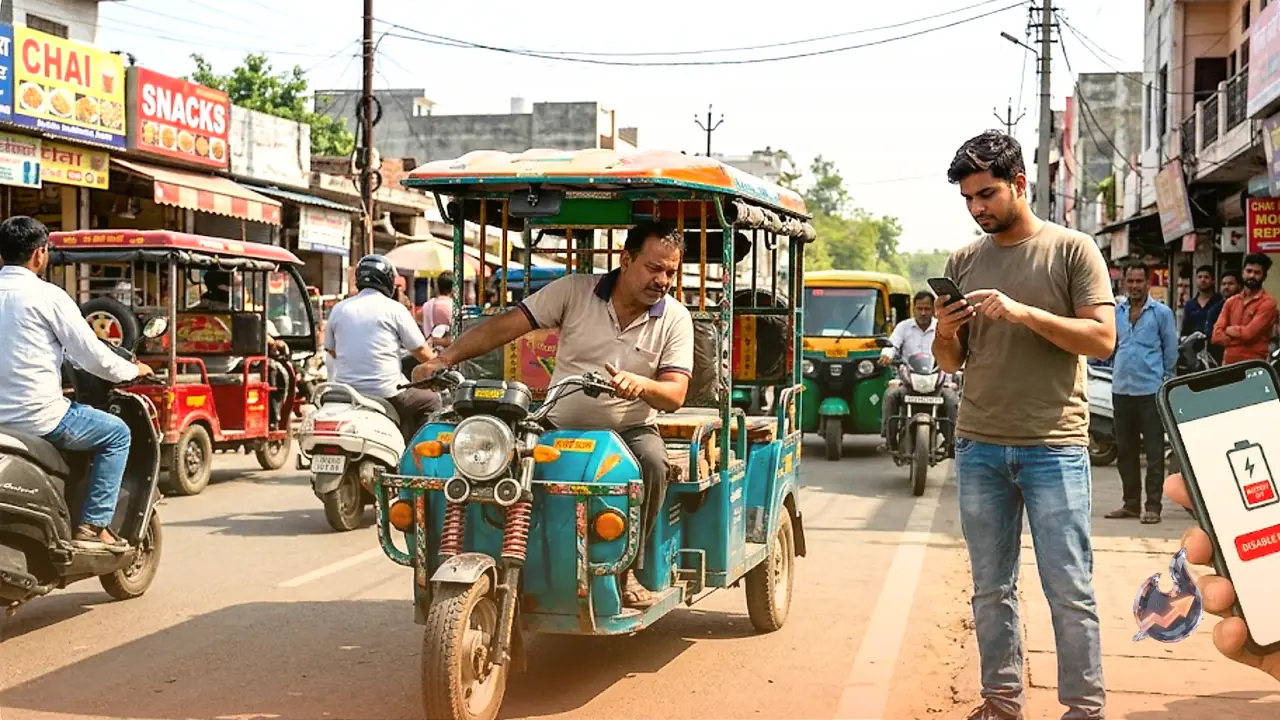

A strange trend is spreading fast on social media, where people on the street use nothing but their smartphones to bring a moving e-rickshaw to a sudden halt in the middle of the road. It looks like some kind of magic trick or high-tech hacking, but it's actually the work of a mobile app called BAT-BMS, which can cut power to a running vehicle within seconds. It may look like a fun reel to some, but it exposes a serious safety gap on Indian roads.
What the app actually does and why it stops rickshaws
BAT-BMS, short for Battery Management System, is not a hacking tool or an illegal piece of software. It's built by the Chinese company Shenzhen Grenergy Technology and is available legitimately on the Google Play Store. It was originally designed so that owners of lithium-ion batteries could use Bluetooth to track their battery's health, voltage, temperature, charging cycles and current draw. The app also includes a safety feature that lets a user turn the battery's discharge, in other words its power supply, on or off. The trouble starts when this exact feature ends up in the wrong hands. Many cheap e-rickshaws and low-speed scooters sold in India use Bluetooth-enabled BMS units, and their manufacturers never bother to set a password or any security lock on them. As a result, when someone opens the app with mischief in mind, every unsecured vehicle within a 10 to 15 metre radius shows up on their screen. All it takes is connecting to that rickshaw's battery through the app and switching off the discharge button, and the motor instantly loses power, leaving the vehicle stranded in the middle of the road.
Not a harmless prank, but a serious legal problem
Even though social media treats this as a fun prank or content for reels, it is entirely unethical and against the law. Picture an e-rickshaw or scooter suddenly dying at a busy intersection, on a flyover, or amid fast-moving traffic, vehicles coming from behind could crash straight into it. That puts the driver, the passengers riding along, and other people on the road in direct danger. Remotely taking control of someone's vehicle or property without their consent can be treated as cybercrime under the law.
Can an electric car be stopped the same way?
The biggest worry among the public, and especially electric car owners, is whether their expensive EVs could be stopped on the road in the same manner. The straightforward answer is no, that simply isn't possible. Electric cars carry far stronger security. Their electronic control units, or ECUs, and their battery packs are protected by automotive-grade cybersecurity and firewalls. That's precisely why hacking or shutting down a car through a basic Bluetooth app is not feasible.
Low-speed electric scooters are an easy target too
Just like e-rickshaws, several low-speed electric scooters sold in the market are falling prey to this same prank. The reason is simple, manufacturers keep costs down by using cheap, generic Chinese lithium battery packs. These batteries come with Bluetooth built into their smart BMS units, but their safety settings are left wide open. Pranksters simply walk up behind or alongside these scooters, connect to their BMS through the app, and cut off the power supply while the scooter is still moving.
How to protect yourself from this digital prank and hacking
If you drive an e-rickshaw or own a scooter running on a Bluetooth-enabled lithium battery, there are simple steps you can take to stay safe.
- The first and most important step is to download your battery's official app, go into its Bluetooth settings, and replace the default password, such as 1234 or 0000, with a strong one.
- If the BMS app allows it, switch the battery's Bluetooth broadcast or visibility to hidden mode so it doesn't show up on an unfamiliar phone.
- If your vehicle keeps shutting down unexpectedly, take it to a trusted mechanic or dealer and have the battery's Bluetooth module disabled until the manufacturer rolls out a security update.
- If you catch someone doing this on the road, report it immediately to the nearest police station or cyber cell, since it's a direct threat to road safety.