
























Consumer appetite across the Indian two-wheeler landscape continues to demonstrate robust momentum, reflecting a healthy blend of conventional internal combustion loyalty and rapidly expanding electric propulsion. Wholesale registration numbers reveal that legacy names still control the core volume, led decisively by Honda Activa as the undisputed benchmark for everyday family transit. Meanwhile, well-entrenched competitors such as TVS Jupiter and Suzuki Access sustained dependable upward trajectories. The most dramatic development across the industry, however, stems from the aggressive acceleration of electric alternatives, with Bajaj Chetak and Hero Vida staging triple-digit percentage gains.
Activa Solidifies Supreme Market Grip
Maintaining an overwhelming lead over all contenders, Honda Activa crossed 2,55,815 unit dispatches during the evaluated period to lock down the apex rank. When compared against the 2,44,271 units recorded in the corresponding timeframe of the preceding year, the nameplate delivered an annual expansion rate of 4.73%. This singular model captures an imposing 35.70% share of the overall scooter marketplace, underscoring its unmatched pull among prospective buyers. A reputational bedrock built on dependable mechanical smoothness, consistent operational efficiency, and steadfast resale values continues to render Activa the automatic default choice for households nationwide.
Jupiter Sustains Runner-Up Position as Access Rules 125cc
TVS Jupiter firmly defended the second rung of the sales ladder, accumulating a total volume of 1,47,450 units. This performance reflects a net addition of 5,039 units over the 1,42,411 units registered during the identical period twelve months earlier, equating to a 3.54% year-on-year advancement. With a market presence standing at 20.58%, Jupiter owes its widespread resonance to an accommodating riding posture, supple suspension calibration, and practical utility tailored to daily commuting tasks.
In the dedicated 125cc segment, Suzuki Access retained commanding popularity, logging 69,558 units to secure the third overall position. This represents a solid 14.39% increase from the previous baseline of 60,807 units, lifting its market slice to 9.71%. Daily urban office-goers frequently opt for Access due to its approachable curb weight, classic body lines, responsive throttle delivery, and refined powertrain engineering.
Electric Powertrains Display Dramatic Volume Spikes
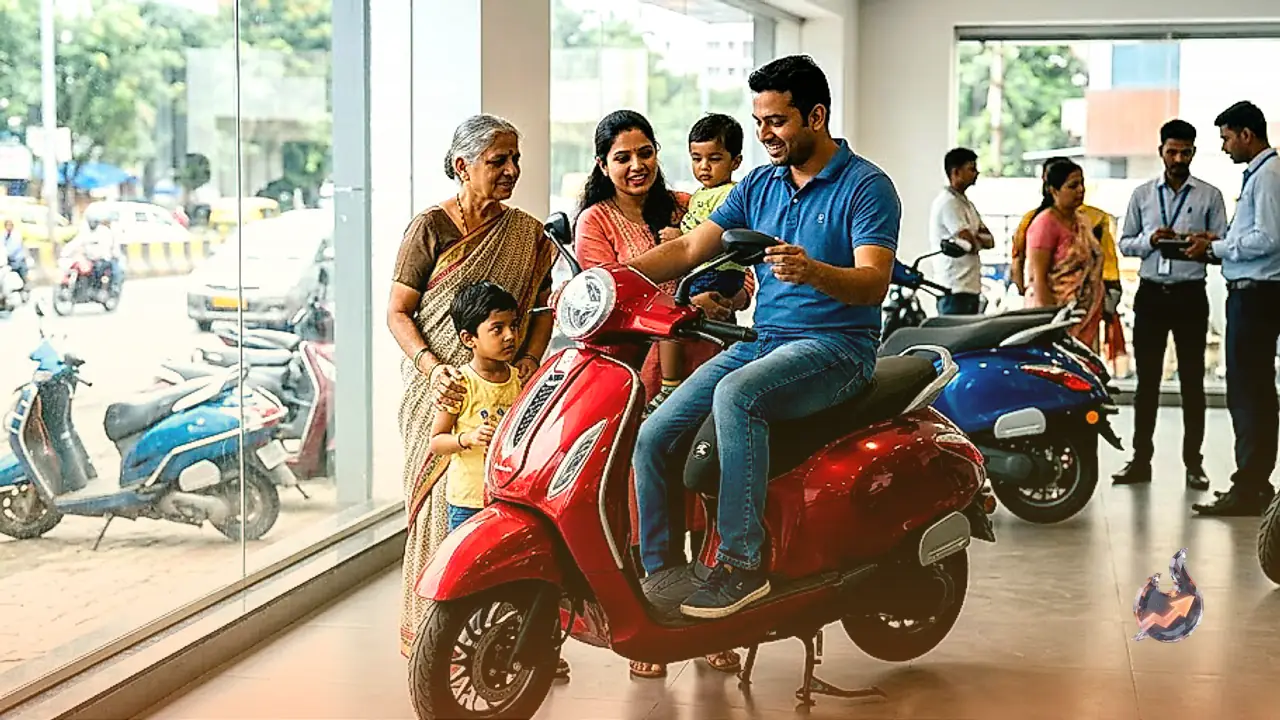
The transition toward zero-emission urban transport produced the most dramatic shifts in ranking, characterized by a phenomenal leap by Bajaj Chetak into fourth place overall. Expanding from a modest 14,014 units a year prior, Chetak deliveries escalated rapidly to 52,248 units, translating into a 272.83% annual surge. The model now controls 7.29% of the collective market. Chetak's robust sheet-metal structure, blended with timeless heritage aesthetics and contemporary digital connectivity, has played a pivotal role in converting mainstream users toward electric mobility.
Similarly, TVS iQube demonstrated sustained traction by capturing fifth place with 42,882 delivered units. Compared to the 24,434 units dispatched during the prior corresponding timeframe, the scooter locked in a 75.50% annual expansion, commanding 5.98% of overall sector volume. Buyers have responded favorably to its conventional family styling, dependable range metrics, intuitive TFT instrumentation, and unhurried road manners.
Youth-Focused Nameplates Capture Spirited Demand
Geared towards the preferences of younger riders and college-going demographics, TVS Ntorq turned in an energetic performance. Registering 40,256 sales units, Ntorq posted a noticeable 32.62% growth curve over the earlier tally of 30,355 units, commanding a 5.62% volume stake. Sharp exterior angles, an assertive exhaust note, Bluetooth integration, and spirited performance dynamics have cemented its enduring appeal in this bracket.
Sharing that youthful demographic focus, Honda Dio recorded 27,670 units to mark a 7.95% annual gain compared to its former total of 25,632 units. Taking home a 3.86% share of the scooter pie, Dio remains widely praised for its featherweight chassis, edgy graphic schemes, and nimble turning circle that eases navigation through tight city traffic.
Practical Commuters and Long-Distance Cruisers
Hero Destini 125 made significant headway in the family commuter class by logging 29,737 dispatches, an impressive 53.42% increase from the 19,383 units posted a year earlier. Capturing a 4.15% piece of the market, Destini benefited directly from Hero's proprietary i3S fuel conservation technology, low service overheads, and a relaxed seating layout suited to frugal riders.
Within the burgeoning EV sphere, Hero Vida emerged as one of the fastest climbing entrants, posting 25,558 units to achieve a 108.25% surge over its past benchmark of 12,273 units. Now occupying 3.57% of total sales, Vida's modular removable battery setup, premium interactive display interface, and advanced features cater effectively to convenience-oriented electric vehicle shoppers.
Rounding out the top ten order, Suzuki Burgman achieved 25,345 dispatches, reflecting a 4.77% yearly rise against 24,191 units previously, which translated to a 3.54% market slice. Characterized by maxi-scooter proportions, extended floorboards, an integrated front windshield, and cavernous luggage capacity, Burgman preserves a distinct niche for long-distance cruising and executive commuting comfort.