





















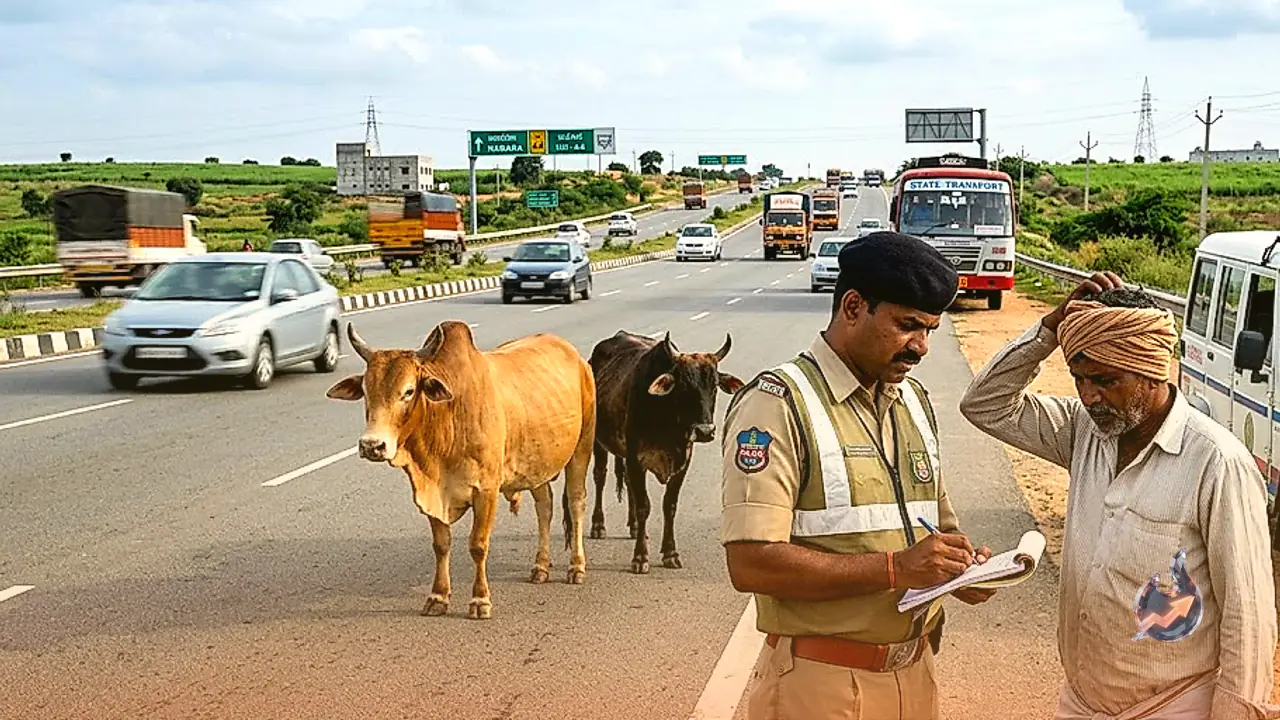

To tackle recurring road accidents caused by wandering livestock on expressways and arterial corridors across the country, the Ministry of Road Transport and Highways has introduced a stringent Standard Operating Procedure (SOP). Under this comprehensive framework, owners who abandon their livestock or allow them to roam freely on high-speed transit routes will face punitive legal measures and hefty financial fines. The ministry has formally distributed a detailed circular to national highway agencies and regional administrations, demanding rigorous ground-level enforcement of these newly minted safety mandates.
Severe Road Safety Hazard and Judicial Intervention
The ministry highlighted in its circular that the unchecked presence of stray cattle and other wandering animals along national highways continues to pose an acute threat to the lives of commuters. Taking note of the mounting danger, the Supreme Court issued definitive directions to the National Highways Authority of India (NHAI) in a suo motu writ petition, mandating the systematic and safe evacuation of all wandering livestock from national highways and expressways. The operational guidelines clarify that the entire expenditure incurred in rounding up these animals and transferring them safely to designated shelters will be borne directly by the concerned highway management agency.
Mandatory Records at Gaushalas and Tracking Livestock Keepers
The intervention extends beyond merely relocating animals away from highway lanes. According to the SOP instructions, authorities must systematically manage and maintain detailed records at local cow shelters and animal care facilities (gaushalas). This record-keeping protocol is specifically crafted to trace the real owners of the wandering animals. Once the keepers are identified, authorities are mandated to initiate formal recovery proceedings to collect all applicable transportation fees, care charges, and punitive fines directly from them.
Invoking the Cattle Trespass Act of 1871
State governments possess statutory powers to initiate penal proceedings against negligent livestock owners by invoking the provisions of the Cattle Trespass Act, 1871. Section 25 of this legislation explicitly empowers administrations to recover fines imposed for damage caused by trespassing livestock through the direct public auction or sale of the animals. This stringent clause remains fully enforceable irrespective of whether the livestock were apprehended in the act of straying or recovered subsequently, and regardless of whether the animals were registered to the offender or were merely under their custody and supervision when the violation took place.
Anticipated Reduction in Fatal High-Speed Crashes
Vehicles traveling at high cruising speeds on multilane expressways and national corridors face catastrophic risks when cattle unexpectedly emerge onto active lanes, leaving drivers with no stopping distance. Such abrupt obstructions have triggered severe collisions in the past, resulting in substantial vehicular damage and claiming numerous lives. Transport authorities anticipate that holding livestock owners legally and financially accountable will significantly deter careless abandonment, ultimately reducing fatalities and making high-speed highway travel considerably safer across the country.