























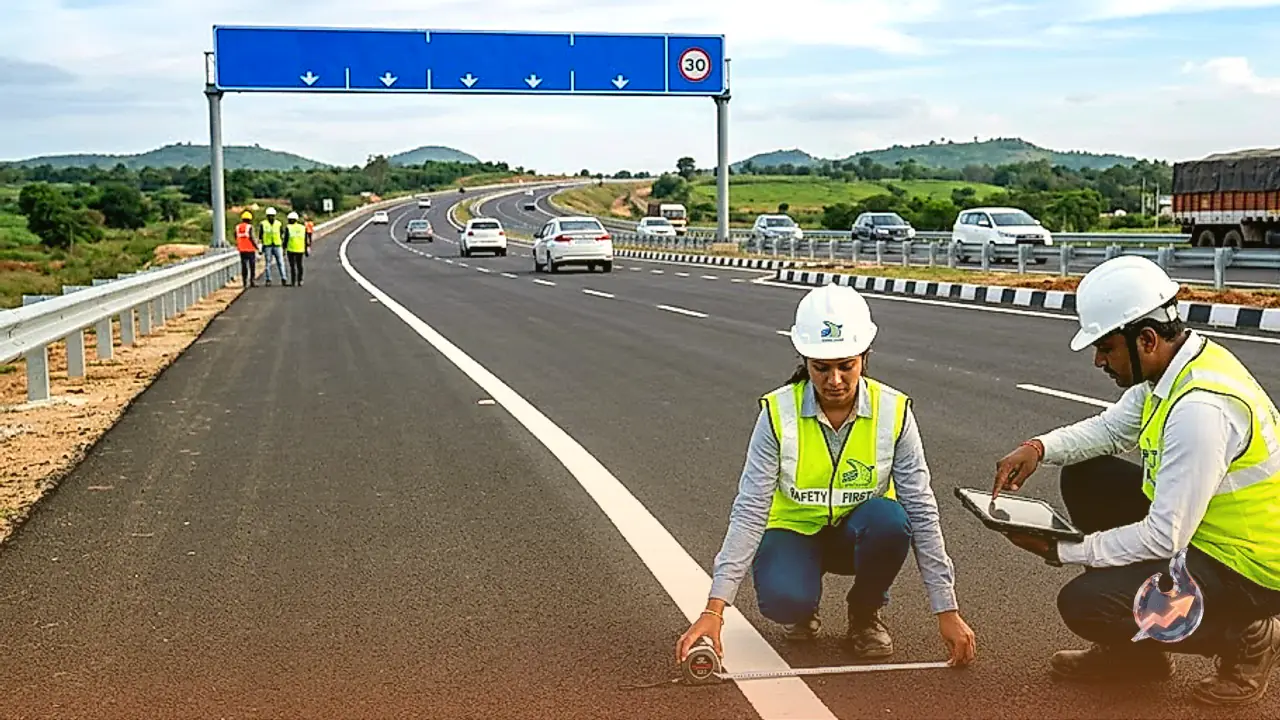

India is steadily expanding its network of express transport corridors to keep pace with growing commercial and personal mobility needs. In a major move to standardize this expansion, the National Highways Authority of India (NHAI) has unveiled comprehensive design and safety guidelines governing the engineering of future access-controlled high-speed national highways. The overarching objective behind this revised framework is to enforce structural uniformity across national corridors, minimize highway fatalities, and streamline vehicular movement across regions.
These newly codified benchmarks will govern both greenfield developments and brownfield widening projects planned as 4-lane and 6-lane access-controlled highways. Under the revised blueprint, highway geometry, lane configuration, and total right-of-way width will directly correlate with verified traffic volume assessments.
Lane Allocation and Corridor Widths Tied to Traffic Projections
To prevent under-capacity bottlenecks and avoid unnecessary overbuilding, NHAI has established an analytical framework matching vehicle count to highway dimensions. Corridors with projected traffic of up to 15,000 vehicles will feature a 4-lane highway accompanied by 4-lane civil structures, maintaining a total corridor width of 60 meters.
For busier stretches handling between 15,000 and 25,000 vehicles, planners must construct a 4-lane highway paired with expandable 6-lane structures, requiring an expanded corridor width of 70 meters. High-density corridors carrying between 25,000 and 40,000 vehicles will be built as full 6-lane highways with 6-lane structures, also spanning a standard width of 70 meters.
Advance Warnings at Entry and Exit Points for Lane Discipline
Safety engineering receives substantial emphasis under the new guidelines, particularly regarding high-speed merge and diverge segments. Highway designs must now integrate clear, early-warning guidance systems well ahead of upcoming entry and exit ramps. Providing motorists with sufficient advance notice allows drivers to filter smoothly into their intended lanes without abrupt maneuvers, eliminating severe braking incidents and sideswipe collisions at highway splits.
Ramped Interchanges at Arterial Crossings and Key Hubs
To eliminate dangerous at-grade conflicts on high-speed stretches, grade-separated ramp interchanges must be integrated at junctions crossing other expressways, national highways, state highways, and major arterial routes carrying heavy traffic volumes.
The engineering blueprint also prioritizes links with vital economic infrastructure. Direct interchange facilities will be mandated at access roads leading to seaports, airports, Multi-Modal Logistics Parks (MMLP), industrial corridors, and major tourist destinations, ensuring heavy freight and tourist traffic can merge onto high-speed lanes without creating local congestion.
Boundary Walls to Restrict Unauthorized Access and Stray Cattle
A recurring hazard on high-speed routes across the country has been sudden perimeter breaches by pedestrians and livestock. To address this vulnerability, the guidelines require a 1-meter-high boundary wall along the outer edges of the corridor right-of-way. This continuous physical barrier is intended to prevent illegal local access, stop stray cattle from wandering onto active lanes, and preserve the controlled-access integrity of the highway.