














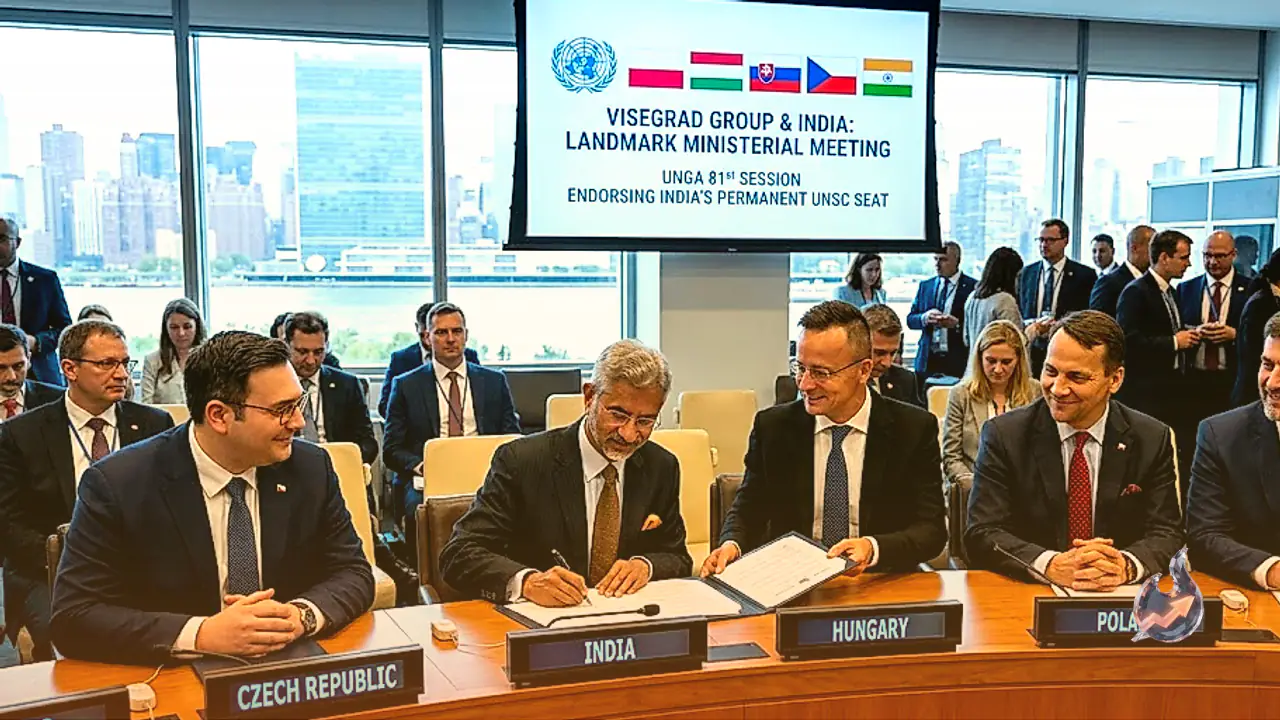

A unified diplomatic endorsement from Central Europe has provided fresh momentum to New Delhi's enduring campaign for structural reform at the highest level of global governance. Convening on the margins of the 81st United Nations General Assembly session, foreign ministers representing the four member nations of the Visegrad Group formally threw their collective weight behind granting India permanent membership on the United Nations Security Council. The inaugural V4 plus India ministerial dialogue brought together Poland, Hungary, Slovakia, and the Czech Republic alongside External Affairs Minister S Jaishankar.
Central European Bloc Recognizes Rising Strategic Stature
The joint declaration highlighted India's indispensable position within both the Global South and the Indo-Pacific geopolitical framework. Slovak Foreign Minister Juraj Blanar articulated the collective resolve of the European grouping following the discussions. Blanar noted that all four member states agree India belongs at the Security Council table as a permanent member reflecting its status as an emerging Indo-Pacific power. Diplomatic observers view this consolidated European backing as a significant diplomatic endorsement for long-delayed institutional restructuring within the United Nations executive body.
Institutionalizing Annual Dialogues and Corporate Engagement
Characterizing the inaugural session as an important historic opportunity, External Affairs Minister S Jaishankar welcomed the deepening ties between India and the Central European quartet. To ensure the partnership sustains tangible momentum, both sides agreed to formalize their engagement architecture. Moving forward, the foreign ministers from all five nations will hold scheduled annual consultations. Alongside government-to-government discussions, the countries will inaugurate an annual business forum designed to catalyze cross-border trade, industrial partnerships, and bilateral capital deployment.
Revitalizing Strategic Defense Ties and Industrial Cooperation
Defense collaboration formed a cornerstone of the comprehensive bilateral deliberations. India shares a long-standing defense industrial history with several Central European nations dating back decades. The ministers resolved to revitalize and expand these legacy links to address contemporary military requirements. Talks centered on expanding joint research, modernizing supply chains, and exploring co-development opportunities, ensuring that past cooperative records translate into active technological collaboration across strategic manufacturing segments.
Broadening Technological, Space, and Academic Linkages
Discussions also extended into forward-looking sectors including space exploration, advanced technology, logistics connectivity, and academic exchange. The ministers emphasized that the burgeoning presence of Indian students across higher education institutions in Poland, Hungary, Slovakia, and the Czech Republic serves as a crucial human bridge between the regions. Strengthening joint research initiatives and institutional partnerships in education and science was identified as a mutual priority to harness top technical talent from both sides.
Navigating Multilateral Challenges and Geopolitical Instability
The high-level gathering addressed pressing international conflicts that continue to disrupt international stability, focusing specifically on the war in Ukraine and volatile developments across the Gulf region. Ministers reaffirmed their shared dedication to revitalizing multilateralism through rule-based international mechanisms. Reflecting on the dialogue, Jaishankar affirmed that advancing political coordination, upgrading economic ties, expanding defense relations, and strengthening people-to-people links remain central to this newly elevated diplomatic chapter.