


















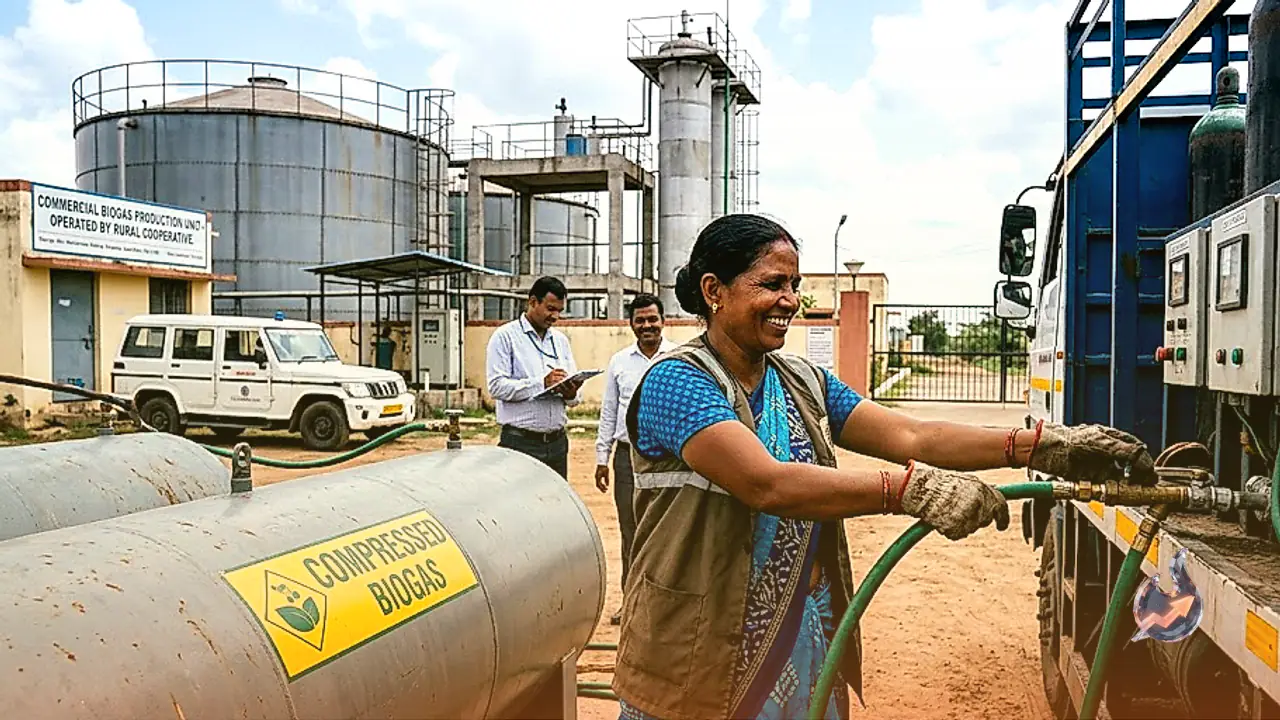

A comprehensive national policy framework carrying a financial outlay of 23,731 crore rupees has been enforced to transform rural agricultural residue and animal waste into commercial energy under the GOBARdhan initiative. The operational model provides a major business incentive for setting up processing plants in rural areas, where raw feedstocks like cattle dung and crop refuse are readily available at negligible expense. Under the new guidelines, plant operators will not have to hunt for buyers across the market, as the framework guarantees structural arrangements for the procurement of their end product.
Ten-Year Implementation Window and Core Objectives
According to the official notification issued by the Ministry of Petroleum and Natural Gas, the operational timeline of the programme spans a ten-year horizon from financial year 2026-27 through financial year 2035-36. The initiative aims to scale up domestic compressed biogas manufacturing, build an economically viable ecosystem for processing facilities, and attract substantial private capital into green fuel infrastructure. GOBARdhan, which stands for Galvanizing Organic Bio-Agro Resources Dhan, converts animal waste, harvest residues, food discards, and municipal organic trash into biogas, compressed biogas, and enriched organic bio-fertilizers. The final compressed biogas will be blended seamlessly into the broader natural gas transmission grid to supply commercial and domestic consumers.
Six Key Pillars Backing Plant Developers
The operational guidelines laid down by the ministry rest on six foundational pillars designed to eliminate commercial risk for investors. These encompass guaranteed procurement of compressed biogas, an administered pricing mechanism, capital assistance, dedicated pipeline infrastructure, credit guarantee support, and a dedicated CBG Ecosystem Challenge Fund. Eligible producers operating under the policy will hold the formal option to sign off on up to 100 percent assured offtake of their commercially available gas output. Furthermore, project developers are set to receive administered price protections and financial capital subsidies for a minimum tenure of ten years.
Mandatory Offtake Quotas for City Gas Distributors
To guarantee steady industrial consumption, the gas logistics will be directly integrated with city gas distribution networks across designated geographical zones. In addition, designated clusters will collect output from decentralized processing hubs and inject the purified fuel into primary pipelines. Licensed city gas distributors will operate under a statutory mandate to blend and sell an escalating share of compressed biogas across their transport CNG and household piped natural gas segments. This blending obligation has been structured at 3 percent for financial year 2026-27, advancing to 4 percent in financial year 2027-28, and reaching 5 percent starting from financial year 2028-29.
Fixed Pricing Mechanism and Long-Term Horizon
To ensure long-term commercial visibility, the administered base rate for compressed biogas has been established at 2,110 rupees per unit (MMBtu). Calculated on the standard benchmark of 95 percent methane content, this pricing translates to roughly 98 rupees per kilogram, excluding applicable taxes and secondary compression charges. This baseline purchase valuation will remain applicable until at least 31 March 2036. The government has retained the authority to calibrate this rate in subsequent years to reflect shifts in raw production costs, general inflation, and wider energy market conditions.