













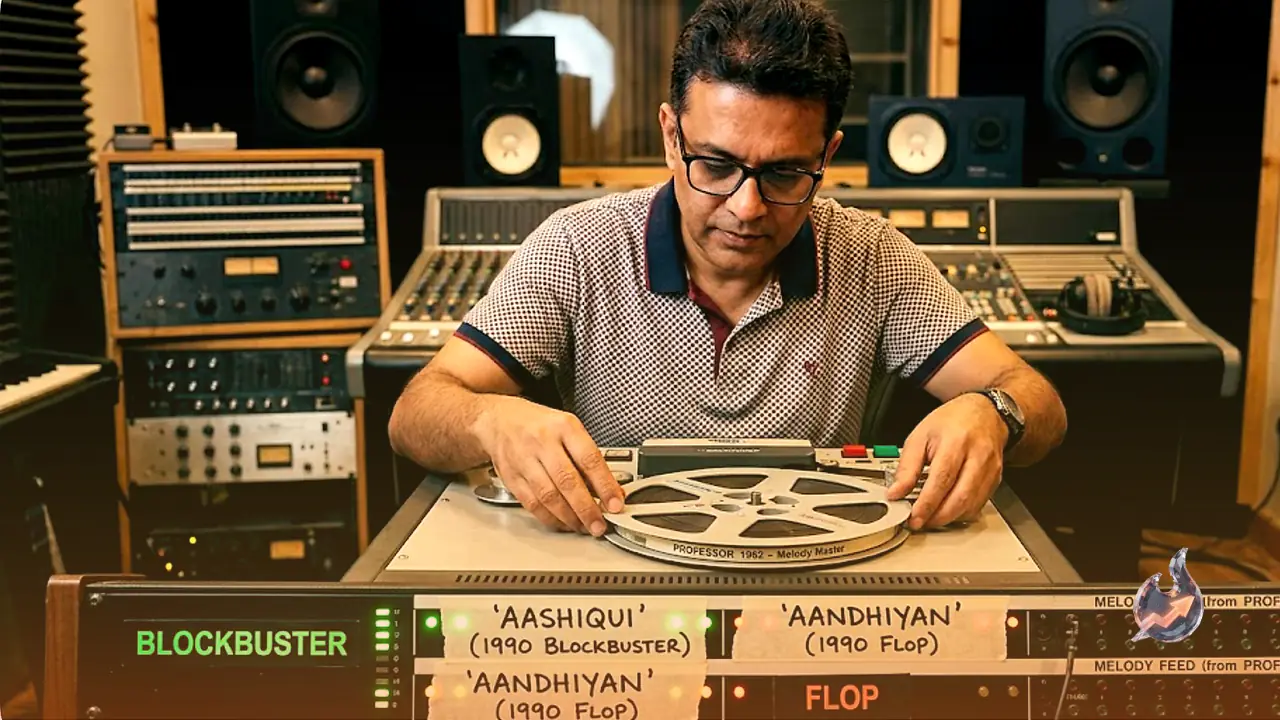

A single melody composed for a 1962 Bollywood film went on to travel through three more movies over the following decades, and its unusual journey ended with two blockbusters and one box office flop.
How 'Professor' brought Shammi Kapoor and Shankar-Jaikishan together
The story begins with the musical comedy 'Professor', released in the 1960s and starring Shammi Kapoor opposite Kalpana Mohan. The film was directed by Lekh Tandon and produced by FC Mehra, with Lalita Pawar, Tun Tun, Iftekhar and Salim Khan playing key supporting roles. Shashi Bhushan wrote the story, while Abrar Alvi penned the screenplay and dialogues. The lyrics came from Hasrat Jaipuri and Shailendra, and the music was composed by the duo Shankar-Jaikishan, who won the Filmfare Award for Best Music Director for their work on the film. 'Professor' also happened to be Lekh Tandon's directorial debut.
Rejected by Guru Dutt, Dev Anand and Raj Kapoor before Shammi Kapoor said yes
Before it became a Shammi Kapoor vehicle, the project had a rocky start. Guru Dutt originally wanted to make the film with Kishore Kumar and Waheeda Rehman in the lead. In that era, filmmakers had to shoot three reels of any film and present them to the censor board before proceeding. When the censor board raised objections, Guru Dutt shelved the project. The film then went to Dev Anand and Raj Kapoor, both of whom turned it down as well. It finally landed with Shammi Kapoor, who wanted either Shakti Samanta or Nasir Hussain to direct it. Lekh Tandon refused to hand the script over to anyone else, and eventually directed the film himself.
A box office hit built on chartbusting songs
The film that finally released won over audiences, with Shammi Kapoor dominating every frame and the film's visuals proving highly appealing. Shankar-Jaikishan's music turned into an all-round success, with songs like 'Hamare Gaon Koi Aayega' (Asha Bhosle-Lata Mangeshkar), 'Awaaz Deke Humein Tum Bulao' (Mohammed Rafi-Lata Mangeshkar), 'Khuli Palak Mein Jhoota Gussa' (Mohammed Rafi), 'Ae Gulbadan' (Mohammed Rafi) and 'Main Chali Main Chali, Peeche Peeche Jahan' (Lata Mangeshkar-Mohammed Rafi) becoming instant favourites. Made on a budget of around 50 lakh rupees, the film earned about 1 crore rupees and was declared a hit, ending up as the third highest-grossing film of 1962.
The tune resurfaces, first across the border
The melody of 'Main Chali Main Chali, Peeche Peeche Jahan' went on to inspire three more songs in the years that followed. One of them turned up in the 1984 Pakistani film 'Dooriyan', in a song with the lyrics 'Bas Ek Tere Siva, Koi Nahi Hai Mera'. The story takes its most interesting turn from here, because the tune of that Pakistani song was itself picked up in 1990 for two separate Hindi songs, one in 'Aashiqui' and the other in 'Aandhiyan'. The two films that carried this shared tune ended up with completely opposite fates, 'Aashiqui' turned into a runaway hit while 'Aandhiyan' sank without a trace.
'Aandhiyan': same tune, no luck at the box office
'Aandhiyan' released on 8 June 1990, featuring Shatrughan Sinha, Mumtaz, Prasenjit Chatterjee and Madhu Shree. The film was directed by David Dhawan, with dialogues written by Anees Bazmee and the screenplay penned by Ram Kelkar. It was produced by Pahlaj Nihalani, with music composed by Bappi Lahiri. Its song 'Duniya Mein Tere Siva, Koi Nahi Hai Mera' was sung by Anuradha Paudwal and Udit Narayan, and its basic tune was inspired by 'Professor's song 'Main Chali Main Chali, Peeche Peeche Jahan'. Despite carrying such a rich musical lineage, 'Aandhiyan' failed to make any mark commercially.
'Aashiqui': the film that rewrote the rules of Hindi cinema
The same year also saw the release of another musical romance, 'Aashiqui', a film that changed the course of Hindi cinema. Directed by Mahesh Bhatt, it starred Rahul Roy and Anu Agarwal in the lead roles, with music by Nadeem-Shravan turning into an outright blockbuster and lyrics written by Sameer. Songs sung by Kumar Sanu and Anuradha Paudwal became inescapable across the country, playing in every lane, every bus and auto, and every paan shop. The film's song 'Jaane Jigar Jaane Man, Tujhko Hai Teri Kasam' was also inspired by 'Professor's 1962 song 'Main Chali Main Chali, Peeche Peeche Jahan', though in reality it was lifted directly from the Pakistani film 'Dooriyan's song 'Bas Ek Tere Siva, Koi Nahi Hai Mera'.
'Aashiqui' is widely credited with bringing down the curtain on Bollywood's long-running era of action films. Mahesh Bhatt produced the film together with T-Series owner Gulshan Kumar, and it marked the debut of both Rahul Roy and Anu Agarwal. The film turned Rahul Roy, Anu Agarwal, composer duo Nadeem-Shravan, singer Kumar Sanu and lyricist Sameer Anjaan into overnight stars. A large part of the film's plot was said to be inspired by their own real-life love stories. Made on a budget of just 90 lakh rupees, 'Aashiqui' went on to earn more than 5 crore rupees, cementing its place as one of the biggest blockbusters of its time.