





















If you want to multiply your income with minimal investment, fish farming can turn out to be a highly profitable business idea for you. The key to success in this venture lies entirely in paying special attention to selecting the right species of fish. Even if you have just a small patch of land or a small plot available, you can easily kickstart this work without much hassle. The most remarkable aspect of this enterprise is that it can be initiated with a starting cost of merely 500 rupees.
Salim Khan and Integrated Farming
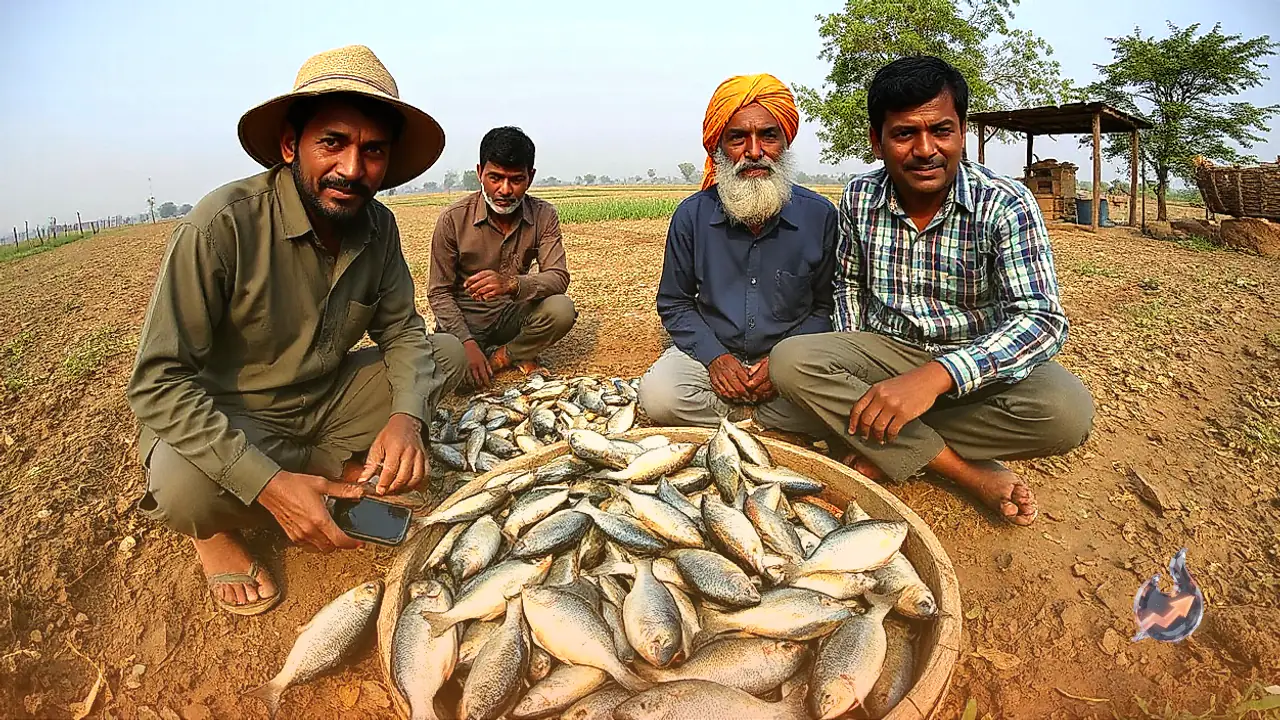
Progressive farmer Salim Khan from the Chhatarpur district of Madhya Pradesh practices integrated farming firsthand, combining multiple agricultural activities efficiently. He manages various tasks simultaneously, ranging from poultry rearing to fish farming, all in one place. He strongly believes that every farmer must adopt fish farming to boost their household income significantly. The primary expense involved in fish farming is restricted only to purchasing fish seeds, which are the fingerlings. If a person sets up fish farming in a compact space measuring 30 by 30 feet, they can generate a revenue of 30,000 rupees in a span of just 8 months.
Small Ponds and High Returns
According to Salim Khan, fish farming does not demand massive ponds or huge water bodies to begin with. One can easily execute this work by digging a pit about 6 feet deep in a small pond or right inside a farm plot. Salim Khan himself has raised around 1,000 fish in his modest pond setup. When these fish are harvested and sold in the month of March, he expects to yield roughly 6 quintals of fish. The juvenile fish take about 8 months to mature completely, and within this timeframe, a single fish attains a weight of roughly 1 kilogram.
Procuring Seeds and Department Support
Any farmer or young entrepreneur willing to venture into fish farming can reach out to the fisheries department in their respective district. High-quality fish seeds are readily available through the fisheries department to help kick things off. Alternatively, seeds can also be procured by getting in touch with local fish suppliers in the area. For a space measuring 30 by 30 feet, buying the fish fingerlings incurs an expense of roughly 500 to 700 rupees. Naturally, if the available space is larger, the initial cost scales up accordingly. The total fish yield in a 30 by 30 space ranges between 300 to 600 kilograms, while the prevailing market price of fish remains around 100 rupees per kilo.
Feeding Management and Additional Benefits
Addressing the dietary requirements of the fish, Salim Khan explains that he feeds them waste material from cows and poultry, strictly according to the capacity of the pond. Care must be taken not to dump excess waste material, as doing so depletes the oxygen levels inside the water. To provide free feed for the fish, an insect trap can be installed near the pond at night. The insects attracted to the light become a ready meal for the fish without requiring any extra financial expenditure. Furthermore, once the fish farming cycle concludes, the residual wastewater left in the pond serves as an excellent resource for irrigating wheat crops.