






















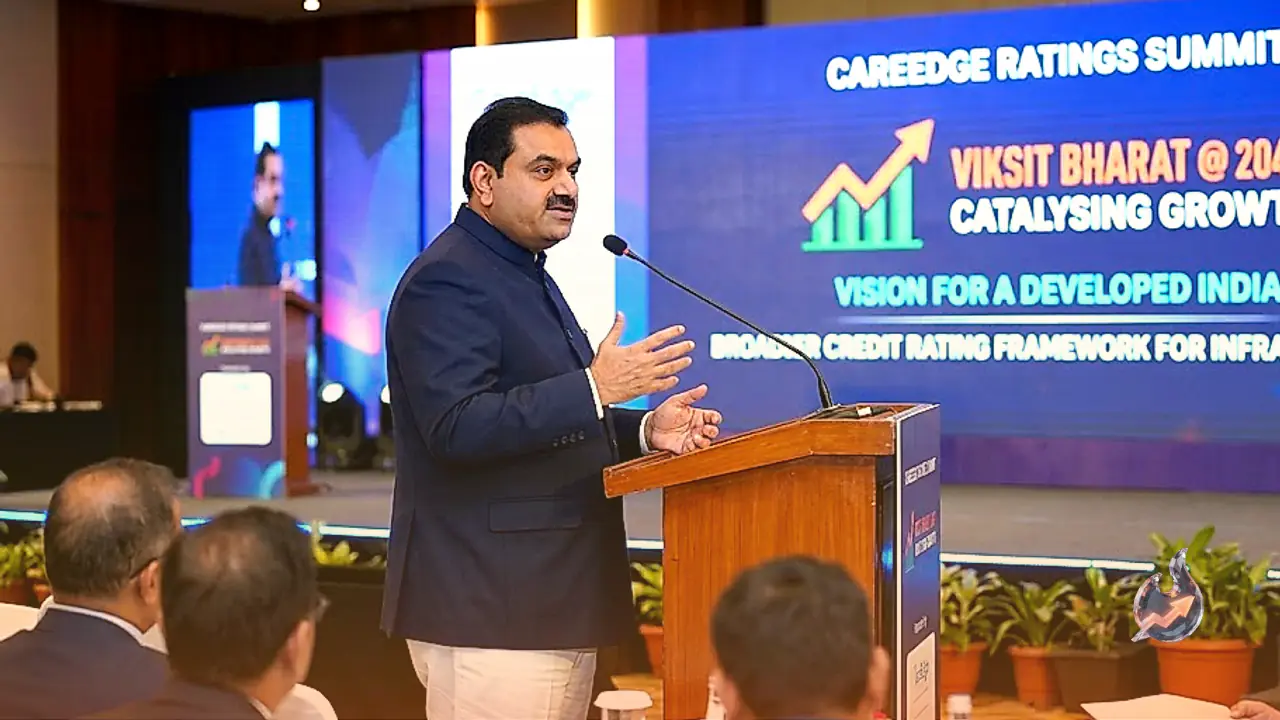

Mumbai: Adani Group Chairman Gautam Adani has shared his comprehensive vision for a developed India while addressing the infrastructure landscape and economic roadmap of the nation. Speaking as the chief guest at the CareEdge Group annual summit in Mumbai, the prominent industrialist discussed the dreams and aspirations of a new India, specifically focusing on how the country evaluates its massive infrastructure projects.
A Broader Perspective Over Lower Standards
Gautam Adani urged India's credit rating agencies to develop comprehensive analytical frameworks designed to assess the risks and true economic utility of infrastructure projects. He noted that traditional rating models often fail to capture the real economic and strategic potential of large-scale infrastructure developments that create entirely new markets, industries, and ecosystems. Stating that India does not need lower credit standards, Adani emphasized that the nation requires a much broader perspective to evaluate infrastructure properly.
Categorizing Infrastructure Into Three Tiers
During his address, Adani suggested dividing infrastructure into three distinct categories. He explained that traditional rating models are entirely adequate for replacement infrastructure. However, when evaluating growth infrastructure, the benefits generated across the broader ecosystem must be factored into the assessment. Furthermore, he highlighted platform infrastructure, which has the capability to give rise to entirely new capabilities, markets, and industrial clusters. Citing Mundra, Vizhinjam, and Khavda, he pointed out that these platforms do not merely satisfy existing demand but actively generate new demand and fresh capabilities.
The Mundra Port Model And Future Demand
Highlighting the evolution of Mundra Port in Gujarat, Adani recounted how a project that began decades ago on a relatively underdeveloped coastline eventually transformed into a comprehensive industrial and logistics ecosystem encompassing rail networks, logistics centers, power generation, and manufacturing. He argued that evaluating such projects solely on the basis of standalone discounted cash flow models restricts their true potential. He warned that building solely for today's visible demand leaves a nation lagging behind tomorrow's opportunities.
Overcoming Skepticism At Vizhinjam And Khavda
Discussing the Vizhinjam International Seaport in Kerala, Adani pointed out that India remained dependent on foreign hubs for transshipment for a long time despite Vizhinjam's proximity to major global shipping lanes. Traditional financial assessments struggled to capture the broader strategic value of this project. He remarked that the biggest risk in building Vizhinjam was never financial, but rather the risk of India believing it could not accomplish such a feat. Additionally, referencing the massive renewable energy project in Khavda, Gujarat, he stressed that clean energy must not be viewed merely as power generation, but as the foundational bedrock for data centers, artificial intelligence, and advanced manufacturing.
Strengthening Standards Without Compromising Independence
Adani clarified that his appeal was not aimed at relaxing rating standards or approving weak projects. He stressed that rating agencies must maintain their independence and rigorous standards while creating dynamic models capable of recognizing the capacity of large national platforms. The new credit framework should integrate traditional leverage and cash flow risks with ecosystem multipliers, strategic resilience, and future-ready capabilities.
Building A Global Credit Framework For 2047
Adani concluded by calling upon CareEdge to take the lead in developing the world's first comprehensive credit framework for integrated platform infrastructure, which could serve as a valuable model for other emerging economies. He stated that the true value of infrastructure lies not merely in immediate financial returns, but in the economic activity and national capability it unlocks. Emphasizing the journey toward 2047, he noted that national ambition must be matched by trust, capital, and enhanced collective capability.