






















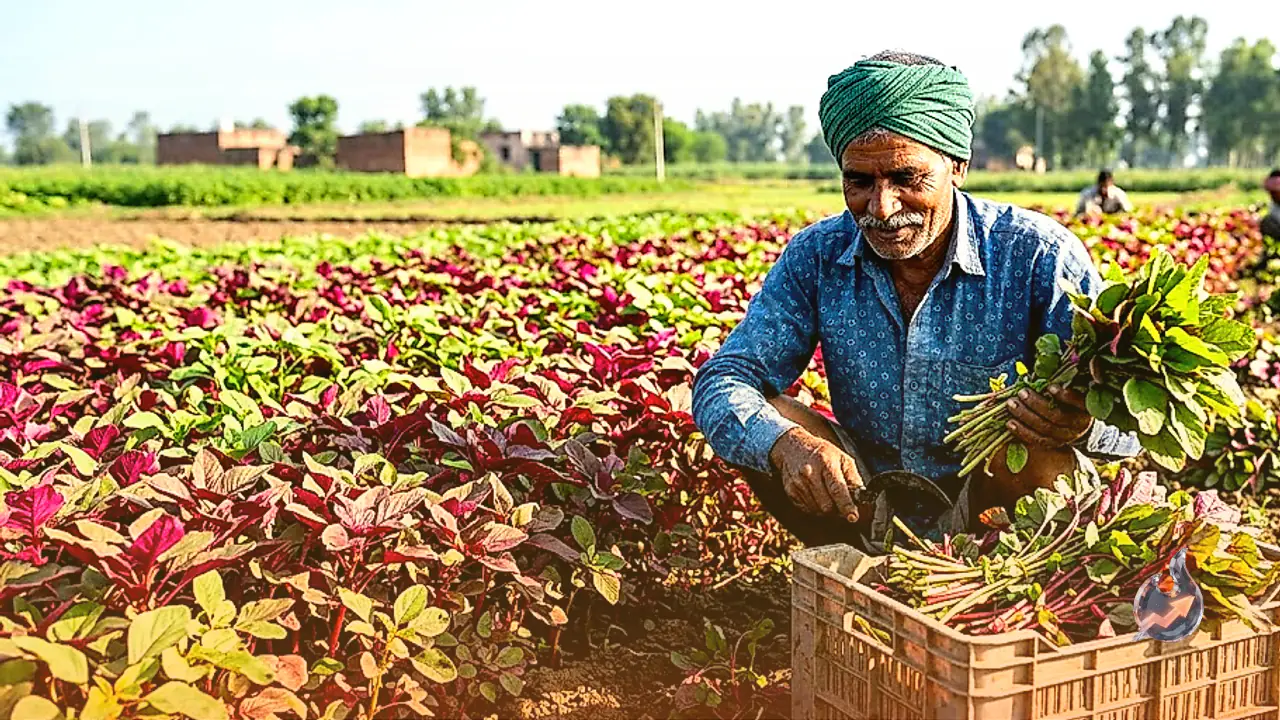

The month of September presents a lucrative opportunity for farmers in Moradabad looking to secure rapid financial returns through vegetable farming. Cultivating red amaranth, locally known as lal saag or chauolai, emerges as an exceptionally viable option for quick earnings. This leafy green vegetable belongs to the category of crops that mature within a remarkably short span. Given favorable weather conditions and proper agricultural care, the crop can become fully ready for harvest in approximately 25 to 30 days. The primary advantage of this farming method lies in its relatively low input costs, allowing growers to fetch attractive market prices wherever local demand remains steady. To achieve a bountiful harvest of red amaranth, fertile loamy soil is considered the most suitable medium. The agricultural field must feature an efficient drainage system because prolonged water stagnation can damage the root system and ruin the entire crop. Prior to sowing the seeds, the soil should be thoroughly plowed to attain a fine tilth, and well-decomposed farmyard manure or compost must be thoroughly mixed into the earth.
For optimal growth of red amaranth, the pH level of the soil should ideally range between 6 and 7.5. Maintaining this specific pH level ensures that the plants easily absorb essential nutrients from the ground, resulting in vigorous and healthy plant development. Before initiating the sowing process, growers are strongly advised to conduct a comprehensive soil test so that fertilizers and nutrients can be applied in accordance with the specific soil conditions. This targeted approach significantly improves both crop quality and overall yield.
Thorough preparation of the field is an absolute prerequisite for successful red amaranth cultivation. The process begins by spreading decomposed animal manure or compost across the land and blending it uniformly into the soil. Following this, the field is plowed to loosen the dirt into a fine consistency, and a wooden plank is dragged across the surface to level the earth evenly. Leveling the field guarantees uniform seed germination and promotes steady upward growth among all plants. Additionally, establishing proper water drainage channels within the plot remains a vital step throughout the cycle.
To ensure high yields and superior crop quality, growers should select disease-resistant seeds boasting high germination rates from proven varieties. Varieties such as Messina Lal can be effectively utilized for this purpose. Seeds must always be procured from certified sources, and their quality alongside germination capacity should be tested prior to planting. This practice maintains an optimal plant population density across the field and fosters superior overall crop development.
Red amaranth seeds are extremely tiny, meaning that burying them too deep can severely hinder the germination process. Farmers should plant these seeds at a shallow depth of roughly one-quarter of an inch, which translates to about 0.5 to 0.7 centimeters. The seeds need to be covered with a very light layer of soil, followed immediately by a gentle irrigation session. This initial watering provides adequate moisture to the seeds and triggers optimal germination.
The cultivation of red amaranth yields returns within an unusually short timeframe. The very first harvest can typically be carried out approximately 30 days after the initial sowing. A major operational advantage of this crop is that instead of uprooting the entire plant, harvesters can simply cut the upper leafy portions, which allows fresh new shoots to sprout rapidly. With diligent care and appropriate watering schedules, a single sowing can yield anywhere between 4 to 5 successive harvests.
Effective weed management is critically important to support the healthy proliferation of red amaranth. Approximately 10 to 12 days after sowing, a light weeding operation should be performed, followed by a second round of weeding around 40 days later to keep the field entirely free of unwanted plants. Once the crop reaches maturity, its tender leaves and succulent stems can be harvested 2 to 3 times selectively. Alternatively, if a grower prefers a single comprehensive harvest, the entire plants can be pulled out by their roots approximately one and a half to two months after planting.