






















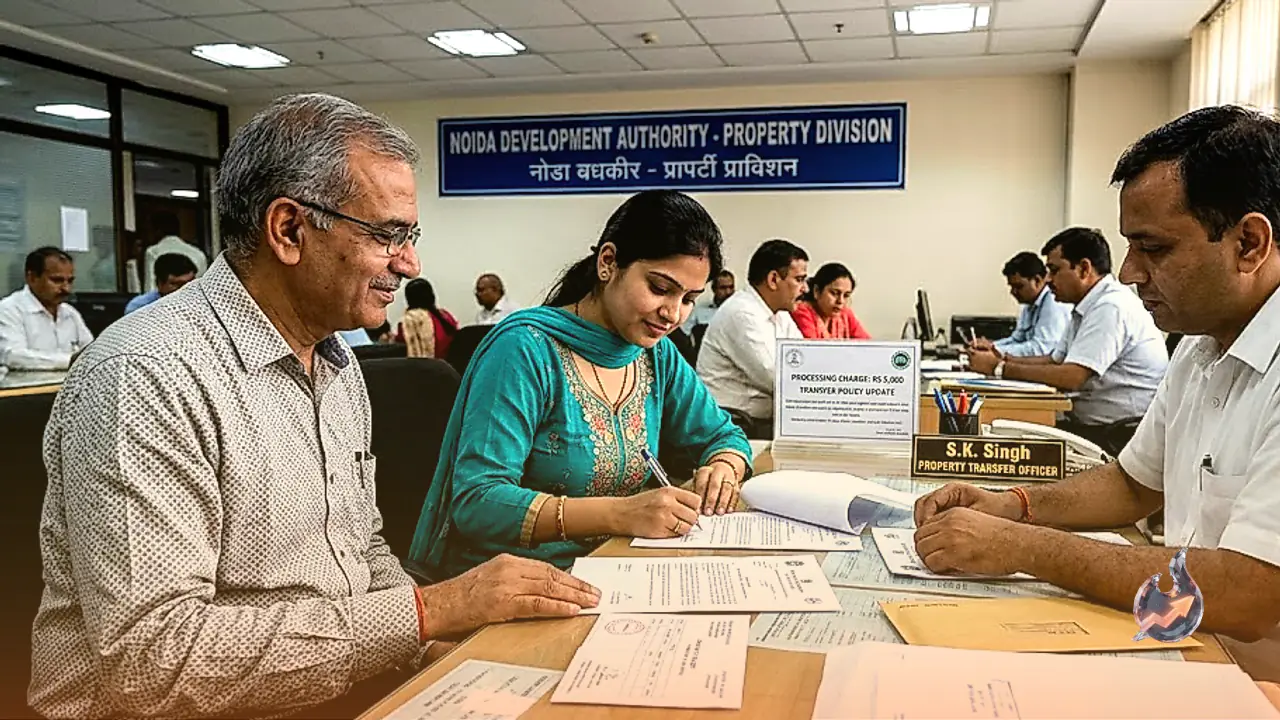

Residents across Noida, Greater Noida, and the Yamuna Expressway region stand to benefit from a major simplification of family property transfer rules. Following the Uttar Pradesh state government's initiative to eliminate exorbitant property transfer charges among blood relatives, the Noida Development Authority has expanded the scope of its waiver scheme. Under the updated Unified Policy, property transactions conducted between a father-in-law and a daughter-in-law will no longer attract heavy transfer fees. Instead, property owners will only be required to pay a nominal processing fee of Rs 5,000 along with standard statutory charges.
Unified Policy Framework Across Regional Authorities
Previously, the three major development bodies in the region, namely Noida Authority, Greater Noida Authority, and Yamuna Expressway Industrial Development Authority, operated under distinct sets of regulations and fee structures for property transfers. To streamline these procedures and resolve long-standing administrative discrepancies, a Unified Scheme was enacted to enforce uniform guidelines across all three zones. When the Yogi Adityanath-led Uttar Pradesh government introduced fee relief for family property transfers under gift deed provisions earlier this year, the Noida Authority responded by broadening its institutional regulations. This policy shift effectively dismantled the multi-tiered financial burden that previously comprised heavy transfer charges, registration fees, and stamp duties.
Exemption Extended to Father-in-Law and Daughter-in-Law
Under the newly integrated provision added by the Noida Authority, property transfers involving a father-in-law and a daughter-in-law have been explicitly granted the same financial concessions as traditional blood relations. Whether a father-in-law transfers real estate assets to his daughter-in-law or a daughter-in-law transfers property to her father-in-law, the primary transfer fee charged by the authority is completely waived. Applicants will only incur a fixed processing charge of Rs 5,000. While applicable government stamp duty remains payable as per state norms, the total expenditure incurred during the transfer process is drastically lower than the previous framework.
Eligible Family Relations Under the Expanded Policy
The definition of eligible family relationships under the Noida Authority's Unified Policy has undergone multiple expansions over time. Initially, the concession was restricted strictly to immediate family members, including spouses, father-daughter, father-son, mother-daughter, mother-son, brother-sister, brother-brother, and sister-sister. In its first expansion phase, the authority extended the policy benefits to include paternal grandparents and maternal grandparents. With the latest policy modification, the inclusion of father-in-law and daughter-in-law marks another key milestone, enabling a wider circle of family members to reorganize asset ownership smoothly and cost-effectively.
Financial Impact: Calculating Savings on a Rs 1 Crore Property
The financial relief offered by the Unified Scheme can be illustrated using a practical scenario involving a high-value property transfer. Prior to these regulatory changes, transferring a property valued at Rs 1 crore in Noida to a family member, such as a son, attracted a 10 percent transfer charge, amounting to a direct payment of Rs 10 lakh to the authority. Under the new policy, this 10 percent transfer fee has been completely abolished, delivering an immediate saving of Rs 10 lakh to the property owner. Today, executing a similar property transfer requires paying only the Rs 5,000 processing fee alongside nominal authority stamp duties, significantly reducing the financial hurdle for families.