























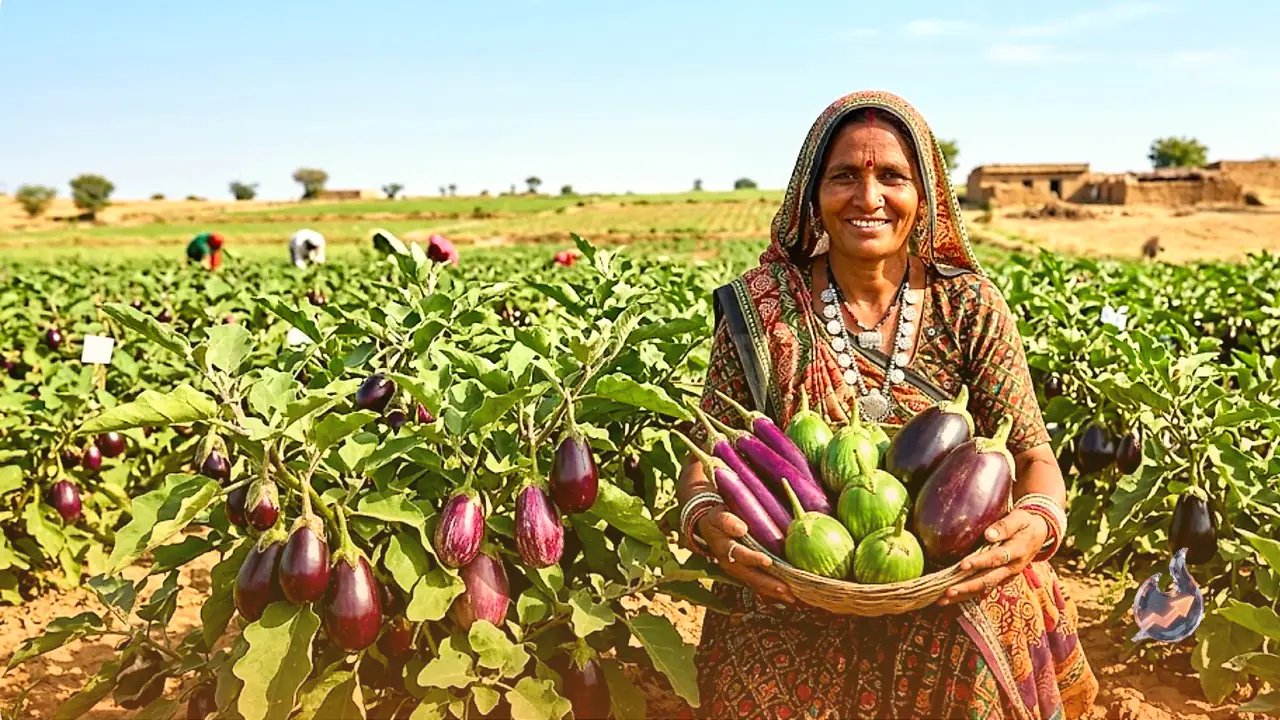

Brinjal farming is fast turning into a profitable cash crop for vegetable growers in Rajasthan, provided farmers pick the right variety. According to Rajasthan Agriculture College, several improved and hybrid brinjal varieties suited to the state's climate are capable of yielding between 350 and 650 quintals per hectare. Some of these varieties also carry stronger resistance to diseases and pests, which cuts crop losses and boosts farmer income.
Choosing the right variety is the first step to success
Agriculture experts say the biggest factor behind successful brinjal cultivation is selecting the correct variety. Certified, good quality seeds, timely sowing, balanced fertiliser management and proper irrigation together can raise both yield and fruit quality.
Rasika and Shamli, the two trusted hybrids for the kharif season
For the kharif season, Rasika and Shamli are considered the two leading hybrid varieties. Rasika produces long, attractive fruits and has a yield capacity of 400 to 580 quintals per hectare. Shamli goes even further, capable of yielding 350 to 650 quintals per hectare. Both varieties need only 150 to 200 grams of seed per hectare for sowing, keeping seed costs in check.
VNR-51C suits regions that prefer small, round brinjals
In areas where the market demands small, round brinjals, VNR-51C is a better option. This hybrid variety can yield around 450 to 500 quintals per hectare. Its fruits come out fairly uniform in size, which improves the chances of a good market price. It can also be grown easily in the kharif season, and 150 to 200 grams of seed per hectare is enough for it too. Its strong yield and quality have made it increasingly popular among farmers.
HABH-8 for farmers who want to grow brinjal all year round
Farmers looking to grow brinjal across different seasons of the year can opt for HABH-8. Its standout feature is that it can be cultivated in all three seasons, kharif, rabi and zaid. This variety produces small, round fruits and can yield 375 to 544 quintals per hectare.
PB-70 stands out for its disease resistance
PB-70 is particularly valued for its resistance to disease. It withstands major diseases and pests such as Phomopsis blight, bacterial wilt, and stem and fruit borer to a considerable extent, which keeps crop damage low. Its yield capacity is around 400 quintals per hectare, and it too can be grown in all three major seasons, kharif, rabi and zaid.
DBL-02 brings long, deep purple fruits
DBL-02, known for its long, deep purple coloured fruits, is also considered a good option for Rajasthan's farmers. Its yield capacity ranges between 370 and 390 quintals per hectare. The variety performs well in the kharif and spring seasons. Its attractive colour and shape keep market demand for its fruits strong, which improves the chances of farmers getting a better price.
A good variety alone isn't enough, scientific farming matters too
Experts at Rajasthan Agriculture College say that alongside choosing an improved variety, following scientific farming methods is equally important. Proper field preparation, timely transplanting, balanced use of manure and fertilisers, regular irrigation and close attention to disease and pest control can lead to a marked rise in production. Experts advise farmers to always buy seeds from certified sources and to farm based on the advice of local agriculture experts.
With demand for vegetables rising steadily in Rajasthan, cultivating these improved brinjal varieties could prove to be a profitable venture for farmers. If farmers pick the right variety among these six based on their local climate and market demand, and follow scientific farming techniques, they stand to gain higher output, better quality fruit and stronger profits in the market. This would not only raise farmers' income but also strengthen vegetable production across the state.