























Thailand's Department of Special Investigation has cast a wider net around a criminal enterprise that investigators say runs illegal crypto mining as cover for laundering billions of baht connected to Chinese crime syndicates, processing illicit funds of more than 10 billion baht, roughly $300 million, every year.
The Expanded Probe
In a press release issued Friday, the DSI said it had broadened its investigation into a network built around so-called "grey" Chinese capital, a term for illicit money moved through channels designed to mimic legitimate finance. The probe spans both illegal crypto mining and transnational money laundering, with financial flows surpassing 10 billion baht annually.
Stolen Power and Seized Machines
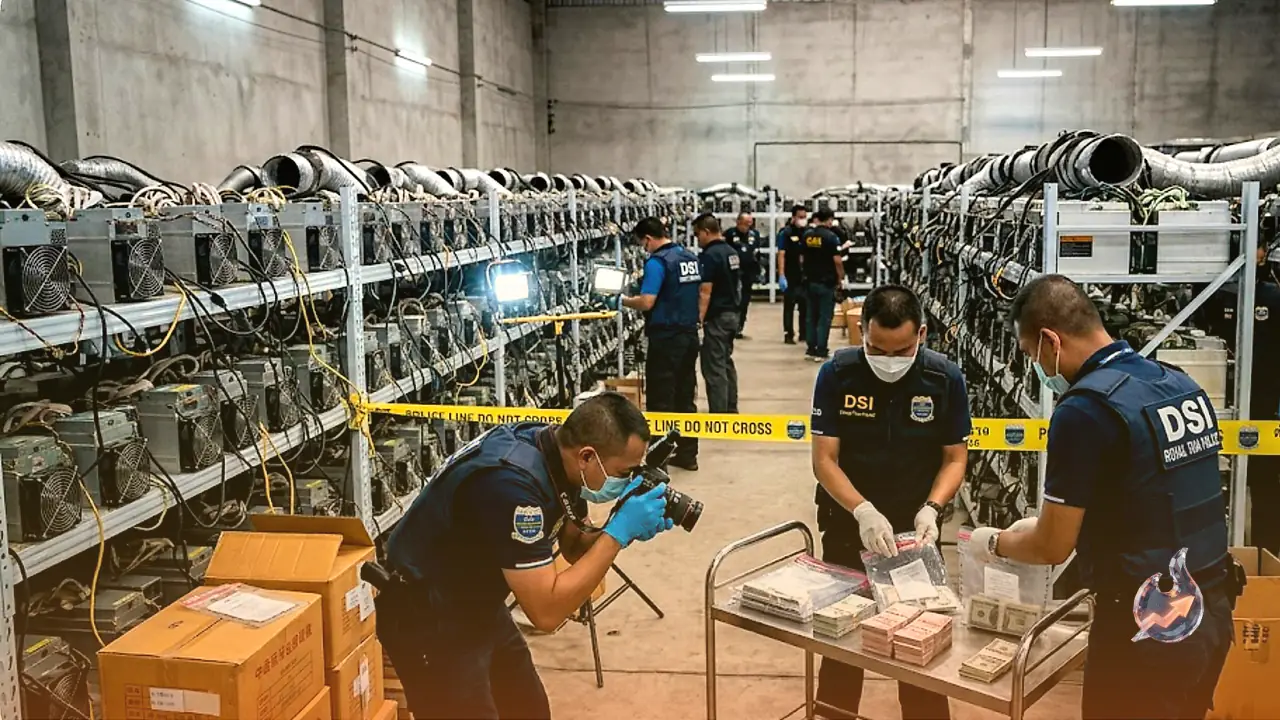
The roots of the case lie in a series of 2025 raids carried out by the DSI's Technology and Cyber Crime Bureau, during which three separate mining networks were dismantled. The raids produced a haul of more than 6,390 machines. The miners had been drawing electricity illegally, causing losses of over 953 million baht, approximately $29 million, to Thailand's state-run Provincial Electricity Authority. Investigators described it as one of the largest instances of utility theft in recent memory.
A Hub for Laundering Scam Proceeds
The mining operations, according to investigators, were not simply cryptocurrency factories. They also functioned as a processing center for money generated through call-center scams and illegal online gambling. To move the cash, Myanmar nationals were recruited to visit Thai banks and withdraw between 30 million and 50 million baht, roughly $920,000 to $1.5 million, in cash each day.
Eight Arrest Warrants and More Suspects Sought
The DSI has issued arrest warrants for eight suspects, four Chinese financiers and four Myanmar nationals, while seven additional suspects are being actively hunted. Five others have been summoned to appear and face charges.
Wang Yicheng: A Bangkok Businessman Under Two Countries' Scrutiny
The most prominent individual named in the case is Wang Yicheng, a Bangkok-based businessman whom the DSI has identified as a key suspect in a major digital-asset fraud. His profile extends beyond Thailand: the U.S. Secret Service has seized more than $17.8 million, approximately 620 million baht, in crypto connected to him, in a matter where victim losses exceeded 2 billion baht.
Wang had already attracted American scrutiny before the current investigation widened. The Secret Service had previously traced funds from a U.S. scam victim to a crypto account registered in his name, which authorities connected to a "pig butchering" operation, a type of long-con romance fraud where scammers cultivate trust with victims before persuading them to transfer large sums in cryptocurrency, then vanish with the money.
Thai Officials Referred to the Anti-Corruption Commission
The investigation has also reached inside Thailand's own institutions. The DSI forwarded two cases to the National Anti-Corruption Commission, naming seven officials from the electricity authority, one law enforcement officer, and 13 individuals described as investors or alleged accomplices. All are accused of helping the mining operations tap into power supplies illegally and evade detection by authorities.
A Campaign Rooted in a December Crackdown
The latest expansion builds on a December operation in which the DSI seized 3,642 rigs valued at $8.6 million from locations linked to Chinese scam networks operating out of Myanmar. That raid provided the foundation for the much broader investigation now under way.
A Challenge Spanning the Region
Thailand's crackdown fits into a wider Southeast Asian effort against crypto-linked power theft and financial crime. Malaysia's state electricity utility has reported roughly $1.1 billion in stolen electricity over five years, and the U.N. Office on Drugs and Crime has warned that transnational criminal networks are increasingly turning to illegal crypto mining as a vehicle for laundering billions of dollars across the region.