






















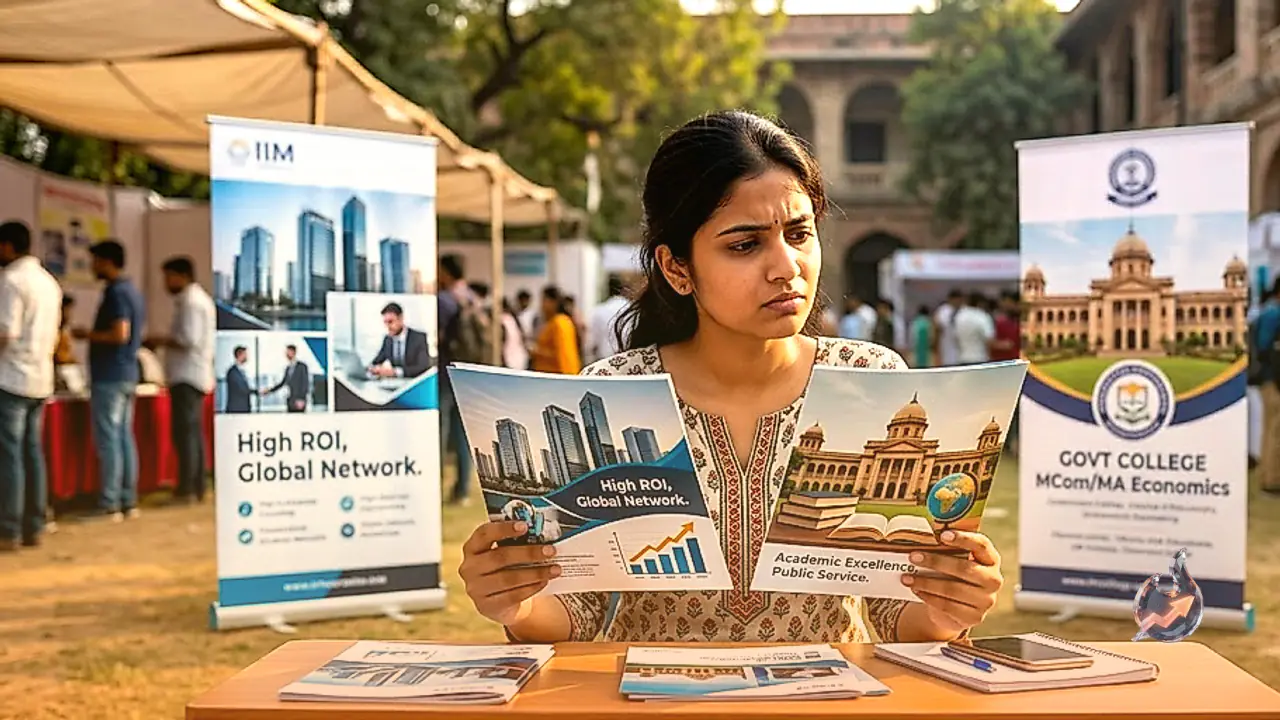

Completing an undergraduate degree brings every student to a critical career crossroads, sparking intense debate over the right postgraduate path to choose. Aspirants frequently weigh the glitz and high financial returns of a Master of Business Administration degree from an Indian Institute of Management against affordable yet highly respected Master of Commerce or Master of Arts in Economics programs offered by premier public universities. While an IIM MBA opens doors to dynamic leadership roles across corporate environments, master programs from top central universities build a solid analytical framework suitable for research, economic policy formulation, banking, and academic careers. Both academic avenues come with distinct financial commitments, selection standards, and professional outcomes, requiring a thorough comparison based on individual budgets, risk tolerance, and long-term career ambitions.
Fee Structure and Financial Commitments
The financial investment required stands as the most prominent differentiator between these two educational pathways. Pursuing a two-year full-time MBA at a premier IIM incurs a total expenditure ranging between Rs 20 lakh and Rs 30 lakh. Due to the high tuition fee, the majority of enrolled students rely heavily on education loans, entering the job market with significant financial liability. In sharp contrast, completing an MCom or MA in Economics from top-tier public institutions and central universities such as Delhi University, Jawaharlal Nehru University, or Banaras Hindu University costs merely Rs 5,000 to Rs 30,000 for the entire course duration. Consequently, pursuing a postgraduation degree at a public university eliminates the need for educational loans, allowing students to focus on their studies without accumulating debt or suffering financial anxiety.
Admission Requirements and Selection Rigor
The admission pathways for both options differ substantially in terms of entry testing and selection procedures. Gaining admission into an IIM is exceptionally competitive, requiring candidates to secure a percentile score of 99 or above in the Common Admission Test. Beyond high test scores, applicants must successfully clear grueling Group Discussion rounds and rigorous personal interviews. On the other hand, admissions for MCom and MA Economics courses at top public universities are primarily conducted through national postgraduate entrance tests such as CUET PG. While both pathways require dedicated preparation, the multi-tiered selection process at IIMs is generally recognized as far more demanding.
Curriculum Orientation and Career Horizons
The academic focus and skill sets developed during these programs cater to entirely different sectors of the economy. The MBA curriculum at IIMs emphasizes practical business strategy, corporate leadership, marketing management, and operational decision-making, tailored to produce future managers for multinational corporations, global management consultancies, and high-growth startups. Conversely, MCom and MA Economics curricula focus heavily on quantitative analysis, theoretical economic models, research methodology, and financial systems. An MA in Economics creates direct pathways toward prestigious government and public sector positions, including the Indian Economic Service, RBI Grade B officer cadres, policy roles at Niti Aayog, financial think-tanks, and banking institutions. Furthermore, clearing the UGC NET examination opens opportunities to serve as university professors and academic researchers.
Placement Ecosystem and Initial Salary Packages
The campus recruitment environment and initial financial returns present a clear contrast. Top IIMs boast highly structured campus placement drives, with graduates securing lucrative average starting packages between Rs 20 lakh and Rs 30 lakh per annum, allowing them to comfortably repay their education loans within a short span. In contrast, traditional postgraduate programs at public universities generally feature fewer direct corporate campus recruitment drives. Graduates entering the private sector typically start with salary packages ranging from Rs 4 lakh to Rs 8 lakh annually. However, students who successfully crack competitive examinations for the UPSC, RBI, or public sector banks achieve exceptional long-term career stability, authority, and steady salary progression.
Making the Right Choice for Your Career
Selecting the ideal degree ultimately depends on your personal financial capacity, willingness to handle debt, and long-term career goals. An IIM MBA is the ideal option for individuals who thrive in high-pressure corporate environments, are ready to take financial risks, and aim to secure high initial compensation despite taking on an education loan. On the other hand, an MCom or MA in Economics from a top public university is the superior choice for students who prefer a budget-friendly education without debt, seeking stable and prestigious careers in civil services, central banking, economic policy analysis, or academia.