























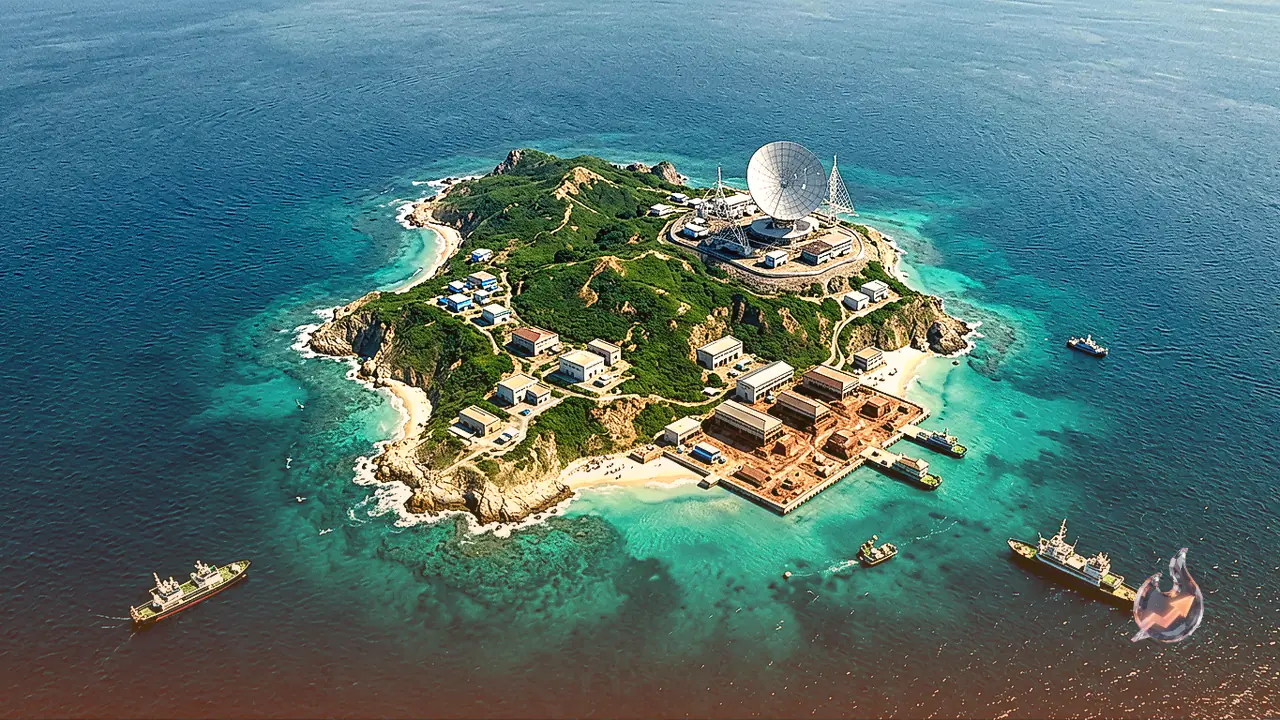

China has reportedly accelerated its military infrastructure expansion in the disputed Paracel Islands region of the South China Sea, drawing heightened strategic scrutiny from international defense observers. Fresh commercial satellite imagery indicates that new construction activities have commenced on Yagong Island, situated adjacent to Antelope Reef. Security analysts evaluate that Beijing is progressively establishing a major military compound and advanced surveillance complex in the area. This development not only escalates long-standing territorial rivalries across Southeast Asia but also intensifies regional security concerns for the United States and Taiwan.
Satellite Images Reveal New Construction on Yagong Island
Detailed satellite imagery captured on 17 August by commercial satellite firm Vantor reveals ongoing structural development on Yagong Island, with activity dating back to March and April of this year. The imagery highlights three-sided spreading structures taking shape across the terrain. While defense intelligence experts note that determining the definitive operational role of these installations remains premature, the layout closely mirrors existing Chinese military radar and early warning facilities deployed elsewhere in the South China Sea. Analysts suspect these buildings will serve as an early warning radar outpost designed to support a much broader base under construction at nearby Antelope Reef.
Antelope Reef Features a Six-Kilometer Artificial Island
Beijing has already completed initial construction phases at Antelope Reef, transforming the maritime feature into an artificial island approximately 6 kilometers in length, complete with a continuous straight coastline exceeding 3 kilometers. Military experts suggest that this extended, linear shore section was constructed to accommodate a potential airfield runway. Geographically, Yagong Island lies roughly 14 kilometers northeast of Antelope Reef, with both formations located in the western sector of the Paracel archipelago. Although the Chinese government has issued no official confirmation regarding a new military installation, with state media citing civilian utilities like meteorological forecasting, fishery conservation, and marine scientific research, security analysts maintain that the site holds unmistakable military significance.
Escalating Security Implications for Washington and Taipei
The South China Sea functions as one of the world's most critical maritime corridors, handling trillions of dollars in global trade annually. China has previously militarized reclaimed land features across the sea by building artificial islands equipped with defensive systems. The combination of a major operational base at Antelope Reef and auxiliary radar infrastructure on Yagong Island significantly expands Beijing's reconnaissance, target tracking, and maritime domain awareness capabilities. For Taiwan, these advancements carry acute sensitivity. In the event of a future cross-strait conflict, the South China Sea would become a vital operational theatre where long runways and high-powered radar systems would enable Chinese forces to monitor military maneuvers at extended ranges.
Threat to Support Aircraft and Reinforcement of A2/AD Strategy
Enhanced Chinese tracking facilities in the Paracels pose a direct operational risk to support aircraft operated by the United States and its regional allies. Platform types such as Airborne Early Warning (AEW) aircraft, aerial refueling tankers, and logistics transports, upon which Western defense strategies heavily rely, could find their freedom of movement severely constrained. This capability reinforces China's Anti-Access/Area Denial (A2/AD) doctrine, which aims to restrict enemy force projection within the first and second island chains. Because the Paracels occupy the northern sector of the South China Sea, consolidating military control here empowers Beijing to oversee vital sea lanes, heightening defense anxieties for Taiwan as well as neighboring nations like the Philippines and Vietnam.
Regional Territorial Claims and Historical Context Since 1974
Defense analysts Damien Symon and Collin Koh note that while conclusive declarations on the site's ultimate role require further monitoring, the probability of it functioning as a specialized radar or intelligence collection node is high. Even if Beijing characterizes the setup as a maritime monitoring post, its integration with a major military hub confirms its strategic utility. Historically, China seized control of the Paracel Islands in 1974 following a military clash. Vietnam continues to claim sovereignty over the entire Paracel chain while simultaneously expanding its own installations in the Spratly Islands. Additional partial claims are maintained by the Philippines, Malaysia, Taiwan, and Brunei. As the US and its allies push to preserve freedom of navigation in international waters, an operational runway and radar array at Antelope Reef would tip the operational balance in China's favor, signaling ongoing preparation for potential future contingencies.