






















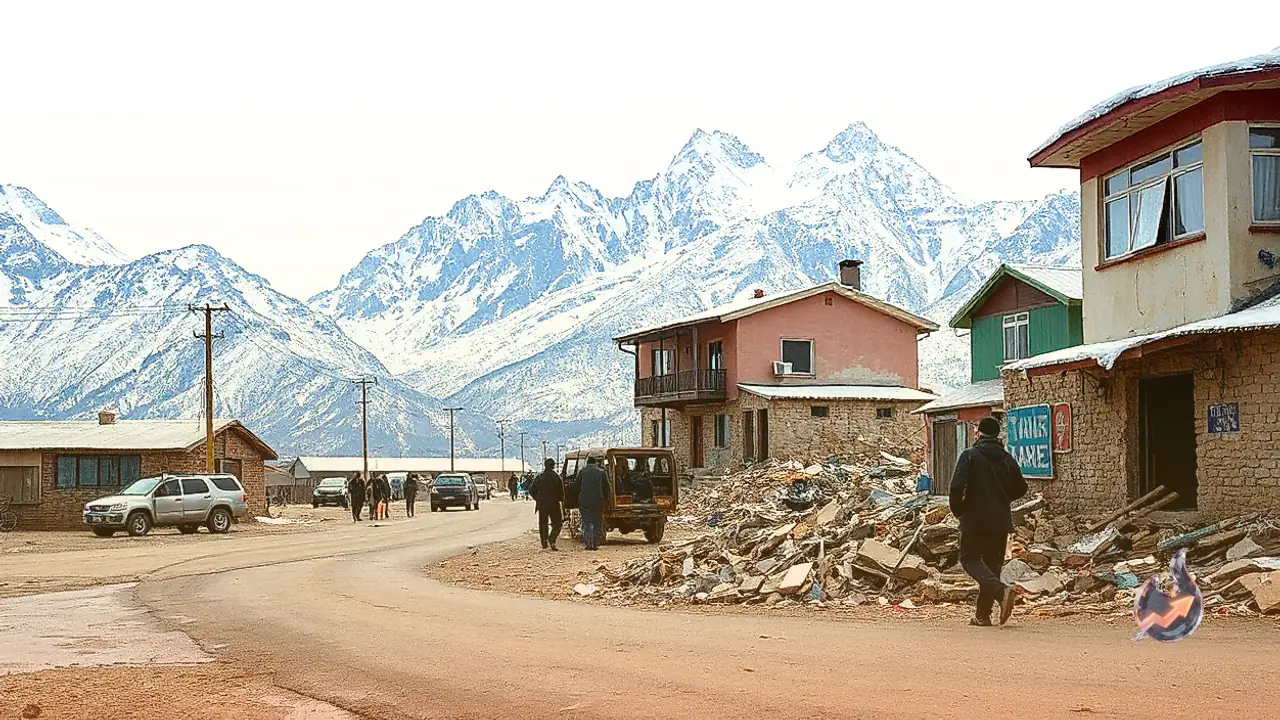

The mountainous region of Tibet has experienced yet another earthquake, sending fresh waves of panic among local residents. This comes shortly after powerful tremors shook Tibet on Thursday, October 22, causing extensive loss of life and property. That disaster claimed roughly 16 lives and destroyed dozens of homes. Following those events, the earth trembled once again on Saturday, October 24, 2026. Given its geographical location, Tibet falls squarely within a seismic zone, registering two distinct earthquake events within the span of 24 to 36 hours.
Early Morning Tremors Strike the Region
According to available details, the seismic activity hit Tibet during the early hours of Saturday morning. Data from the National Center for Seismology (NCS) indicates that the magnitude of this latest earthquake measured 4.5 on the Richter scale. The NCS reported that the tremor occurred at approximately 5:38 AM according to Indian Standard Time (IST). At present, detailed information regarding the exact focal depth and potential destruction caused by this specific tremor remains unavailable. Fortunately, no immediate reports of casualties, injuries, or structural damage have surfaced following the event.
Recent Devastation From Powerful Shocks
Just prior to this, late Thursday evening at around 8:00 PM, Tibet was rattled by a remarkably powerful earthquake. The NCS recorded the magnitude of that earlier event at 7.0 on the Richter scale. Its hypocenter was located at a depth of approximately 173 kilometers beneath the earth's surface. That natural disaster resulted in 16 fatalities, alongside a large number of injuries. Information shared by the local administration confirmed that residential buildings suffered widespread and severe damage as a result of the violent shaking.
Seismic Zonation and Vulnerability in India
In terms of earthquake hazard exposure, India is categorized into four primary zones. Zone-5 represents the highest risk area, where severe earthquakes can cause catastrophic devastation. Regions falling under this highest-risk bracket include the Kashmir Valley, Western and Garhwal Himalayas, northern Bihar, Northeast India, the Rann of Kutch, and the Andaman and Nicobar Islands. Meanwhile, Zone-4 is designated as a high-risk area, encompassing major portions of Delhi, Jammu and Kashmir, Ladakh, Himachal Pradesh, Uttarakhand, Sikkim, and large parts of Bihar.
Classification of Other Zones and Cities
Zone-3 incorporates several major metropolitan cities known for dense populations, such as Mumbai, Chennai, Kolkata, Pune, and Ahmedabad. In contrast, Zone-2 is classified as a low-risk area, housing cities like Bengaluru, Hyderabad, and Jaipur. Notably, the seismic zoning framework in India does not currently make use of Zone-1, leaving the remaining regions distributed across the four active tiers.