





















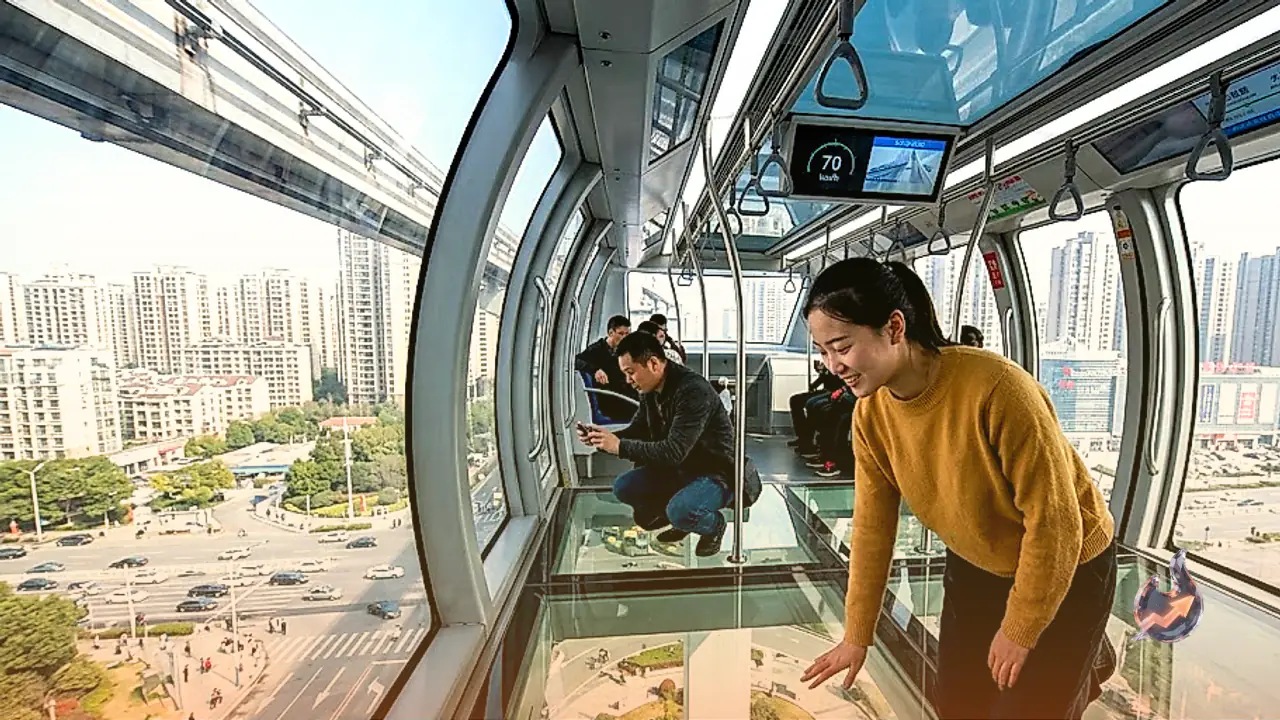

Modern structural engineering has blessed the world with many awe-inspiring landmarks, but few are as visually striking and technologically advanced as a train that hangs upside down while carrying hundreds of passengers. Far from being a concept in a futuristic movie, this is a fully functional transit system where the rail line is suspended high in the air, with the passenger coaches dangling below it. As soon as the doors glide shut, this unique train accelerates swiftly, gliding smoothly over urban landscapes. One of the most breathtaking aspects of this journey is the vantage point offered to those inside. Instead of looking at a solid metal floor, passengers gaze directly through heavy-duty glass panels beneath their feet to see the drop below. For some, this panoramic, unobstructed view of the height is a source of pure adrenaline-pumping thrill, while others find themselves holding onto their seats in sheer suspense. To onlookers watching from the streets below, the sight of a massive train safely holding dozens of commuters while suspended mid-air is nothing short of a miracle.
The Architecture Behind the Optics Valley Skyrail
Known officially as the Optics Valley Skyrail, this groundbreaking suspended monorail is also affectionately referred to as the Optics Valley Photon. Located in the bustling city of Wuhan, in China's Hubei province, this system represents a departure from traditional railway design. Conventional trains require tracks laid directly onto the ground or mounted on top of massive concrete viaducts. The Skyrail flips this concept completely on its head. Here, the steel and concrete tracks are positioned overhead, resembling a ceiling-like support structure. The top of the train carriage is securely attached to a single, heavy-duty beam made of reinforced concrete and steel. This suspended configuration allows the body of the train to dangle freely below the track, creating the illusion of a train traveling upside down through the sky.
Innovative Engineering Ensuring Total Passenger Safety
From an external viewpoint, the sight of a train hanging from an overhead track can evoke fears of instability. However, the engineering behind the Optics Valley Photon is incredibly rigorous, prioritizing passenger safety above all else. The guideway, track systems, and elevated stations were built using highly precise prefabricated components, ensuring tight structural tolerances and eliminating construction inconsistencies. To guarantee a peaceful and comfortable journey, the train does not use traditional steel wheels on steel tracks. Instead, it is equipped with specialized rubber tires. These rubber components serve a dual purpose: they drastically reduce noise levels during operation and absorb vibrations, allowing the train to glide with remarkable smoothness. The locking and suspension mechanisms are designed with multiple redundancies, making it physically impossible for the train to detach from its overhead beam.
Passenger Capacity and the Spectacular 270-Degree View
In terms of carrying capacity, the train is currently operating with a two-car configuration. This double-coach setup is capable of accommodating approximately 220 passengers comfortably during a single trip. According to the manufacturer, CRRC Qingdao Sifang, the entire system is highly modular. If passenger demand increases in the future, the train set can be easily expanded from its current two-car layout up to a maximum of six coaches. What truly sets this ride apart is its visual design. The passenger cars feature large, sweeping side windows paired with a completely transparent glass floor. This combination provides riders with an unparalleled 270-degree view of their surroundings. As the train glides along, passengers get the sensational feeling of flying through the air, watching the scenic landscape unfold directly beneath their feet.
Green Battery Power and Fully Automated Operations
Beyond its striking visual appearance, the Optics Valley Photon is a marvel of green technology and automation. The entire train set runs on advanced battery systems, making it a zero-emission, environmentally friendly public transit solution. By eliminating fossil fuels and direct electrical grid dependency during motion, it significantly reduces the carbon footprint of urban commuting in Wuhan. Structurally, the train is capable of reaching a maximum speed of 70 km/h. To ensure maximum comfort and safety for passengers, it currently operates at a service speed of 60 km/h. Furthermore, this system is completely driverless. Advanced automated systems control every aspect of the journey, including starting the train, navigating the route, entering stations with high precision, managing speed profiles, and operating the automated doors. No human intervention is required for its daily runs.
The 10.5-Kilometer Route and Multi-Modal Transit Connections
The first phase of this suspended monorail project spans a total distance of 10.5 kilometers. Designed to cater to both daily commuters and visiting tourists, the route connects some of the region's most scenic spots. The line originates at Jiufengshan within the Jiufeng National Forest Park and runs all the way to Longquanshan. Along this 10.5-kilometer stretch, there are six strategically placed stations. To make travel as seamless as possible, these stations are integrated with Wuhan's existing public transportation network. At the Gaoxin Boulevard station, commuters can easily transfer to Metro Line 11. Similarly, at the Gaoxin Second Road station, passengers can make a quick transition to Tram Route 2. This connectivity allows travelers to move across different modes of transit without long delays.
A Major Tourist Draw and the Daily Operational Schedule
The Optics Valley Skyrail operates for 12 hours every day, welcoming passengers from 8:00 AM to 8:00 PM. To prevent overcrowding and keep waiting times to a minimum, trains depart from the stations at frequent 10-minute intervals. Riding the train at its operating speed of 60 km/h is a highly memorable experience. Looking down through the glass floor, some passengers close their eyes in a brief moment of vertigo, while others eagerly record the experience on their smartphones. This innovative suspended monorail has rapidly become a major tourist attraction, drawing visitors from far and wide. For pedestrians on the ground, watching a train full of passengers cruise effortlessly through the sky is a fascinating spectacle. The Optics Valley Skyrail serves as a brilliant preview of how modern cities can utilize aerial space to build efficient, eco-friendly, and thrilling transit solutions.