






















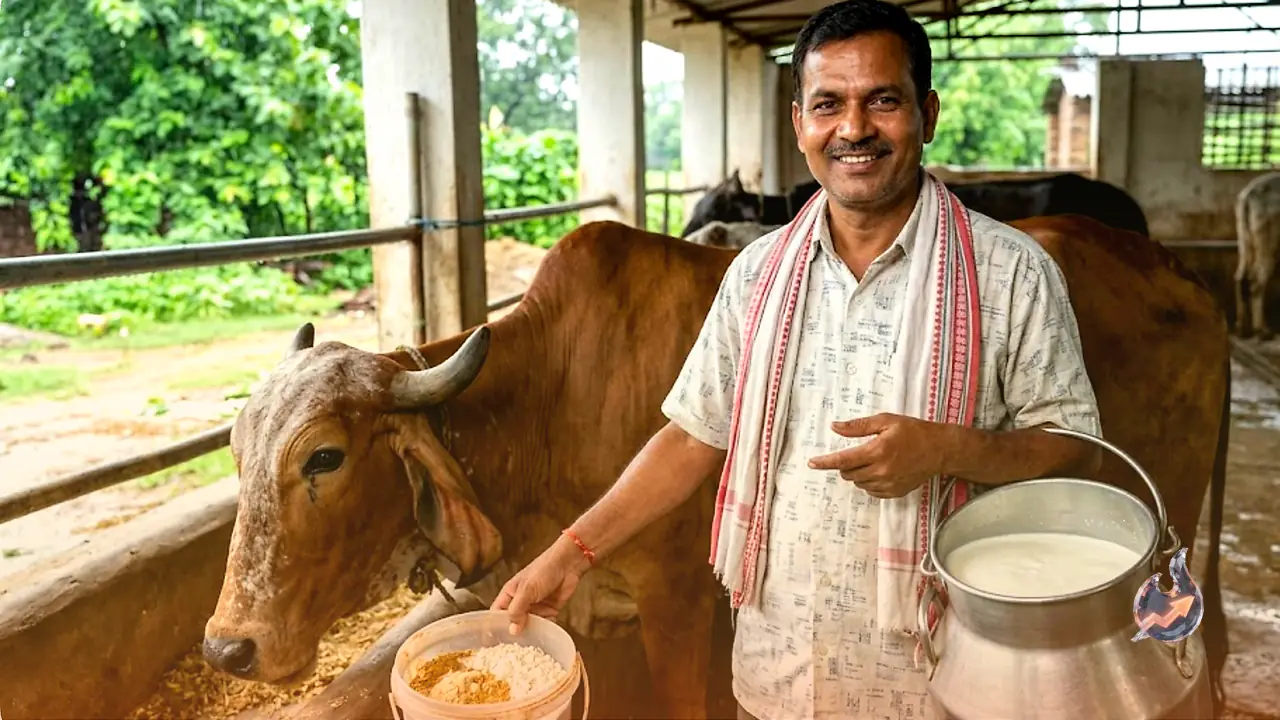

The moment monsoon sets in, most cattle owners run into the same problem, their cows fall sick, run fever and start giving noticeably less milk. Bhanu Pratap, a dairy farmer in Ranchi, says this whole problem can be avoided with the right feeding routine. He explains that his cows are given gram flour and different kinds of oil cake, with the very first feed of the day being rice starch. This, he says, keeps milk output high depending on the breed, and he sells that milk for a living.
According to Bhanu Pratap, the full diet is split across three feedings a day, morning, afternoon and night. At every one of those three feedings, at least a fistful of gram flour has to be given, no matter which oil cake is used alongside it.
Morning starts with rice starch, then oil cake mixed with gram flour
The day begins with a full bucket of rice starch given to the cows. Bhanu Pratap says rice starch naturally contains a number of nutrients that pass directly to the animal. That is why the risk of fever or any other illness drops sharply, while milk quality stays good as well. After the rice starch, mustard oil cake mixed with a little gram flour is given. In his setup, mustard oil cake is used specifically in the morning, along with sudha dana or sudana, a feed that is easily available in the market and considered highly nutritious. Bhanu Pratap says mustard oil cake works best among the options, and mixing in a fistful of gram flour with it is an essential part of the routine.
Afternoon feed uses farm waste, neem oil cake and plenty of water
The afternoon feed is prepared a little differently. Whatever crop residue is left over from Bhanu Pratap's fields is reused rather than wasted. A fistful of gram flour and neem oil cake are mixed into this residue, and the combination is given to the cows around midday. Enough water is also provided at this time, so the animals do not get dehydrated in the heat and humidity, and their digestion stays smooth.
Evening grazing, followed by a porridge based night feed
Once evening arrives, the cows are let out to graze freely so they can get fresh green grass, which is considered good for both their health and their milk output. Food is served again at night. Bhanu Pratap suggests that farmers can pick whichever oil cake suits them, as long as they mix in a fistful of gram flour along with daliya, a coarse feed sold specifically for animals in the market. All three of these are combined and given as the night meal.
The payoff is 6 to 7 kg of milk daily, but timing matters just as much
Bhanu Pratap says that sticking to this diet means a cow does not stop giving 6 to 7 kg of milk every single day, in other words, the yield stays consistently good. Alongside this, he stresses one more crucial point, feeding times have to be completely fixed. That means the cows should get their food at the exact same time every day, without much variation. According to him, this is just as important as choosing the right diet. Bhanu Pratap says that if these things are followed properly, milk production stays strong and the animals remain healthy overall, especially during the monsoon when the risk of disease is already at its highest.