























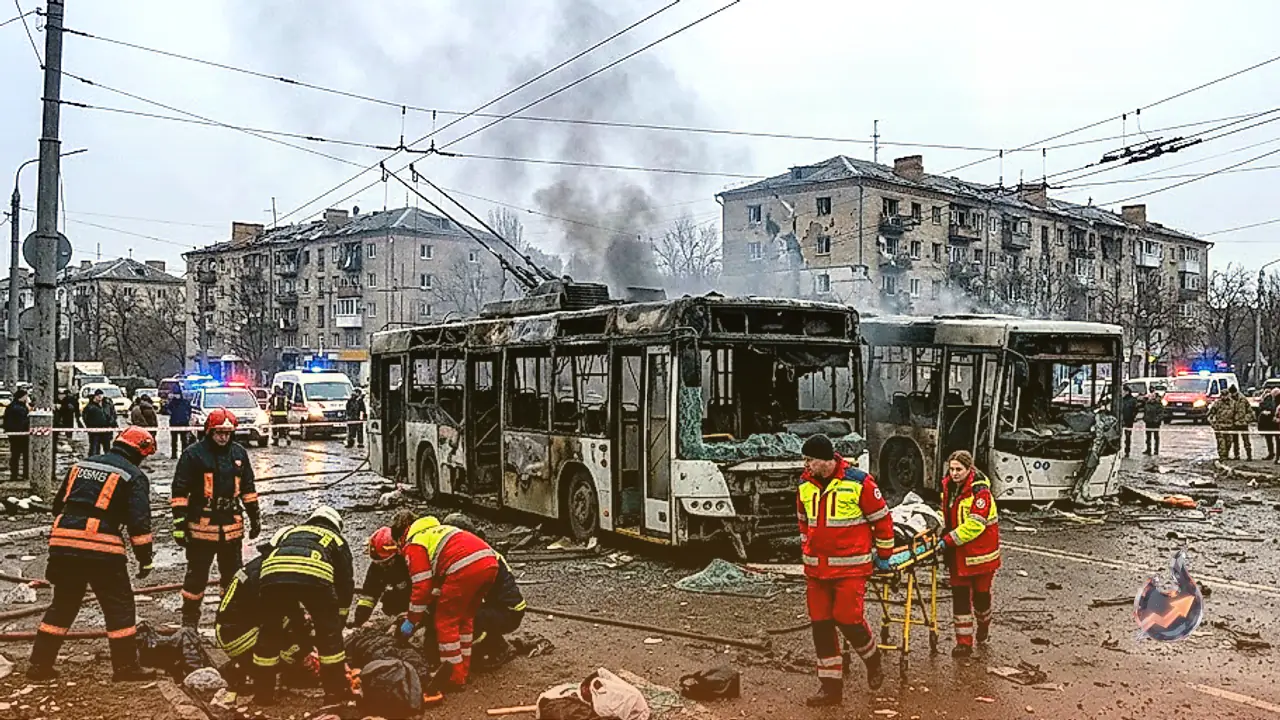

A devastating Russian glide bomb strike tore through two passenger buses in the frontline city of Kramatorsk, killing more than 30 people in one of the deadliest single attacks on eastern Ukrainian civilians in recent weeks. Rescue personnel working through charred wreckage confirmed the catastrophic toll, while authorities noted that three additional residents were killed in the nearby village of Bilenke, situated within the wider Kramatorsk community. Vadym Filashkin, head of the Donetsk regional administration, confirmed that 18 other passengers sustained injuries. Accusing Russian forces of deliberately targeting public transport to inflict maximum casualties, regional officials ordered an immediate suspension of all public transit across the area to prevent drivers and commuters from facing further bombardment.
Devastation on the Frontline and Immediate Transit Shutdown
Images distributed by local prosecutors laid bare the sheer brutality of the blast, showing the burning metallic skeletal frame of a destroyed bus surrounded by scattered debris and victims lying on the road. Vadym Filashkin stated that the targeted vehicles were ordinary municipal buses packed with civilians moving through the city. Stressing that the preservation of human life remains the absolute priority, Filashkin issued an urgent appeal to all remaining residents in the eastern frontline belt, begging them to evacuate immediately toward safer central and western territories of Ukraine. He emphasized that the regional leadership had no right to gamble with the lives of operators and transit users, making the immediate cancellation of public transport unavoidable.
Kramatorsk City Council condemned the attack as a horrific crime committed by the Russian army against the civilian population. Municipal authorities underscored that the strike landed directly on an urban corridor entirely devoid of military personnel, equipment, or defensive installations. Moscow offered no immediate comment on the carnage. Throughout the conflict, Kramatorsk has operated as a critical logistics and logistical supply center for Ukrainian military operations. However, as Russian ground elements push progressively closer to the eastern edges of the urban perimeter, the city has been subjected to near-daily shelling and aerial barrages.
The Threat of Winged Glide Bombs and the Campaign for Donbas
The assault reflects the expanding deployment of standoff glide bombs by Russian forces against Kramatorsk and the neighbouring urban hub of Slovyansk. Unlike conventional unguided gravity ordnance, glide bombs are retrofitted with aerodynamic winglets that allow them to fly extended distances toward their targets rather than dropping straight down from aircraft. This aerodynamic design makes them exceptionally difficult to detect and intercept with short-range ground defenses. In late August, Russian aircraft fired as many as nine glide bombs into Kramatorsk in a single day, causing widespread destruction across residential and civil infrastructure.
Together, Kramatorsk and Slovyansk form the anchor of the so-called fortress belt that shields the remaining unoccupied portions of the industrial Donbas basin. Moscow remains determined to capture this fortified urban line as part of Russian President Vladimir Putin's stated ambition to seize the entirety of the region. Russian political figures have routinely cited the protection and liberation of the largely Russian-speaking Donbas territory as their primary justification for the full-scale invasion of Ukraine. The Donbas consists of Luhansk and Donetsk provinces. With almost all of Luhansk currently under Russian control, the Kremlin has concentrated offensive firepower on seizing the remaining 20% of Donetsk territory still retained by Ukrainian forces.
Ukrainian Leadership Demands Response as International Envoys Visit Kyiv
Ukrainian President Volodymyr Zelensky reacted forcefully to the strike, extending his condolences to the grieving families and vowing that the atrocity would meet a decisive countermeasure. Writing on Telegram, Zelensky stated that the strike would not go without a response, emphasizing that Russia is systematically trying to eliminate all life across Donbas. He urged the international community to deliver a severe, resolute reaction commensurate with the deaths inflicted by Russian forces. Zelensky maintained that rhetorical condemnation is no longer sufficient, calling on Ukraine's allied partners to deliver concrete action through fresh defense assistance packages designed to safeguard the nation's airspace.
The bloody strike coincided with high-level diplomatic engagements in Kyiv, where UK Foreign Secretary Ed Miliband met with Zelensky on Thursday. Condemning the broader surge of aerial violence, Miliband asserted that the recent atrocities laid bare Putin's evil intent and destructive strategy. The British diplomat unveiled an expanded sanctions package targeting the Russian military apparatus, the Kremlin's shadow tanker fleet, crude oil corporations, cryptocurrency conduits, and war finance networks. Miliband reaffirmed to Zelensky that the United Kingdom would maintain unwavering solidarity with Ukraine for as long as necessary to achieve victory in the conflict.
Rising Civilian Casualties from Pryluky to the Capital
The tragedy in Kramatorsk follows a steep, alarming rise in civilian casualties across the country. UN monitoring figures indicate that the number of Ukrainian civilians killed by August this year had already surpassed the total recorded civilian fatalities for all of 2025. Just early on Wednesday, a single Russian strike destroyed a five-storey block of residential flats in the town of Pryluky, located east of Kyiv, claiming 22 lives. Among the dead in Pryluky were five children, three of whom were only one year old.
The capital city of Kyiv has endured persistent air raids, with warning sirens sounding repeatedly throughout the day. Kyiv Mayor Vitali Klitschko reported that attacks on Thursday claimed three lives and injured 14 others, with two of the wounded remaining in critical condition. The relentless bombardment has repeatedly disrupted daily routines, forcing schoolchildren to evacuate classrooms for underground civil defense shelters, shuttering commercial enterprises, and paralyzing local transit corridors. Prior to the Pryluky tragedy, Zelensky had publicly cited intelligence assessments warning of an impending massive Russian aerial onslaught, prompting thousands of families in Kyiv to seek refuge in subterranean metro platforms.
Attacks on Essential Energy Networks and Depleted Interceptors
Compounding the human toll, coordinated strikes on Ukraine's utility network are threatening essential municipal services as cold weather approaches. Heavy bombardment directed at the national energy grid has triggered widespread blackouts, which in turn have crippled municipal water pumping operations. Water utilities in Kyiv issued warnings on Thursday that tap water pressure was dropping sharply across the right bank of the capital due to emergency electrical cutoffs.
For the average civilian, pre-strike sirens and intelligence advisories currently represent the principal shield available against aerial devastation. Interceptor missiles are facing an acute worldwide supply shortage, leaving Ukrainian air defense units with minimal ammunition to knock down incoming Russian ballistic missiles and high-speed glide ordnance. Concurrently, both combatants have ramped up long-range strike operations against deep targets over recent months, with Russian missiles and drones increasingly zeroing in on Ukrainian logistical warehouses and digital data facilities.