



















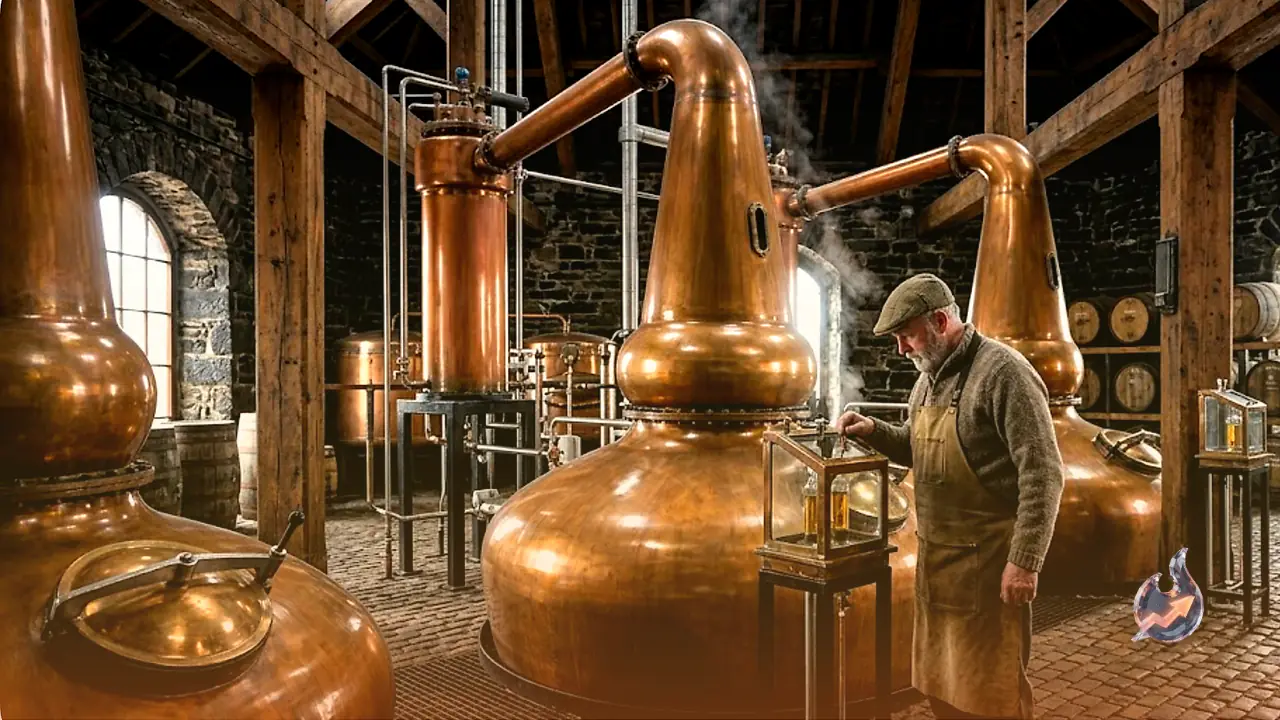

Nestled along the banks of the Bush River where the fierce Atlantic winds strike the basalt cliffs of County Antrim, Northern Ireland, lies the quiet town of Bushmills. This modest settlement is the birthplace of the world’s oldest licensed whiskey distillery. For more than four centuries, this facility has been transforming barley into liquid history, maintaining a distillation process that has withstood the tests of time, tragedy, and taste.
The Birth of the "Water of Life"
The origin story of this legendary spirit traces back to the year 1276. A legendary warrior named Sir Robert Savage is said to have served his soldiers "Aqua Vitae" (meaning the water of life) before heading into battle. Over the centuries, this Aqua Vitae evolved into Uisge Beatha, eventually becoming the modern word "whiskey." The tradition of distilling on this land predates official paperwork by centuries.
On April 20, 1608, King James of England granted a royal distilling license to Sir Thomas Phillips, a local landowner in the Bushmills area. Distilling at the time was a clandestine, tax-evading practice popular among small farmers. To regulate and generate government revenue from this popular hobby, the King stepped in. The license, granted for seven years, permitted Sir Thomas to produce and sell Aqua Vitae, Usquebaugh, and Aqua Composita. To this day, the historic date of 1608 is proudly embossed on the label of every Bushmills bottle.
Resisting Taxes and Surmounting Disasters
In 1784, the Old Bushmills Distillery was officially registered, introducing its iconic trademark. The traditional copper vessel used for distilling, known as the "Pot Still," has served as the brand’s visual identity for over 300 years.
During the mid-19th century, the British government introduced a heavy malt tax. To bypass this tariff, the majority of Irish distilleries abandoned pure barley, choosing instead to use corn and other inexpensive grains. Bushmills, however, refused to compromise. The distillery stuck to its traditional recipe of pure malt whiskey, a decision that forged its unique global reputation.
In 1885, a devastating fire burned the Old Bushmills building to the ground. However, the business was far from finished. Driven by massive public demand, the distillery was rebuilt immediately, returning to full production capacity without missing a beat.
Conquering Global Markets and Surviving Prohibitions
By 1890, the distillery took its trade to the high seas. Its proprietary steamship, the SS Bushmills, crossed the Atlantic to deliver the first shipments of whiskey to Philadelphia and New York City. From the United States, its global reach expanded rapidly, reaching Singapore, Hong Kong, Shanghai, and Yokohama, Japan. A local product from a tiny Irish parish had officially captured the world's attention.
When US Prohibition began in 1920, it dealt a massive blow to the Irish whiskey trade. However, Wilson Boyd, the director of Bushmills at the time, made a calculated gamble. Predicting that the ban would be short-lived, he ordered the continuous production and stockpiling of vast quantities of whiskey. When Prohibition was finally repealed, Bushmills was uniquely positioned to flood the American market, leaving competitors behind.
World War II brought further devastation when German bombers targeted Belfast, destroying the company's main headquarters, precious historical archives, and vast warehouses of whiskey. Despite the tragedy, Bushmills aided the war effort, slowing down commercial production to house American troops stationed in the area. Today, the brand's enduring cultural footprint is cemented by its frequent appearances in films, music, and television shows.
The Secret Recipe: Volcanic Water and Triple Distillation
The secret of Bushmills lies not just in its longevity but in its craftsmanship. The water used in production is drawn directly from the Bush River, which flows over prehistoric basalt rocks. These volcanic formations impart a unique mineral balance to the water, defining the whiskey’s flavor profile. All its single malts are triple-distilled in traditional copper pot stills. Unlike Scotch whiskeys, which are typically distilled only twice, the third distillation step is what gives Bushmills its signature smoothness.
The whiskey is made using 100 percent Irish malted barley at a single location. With an annual production capacity of 90 lakh liters, Bushmills stands as the second largest whiskey distillery in Ireland. This legendary brand, carrying over 400 years of history in every single bottle, is widely available globally, including in India.
The Legend of "The Grey Lady"
The historic distillery is also associated with a chilling local mystery. It is rumored that a ghost known as "The Grey Lady" wanders the halls of the centuries-old facility. Local lore suggests that an elderly couple, George and Margaret, once lived directly across from the distillery. One day, George went out to walk his dog and vanished forever. Margaret spent the rest of her life searching for him around the grounds of the distillery. To this day, staff and visitors report sudden cold spots and locked doors swinging open on their own.