
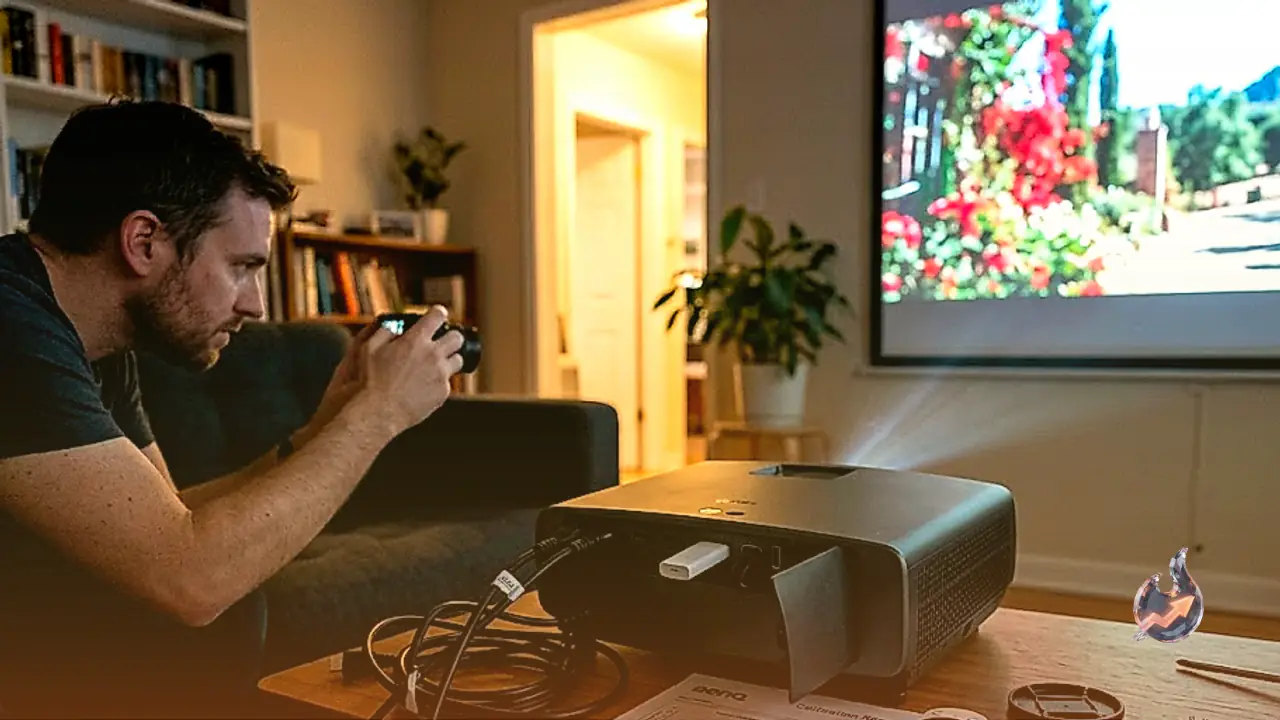



















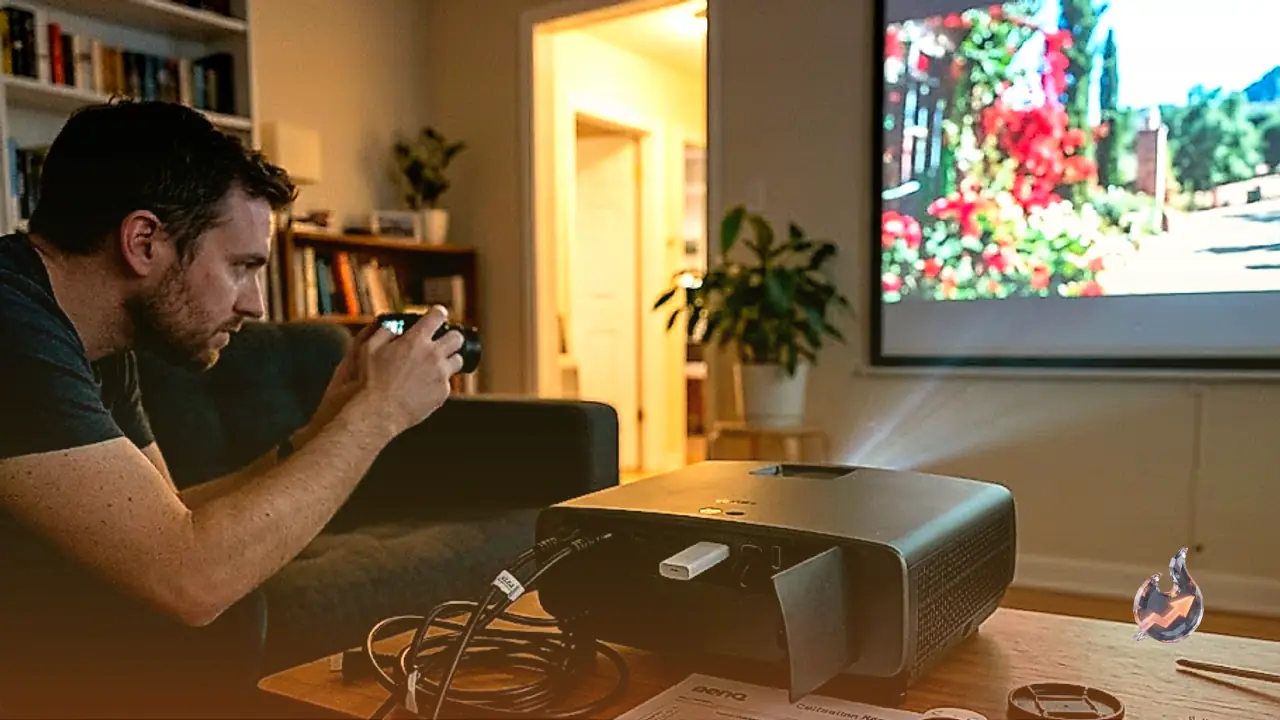

Targeted at home entertainment enthusiasts seeking a large-screen viewing experience, the BenQ W2720i combines a 4LED solid-state illumination system with DLP pixel-shifting technology to generate a crisp 4K picture. With its 1.0–1.3:1 throw ratio, the projector can cast imagery measuring anywhere from 30 inches to an expansive 200 inches diagonal. To eliminate the need for an external streaming device, BenQ includes a dedicated Android TV dongle right in the packaging, granting immediate access to popular streaming apps. The hardware also integrates dual 5W internal speakers for standalone audio, along with a trio of HDMI inputs that includes one HDMI 2.1 connection.
Home Theater Performance and Black Level Challenges
Evaluated strictly as a dedicated home cinema projector, the BenQ W2720i delivers middle-of-the-road results. Its primary weakness lies in a lackluster native contrast ratio. In dark sequences, shadow details lose their dramatic impact and deep blacks take on a visible gray tint, causing shadowy cinema frames to look somewhat washed out. On the positive side, the contrast ratio holds up steadily when switching to brighter environments, ensuring that daytime sequences avoid looking excessively flat even if they still fall short of true cinematic dimensionality.
Color reproduction represents one of the projector's strongest highlights. The unit achieves punchy color volume across standard cinema formats, delivering rich tones straight out of the box that faithfully reflect the director's original grading. Factory color accuracy is commendable, although white areas exhibit a slight cool bias. For viewers sensitive to color balance, performing an aftermarket calibration dials out the tint to deliver near-perfect fidelity. Saturation can appear slightly muted when rendering rare content graded in the ultra-wide BT.2020 color gamut, but standard masterings look vivid. Because the display engine utilizes single-chip DLP architecture, sensitive viewers might detect a subtle rainbow artifacting effect that lacks any internal menu toggle to suppress. Quiet operation helps compensate for optical compromises, as the cooling fan produces minimal whisper-quiet acoustic noise during low-volume viewing.
Motion Handling and Judder Performance
Motion processing on the BenQ W2720i presents a divided picture depending on the selected source equipment. It successfully eliminates judder from playback hardware that matches its frame rate output to the original cinema frame rate, such as an Apple TV with Match Frame Rate configured. When receiving these synchronized signals, panning shots and action sequences glide with cinematic smoothness. Conversely, the projector fails to strip judder from native 60Hz feeds, which includes traditional cable boxes as well as the bundled Android TV dongle. Consequently, streaming directly from the included dongle exhibits noticeable frame stutter and choppy panning.
Gaming Responsiveness and Refresh Rate Nuances
The projector offers mixed utility for gaming setups. Console and PC users can choose between high visual fidelity or rapid frame rates, supporting 4K resolution at 60Hz alongside 1080p playback at 120Hz and 240Hz. The underlying DLP optical engine keeps motion blur down to negligible levels. However, screen tearing remains unmitigated due to the absence of Variable Refresh Rate (VRR) technology, and the unit fails to display 4K at 120Hz despite promotional materials claiming compatibility.
High latency remains the most significant roadblock for interactive gameplay. Running at 4K 60Hz, input lag is substantial enough to make player inputs feel heavy and sluggish. Stepping down to 1080p at 120Hz or 240Hz markedly sharpens controller responsiveness, but latency remains too high for competitive multiplayer titles where millisecond reactions decide match outcomes. While game worlds pop with good color richness and punchy illumination in light-controlled rooms, washed-out shadows reduce atmospheric immersion in moody, dark gaming environments.
Hardware Ergonomics, Portability, and Alignment
From an installation perspective, the BenQ W2720i is best suited for permanent placement rather than portable entertainment. Its sizable footprint and substantial weight make transferring it between living spaces cumbersome, especially since the chassis omits carrying handles and arrives without an included travel bag. A protective slip-on lens cap keeps the glass safe during moves, but the lack of an internal battery confines operation strictly to domestic wall sockets.
Automatic geometry tools are virtually absent from the chassis. Users must dial in focus manually and adjust horizontal keystone alignment by hand, with only vertical keystone correction receiving automatic electronic tuning. The 1.3x optical zoom ring simplifies sizing the projected frame without shifting the entire physical unit. However, lens manipulation remains restricted: vertical lens shift offers very narrow travel suited only for minor height trimming, while horizontal lens shift is absent altogether. To center the geometry against a projection screen, the entire device must be physically positioned on axis. While its footprint dominates bedside tables in smaller bedrooms, the whisper-quiet fan noise and sufficient light output make it pleasant for late-night viewing in darkened rooms.