























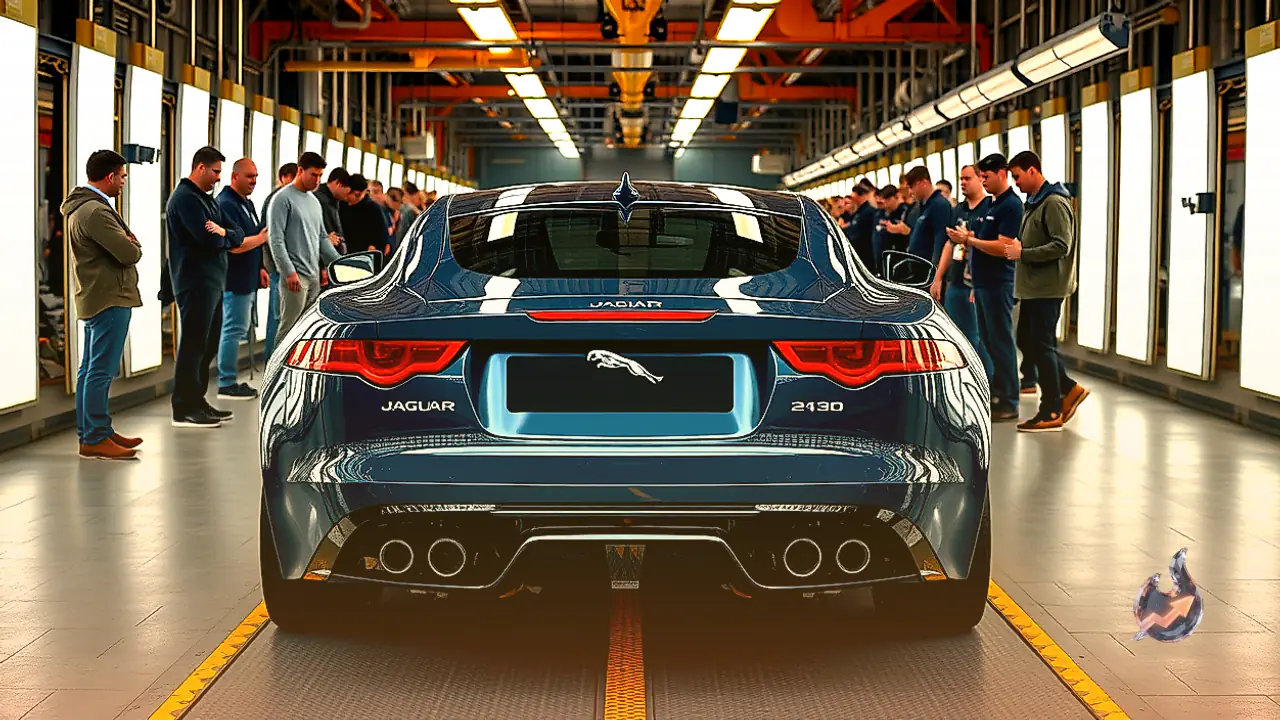

British luxury marque Jaguar has officially taken the covers off the Type 01, the finished four-door grand tourer that marks the operational core of its comprehensive brand overhaul. Unveiled at a dedicated presentation in New York City on Tuesday, the production-spec fastback represents the road-ready execution of the Type 00 concept car shown previously. The reveal arrives after an intense chapter for the manufacturer, defined by polarising marketing campaigns, top-level leadership changes, and an extended retail pause during which the company did not sell any new vehicles.
The build-up to this moment witnessed significant executive disruption across Jaguar Land Rover, notably including the departure of chief creative officer Gerry McGovern, the designer who approved the brand's sharp electric design identity and minimalist launch messaging. Throughout the upheaval, Jaguar managing director Rawdon Glover held firm to the proposition that presenting the finished, road-ready GT would validate the dramatic pivot. Glover maintained that once prospective drivers encountered the tangible product, the logic behind the brand's transformation would become clear.
Low-Slung Proportions and Wind-Tunnel Efficiency
Visually, the Type 01 retains the striking physical presence outlined during its concept stage. The silhouette carries a remarkably low roofline, compact front overhangs, an elongated tail, an expansive bonnet, and massive 23-inch alloy wheels. Beneath the rear-shifted passenger cell sits an exact 50-50 front-to-rear weight balance. While its vast metal surfaces suggest a heavy footprint, detailed aerodynamic work delivers an overall drag coefficient of 0.23 Cd. This low aerodynamic resistance is made possible by active cooling vanes, an automatically deploying rear spoiler, and intricate beneath-the-surface airflow management.
Moving from a pure concept to the four-door production format brings functional proportions that balance show-car flair with usable packaging. Designers have subtly relaxed the ultra-bluff frontal nose seen on earlier show pieces, lending the front fascia a more resolved street presence. At the tail, the design relies on horizontal strikethrough detailing that completely conceals the full-width lighting array until the illumination elements are actively switched on.
Tri-Motor Powertrain and Performance Numbers
Engineering figures position the Type 01 as the most powerful road-going machine in the British firm's history. Propulsion comes from a tri-motor configuration that combines a 260 kW motor driving the front axle with two independent 310 kW motors mounted at the rear. Together, the setup generates up to 1,030 Pferdestärke (PS) alongside 1,365 Newton-metres of torque. Launching from rest, the car reaches 62 mph in 3.2 seconds.
Underlining the brand's philosophy of maintaining ample power reserves during transit, the vehicle requires only an additional 4 seconds to climb from 62 mph up to 112 mph. In terms of dimensions, the car measures 5,235 mm in length and stands 1,403 mm high. To keep such substantial proportions agile through tight corners and city streets, engineers equipped the chassis with standard all-wheel steering.
The Type 01 rides on a bespoke 850-volt platform housing a 118 kWh usable battery pack. According to manufacturer projections, this energy store provides an estimated EPA range of up to 400 miles, equating to roughly 450 miles under WLTP testing metrics, while sustaining up to 320 miles of range at continuous motorway speeds. Charging hardware supports 350 kW DC rapid charging, which can replenish up to 200 miles of driving range in 13 minutes.
Minimalist Cabin Architecture and Interface Technology
The interior architecture departs radically from traditional automotive luxury layouts. A prominent architectural spine bisects the entire length of the cabin, defining separate living spaces for each seating position. Cabin trim makes liberal use of warm, brass-inspired metal accents intended to convey bespoke craftsmanship. Overhead, a continuous panoramic glass roof incorporates adjustable virtual blinds to modulate daylight ingress.
The rear design omits a traditional back glass window altogether. In its place, Jaguar integrated a ClearSight digital rear-view monitor into the panoramic soundbar running along the windscreen base. By mounting the video feed at the exact visual height of the exterior side mirrors, the system eliminates the visual refocusing delay that drivers commonly experience when looking between mirrors and digital screens.
Driver information is presented across a 24-inch OLED display panel sweeping toward the centre of the dashboard. Secondary cabin functions such as climate adjustment and media controls are housed within a 7-inch vertical touchscreen situated between the front seats, completely replacing conventional physical buttons and toggles. Seating features 12-way electric adjustability along with an integrated hot stone massage function. An internal filtration unit cleans the atmosphere of particulate matter, allergens, and toxins, complemented by an active fragrance diffuser offering selectable cabin scents. Cargo capacity stands at 450 litres, expanding to 1,000 litres when the rear seats are folded.
Manufacturing Hurdles and the 'Impossible Panel'
Bringing the Type 01 from clay sketches to final assembly required extensive development efforts. Jaguar manufactured more than 150 experimental prototypes, logged 700,000 test miles, and submitted over 360 individual patent applications. The most demanding manufacturing accomplishment on the vehicle is what internal teams dubbed the impossible panel.
Measuring more than 3 metres in unbroken length, this single stamped piece stretches seamlessly from the vehicle's A-pillar to its rear quarter. Because the sheet metal incorporated five separate acute angles, internal computer simulation models originally deemed the pressing operation physically impossible. Overcoming the bottleneck required 22 weeks of intensive tooling adjustments and 1,500 development hours, eventually calling a retired fabrication specialist back to active duty to finalise the stamping process.
Market Positioning and the Luxury EV Challenge
Pricing strategy will serve as the true test of the grand tourer's viability. The vehicle is projected to start around $170,000 (roughly £130,000), though finalised market prices remain unconfirmed. This placement positions the model well underneath exotic electric machinery from Ferrari, Lamborghini, high-end Mercedes G-Class variants, and the Bentley Torcal, slotting directly into what Glover describes as a targeted sweet spot between premium production vehicles and ultra-exclusive hypercars.
Historically, luxury automakers have struggled to build reliable, high-volume demand around pure electric flagships. Porsche, Mercedes-Benz, and Lamborghini have encountered sharp headwinds, while Bentley is only now preparing its entry. Glover argues that success in this territory requires cars to stand on their design, sensory execution, and dynamic poise rather than leaning on their electric credentials alone. To hit volume targets over the model's initial two-year sales window, Jaguar must cultivate an entirely new buyer demographic: an affluent, urban, design-oriented audience that views the storied badge as a modern cultural statement.