























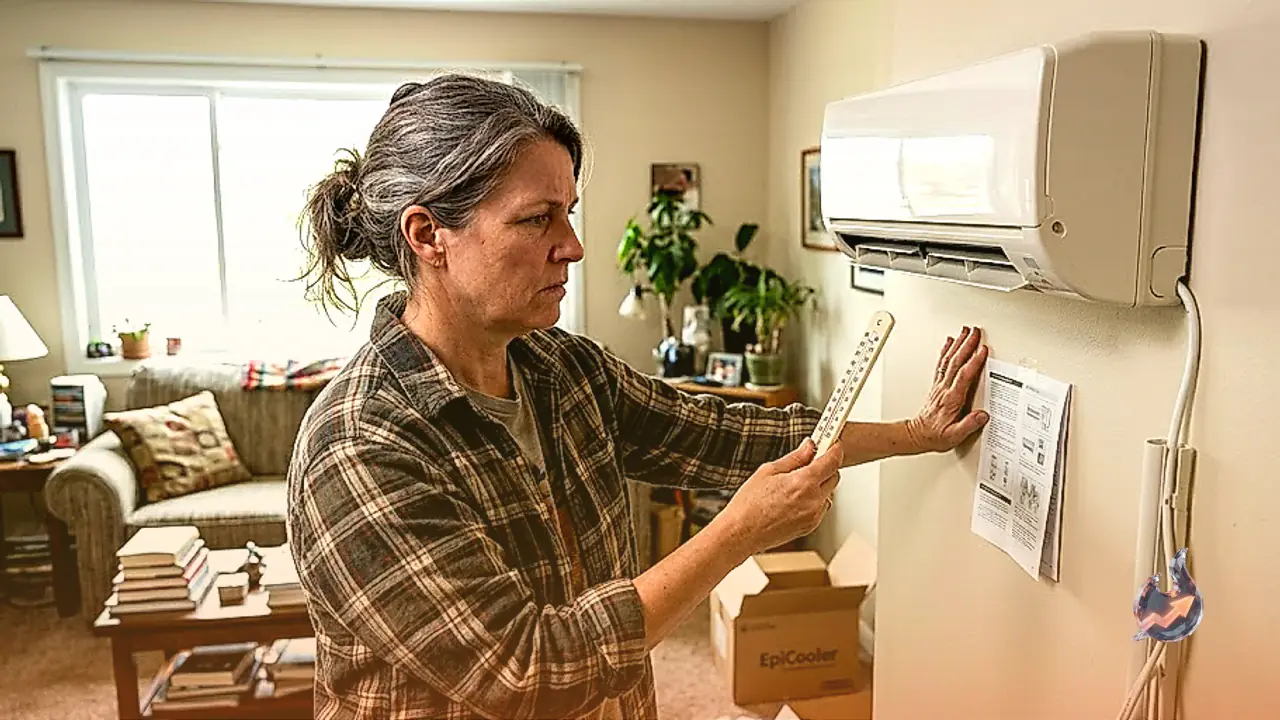

Marketed prominently under the guise of an air conditioner, the EpiCooler functions purely as a wall-mountable plug-in fan equipped with supplementary heating elements. While its promotional materials suggest climate control capabilities, an objective evaluation reveals that the hardware lacks the foundational components required to extract heat from an enclosed living space.
Hardware Architecture and Cooling Limitations
Traditional refrigeration depends heavily on a dedicated compressor and balanced intake and exhaust vents to circulate refrigerant and exhaust thermal energy outdoors. The EpiCooler integrates none of these critical parts. Because there are no exhaust ducts or internal refrigeration systems, the device cannot pull heat out of ambient air. In technical lab assessments, the machine registered no measurable cooling capacity whatsoever, rendering it incapable of completing standard air conditioner benchmark evaluations for cooling efficiency or climate maintenance.
Performance Across Bedrooms and Living Areas
Installing this unit inside bedrooms or small living quarters yields negligible comfort during peak summer periods. Unless an individual sits directly in front of the airflow while sleeping or working at a desk, the room temperature remains entirely unchanged. Even then, the resulting breeze merely mirrors what a standard household fan delivers at a fraction of the complexity. For larger open spaces, the unit proves entirely inadequate, failing to generate any perceptible drop in overall room temperature.
Heating Element, Remote Operation, and Form Factor
On the design front, the unit offers a remarkably compact and lightweight physical footprint. Its wall-mount configuration helps conserve floor and table space, and its petite chassis allows it to be tucked away inside a closet whenever seasonal storage is required. Operationally, it draws very little electrical power and includes a dedicated remote control for basic adjustments. Furthermore, an integrated heating coil enables the machine to blow warm air when desired, effectively positioning it as a compact supplemental heater rather than an active cooling appliance.